روایت تغییر در ایران
گزارش پژوهشی و تحلیلی

از جنگ ۱۲ تا ۳۹ روزه و
انقلاب شیر و خورشید

روایت تغییر در ایران

پیشکش به خانواده بازماندگان از انقلاب شیر و خورشید
دانلود گزارش PDF
برای مطالعه به پایین بروید
فهرست مطالب

چکیده اجرایی

شمار بالای جان‌باختگان اعتراضات دی ۱۴۰۴ — منبع: شبکه‌های اجتماعی و منابع مردمی، دی ۱۴۰۴

در ۶می ۲۰۲۵__۱۶ اردیبهشت ۱۴۰۴، حدود شش هفته پیش از جنگ ۱۲ روزه، تحقیقی منتشر کردم[۱] با عنوان «اپوزیسیون در شرایط جنگی چه اقدامی باید انجام دهد؟» آن تحقیق چهار سناریوی اصلی را پیش‌بینی کرده بود: حمله گسترده اسراییل به تأسیسات هسته‌ای و موشکی، حذف فرماندهان کلیدی سپاه، مرگ رهبری جمهوری اسلامی و اعتراضات سراسری. چند هفته بعد، جنگ ۱۲ روزه سناریوی حمله خارجی را فعال کرد. ضربات بعدی به ساختار فرماندهی و امنیتی رژیم، سناریوی دوم را وارد میدان کرد، ستون امنیت فرماندهی و اقتدار رژیم دچار بحران شدید شد و علی خامنه‌ای در شرایط حذف قرار گرفت. بحران خامنه‌ای و رژیم در دیماه به شکل فروریزی عمیق مشروعیت رهبری او، خود را نشان داده بود اما با شروع جنگ ۳۹ روزه، حذف او را در خاورمیانه کاملا پذیرفتنی کرد. و سرانجام، اعتراضات دی‌ماه ۱۴۰۴ سناریوی چهارم را محقق کرد. به این ترتیب، اهمیت تحقیق ماه می فقط در پیش‌بینی جنگ نبود؛ در این بود که زنجیره‌ی بحران و تقاطع درگیری را درست دیده بود: جنگ، فرماندهی، رهبری، خیابان.

واقعیت محوری این روایت آن است که مسیر بحران از مذاکره به جنگ، از جنگ به فرسایش ساختاری و از فرسایش ساختاری به اعتراضات دی‌ماه رسید. گفت‌وگوهای هسته‌ای از ۱۲ آوریل ۲۰۲۵ ــــــ ۲۳ فروردین ۱۴۰۴ در عمان [۲] آغاز شد؛ پس از چند دور مذاکره، با سخت‌ترشدن مواضع و هشدار نهایی ۶۰ روزه، جنگ ۱۲ روزه در ۱۳ ژوئن ۲۰۲۵ ــــ ۲۳ خرداد ۱۴۰۴ آغاز شد؛ آتش‌بس ۲۴ ژوئن ــــ ۳ تیر برقرار شد، اما بحران تمام نشد. چند ماه بعد، اعتراضات از ۲۸ دسامبر ۲۰۲۵ ــــ ۷ دی ۱۴۰۴ از بازار آغاز شد، در ۸ و ۹ ژانویه ۲۰۲۶ ــــ ۱۸ و ۱۹ دی ۱۴۰۴ به نقطه عطف رسید و در سطح روایت و سرکوب به یکی از بزرگ‌ترین بحران‌های داخلی جمهوری اسلامی در سال‌های اخیر تبدیل شد [۳].

از نظر تحلیلی، جنگ ۱۲ روزه فقط حمله به برنامه هسته‌ای نبود؛ حمله به داشته‌های بازدارندگی رژیم بود. کشته‌شدن فرماندهان ارشد، زدن مراکز هسته‌ای مانند نطنز [۴]، فردو [۵] و مجموعه‌های مرتبط در اصفهان [۶] و سپس انتقال درگیری در ۲۰۲۶ در حمله به زیرساخت انرژی، برخی نقاط ریلی، نفتی و دریایی، نشان می‌دهد که مساله از «مهار هسته‌ای» به «فرسودن ظرفیت بقا» تغییر کرد. در همین چارچوب، یک متدولوژی ترکیبی برای ثبت فرسایش و مرگ روزانه رژیم نوشتم. گزارش روز ۳۹ شاخص فرسایش را مقدار ۵۸.۸٪ ثبت کرد که مبتنی بر متغییرهای گوناگون نظامی و حکمرانی بود و البته متدولوژی تصریح می‌کرد که این شاخص یک مدل تحلیلی با محدودیت‌های اعلام‌شده است، نه یک اندازه‌گیری تجربی قطعی، اما توانست با تکیه بر ارزش‌گذاری به داده‌های نظامی و فرسایش حکمرانی با منابع باز، فرسایش بقای رژیم را به طور نسبی اندازه‌گیری کند[۷].

اعتراضات دیماه را نیز نمی‌توان فقط واکنش به گرانی دانست. ارزش ریال در ۲۰۲۵ تقریبا نصف شد، تورم رسمی دسامبر به ۴۲.۵٪ رسید و دولت جایگزینی ارز ترجیحی با پرداخت مستقیم را پیش برد؛ اما آنچه دیماه را تاریخی کرد، اتصال بحران اقتصادی به لحظه سیاسی بود: فراخوان‌های رضا پهلوی [۸]، همزمانی زمانی با پست‌های دونالد ترامپ [۹] و انتخاب آگاهانه رژیم برای قطع اینترنت، شلیک، بازداشت، تهدید قضایی و حمله به مراکز درمانی، بخشی از طوفان درهم تنیده‌ی وقایع بود. شواهد موجود نشان می‌دهد این سرکوب بداهه نبود؛ در سه سطح ساختاری، روایی/روانی و عملیاتی، رژیم از ماه‌ها پیش برای مواجهه با خیزش پساجنگی آماده می‌شد [۱۰].

در این گزارش با اتکا به گزارش‌های رویترز [۱۱]، آسوشیتدپرس [۱۲]، گاردین [۱۳]، آژانس بین‌المللی انرژی اتمی [۱۴]، صفحات bardia.ai و در بخش رسمی حکومتی از رسانه‌های ایرنا [۱۵]، خبرگزاری فارس [۱۶] و بررسی برخی دیگر از متون وابسته به حکومت اسلامی در ایران استفاده شده است [۱۷].

از غزه تا تهران

زنجیره بحران را نباید از مذاکرات عمان آغاز کرد. مبدأ واقعی، ۷ اکتبر ۲۰۲۳ است. بدون حمله حماس به اسراییل، اسراییل ضربه به کنسولگری ایران در دمشق را نمی‌زد. بدون دمشق، حملات متقابل آوریل و اکتبر ۲۰۲۴ نبود. بدون آن‌ها، جنگ ۱۲ روزه شکل نمی‌گرفت و بدون جنگ ۱۲ روزه، نه جنگ ۳۹ روزه بود و نه شاید دی‌ماه. بدون وقایع مرتبط با تنش جنگی حکومت با امریکا و اسراییل، شاید اعتراضات دی‌ماه، مردم ایران و به پیروی از آن اپوزیسیون، این همه درگیر با یک پدیده جنگ منطقه‌ای در محاسبات مقاومت مدنی نمی‌شد. اما نکته‌ای که بسیاری از تحلیلگران از آن پرهیز می‌کنند و باید صریح گفته شود: واکنش بخش قابل توجهی از مردم ایران به حملات اسراییل علیه رژیم، همدلی بود، نه خشم. این همدلی نه یک پدیده عجیب اخلاقی است و نه توطئه خارجی؛ نتیجه منطقی حکمرانی ۴۷ ساله و پایندگی ملت برای تغییر بنیادی و نابودی رژیم اسلامی بود. رژیمی که به نام فلسطین سرکوب می‌کند، به نام فلسطین و لبنان، ثروت ملت را هزینه نیابتی‌ها می‌کند و به نام فلسطین آزادی را ممنوع اعلام می‌کند، طبیعی است که مردمش در لحظه‌ی ضربه به آن رژیم احساس رهایی کنند. شعار پر تکرار «نه غزه، نه لبنان، جانم فدای ایران» و سپس در دیماه ۱۴۰۴ شعارهای مستقیم علیه فلسطین‌بازی حکومت (بگو .یر تو فلسطین)، به شکلی رکیک، شاخصی از عمق گسست بین مردم و رژیم است. مردم ایران دشمنِ دشمن خود را نه از سر ایدئولوژی بلکه از سر محاسبه سیاسی متحد خود دیدند. این داده را باید بدون تعارف ثبت کرد: همپوشانی استراتژیک بین خواست مردم ایران برای آزادی و عملیات نظامی اسراییل و آمریکا علیه رژیم، ریشه در ۷ اکتبر دارد و زنجیره‌ای ساخت که از غزه به تهران رسید.

طراحی جنگ ۱۲ روزه و پایان دیپلماسی

واقعیت‌ها نشان می‌دهند جنگ همچنین از دل یک دیپلماسی در حال شکست بیرون آمد. مذاکرات غیرمستقیم ایران و آمریکا در ۱۲ آوریل ۲۰۲۵ ــــ ۲۳ فروردین ۱۴۰۴ در عمان آغاز شد؛ در ۲۰ می ــــ ۳۰ اردیبهشت، علی خامنه‌ای [۱۸] خواسته آمریکا برای توقف غنی‌سازی را «زیاده‌خواهانه و وقیحانه» خواند؛ دور پنجم در ۲۳ مه ـــ ۲ خرداد با «پیشرفت محدود» پایان یافت؛ و در ۱۲ ژوئن ـــ ۲۲ خرداد، دور ششم برای ۱۵ ژوئن در مسقط اعلام شد. با این حال، در ۱۳ ژوئن ـــ ۲۳ خرداد، پیش از آنکه دور ششم برگزار شود، حملات آغاز شد. همزمان، ترامپ به رویترز گفت که به ایران ۶۰ روز فرصت داده شده بود و حمله در «روز ۶۱» رخ داده است [۱۹].

از نظر تحلیل راهبردی، این توالی منتهی به جنگ نه صرفا «شکست گفت‌وگو» بلکه امتداد دیپلماسی تحت اجبار بود. خط قرمز آمریکا روی غنی‌سازی، اصرار تهران بر حفظ آن و تداوم برنامه موشکی و شبکه نیابتی باعث شد مذاکره عملا به یک پنجره‌ی زمان‌بندی‌شده برای تصمیم نظامی تبدیل شود. به بیان دقیق‌تر، دیپلماسی در این دوره نه بدیل جنگ، بلکه بخشی از فرایند آماده‌سازیِ مشروعیت سیاسی برای جنگ بود [۲۰].

جنگ در ۱۳ ژوئن ۲۰۲۵ ـــ ۲۳ خرداد ۱۴۰۴ با حملات اسراییل به مراکز هسته‌ای و نظامی در ایران آغاز شد. در همان روز، گزارش‌ها از اصابت به نطنز و کشته‌شدن فرماندهان ارشد و دانشمندان هسته‌ای خبر دادند. در ۲۲ ژوئن ـــ ۱ تیر ۱۴۰۴، حمله مستقیم آمریکا به فردو، نطنز و اصفهان ثبت شد. آژانس بین‌المللی انرژی اتمی ابتدا در ۱۳ ژوئن تأیید کرد که نطنز هدف قرار گرفته و فردو و اصفهان در آن لحظه آسیب ندیده‌اند؛ سپس در ۲۲ ژوئن تأیید کرد که هر سه سایت فردو، نطنز و اصفهان در حملات آمریکا هدف قرار گرفته‌اند. آتش‌بس نیز در ۲۴ ژوئن ــ ۳ تیر برقرار شد [۲۱].

از نظر تلفات و فرماندهی، رویترز در همان روز نخست از کشته‌شدن حسین سلامی، محمد باقری، غلامعلی رشید و چند دانشمند هسته‌ای خبر داد. چند روز بعد، یک مقام نظامی اسراییل به رویترز گفت که در مجموع ِجنگ، بیش از ۳۰ مقام امنیتی ارشد و ۱۱ دانشمند هسته‌ای کشته و بیش از ۹۰۰ هدف زده شده‌اند؛ در همان جمع‌بندی، اسراییل از ۲۸ کشته در خاک خود خبر داد و رسانه‌های ایران از ۶۲۷ کشته در ایران. این اعداد، به‌ویژه درباره تلفات ایران، بر مبنای داده‌های طرف‌های درگیرند و در برخی اجزا نیازمند راستی‌آزمایی بیشتر باقی می‌مانند [۲۲]. معنای سیاسی جنگ این بود که ضربه فقط به سانتریفیوژها وارد نشد. جنگ، سه ستون اصلی را هدف گرفت: چرخه سوخت هسته‌ای، زنجیره تولید و پرتاب موشک و سران فرماندهی. به همین دلیل، نتیجه‌ی راهبردی آن را باید «کاهش ظرفیت بازدارندگی» دانست، نه صرفا «عقب‌انداختن برنامه هسته‌ای» که غالبا در تحلیل‌ها می‌شنویم. این همان نقطه‌ای است که جنگ از حوزه فنی هسته‌ای به حوزه بقای رژیم منتقل شد [۲۳].

از آتش‌بس ناپایدار تا جنگ ۳۹ روزه

فاصله‌ی پس از ۳ تیر ۱۴۰۴ ـــ ۲۴ ژوئن ۲۰۲۵، فاصله‌ی آرامش نبود. رویترز گزارش کرد که تنها یک روز پس از آتش‌بس، رژیم به سرکوب داخلی روی آورد: بازداشت‌های گسترده، استقرار نیرو، ایست‌های بازرسی و آماده‌باش یگان‌های امنیتی، به‌ویژه در مناطق حساس. بعدتر، یک گزارش رسمی که آسوشیتدپرس نقل کرد، این تصویر را با عدد تکمیل کرد: پلیس ایران گفت در خلال همان جنگ ۱۲ روزه، ۲۱ هزار «مظنون» بازداشت و بیش از هزار ایست بازرسی در کشور برپا شده بود. این دو داده کنار هم مهم‌اند، چون نشان می‌دهند حکومت از همان تابستان ۱۴۰۴ مساله را همزمان «جنگ خارجی» و «امنیت داخلی» می‌دید [۲۴].

در گزارش‌های سه‌گانه تحلیلی ـــ عملیاتی منتشر شده در دسامبر، این وضعیت را به‌ صورت فرض «آتش‌بس ناپایدار» صورت‌بندی کردم. گزارش دسامبر ۲۰۲۵ ـــ آذر ۱۴۰۴ صریحا می‌گوید فرض مبنا آن است که آتش‌بس غیررسمی پس از جنگ ۱۲ روزه ناپایدار است و احتمال از سرگیری حملات بالاست[۲۵]. این گزارش‌ها در مجموع استدلال می کردند که تمامی گروه‌های اپوزیسیون هر چه سریعتر باید خود را در یک ائتلاف نظامی ببینند و نه الزاما مدیریت سیاسی وضعیت! این موضوع از آن جهت اهمیت داشت که برخی فقدان‌ها شاید زودتر ادراک می‌شد.

در سطح وقایع ِروز ۳۹ جنگ، گزارش‌های فرسایش نظامی رژیم از تخریب ۸ پل در پنج شهر، هشدار رسمی اسراییل درباره دوری از خطوط ریلی، حملات آمریکا به جزیره خارک [۲۶]، هدف‌گیری دوباره‌ی حلقه‌های چرخه سوخت و بن‌بست دیپلماتیک در شورای امنیت خبر می‌دهد. این داده‌ها در رسانه‌های بزرگ هم پژواک داشتند: رویترز حملات به خارک، هشدار درباره خطوط ریلی، و تهدید ترامپ به زدن پل‌ها و نیروگاه‌ها را ثبت کرد؛ رویترز همچنین حمله به پارس جنوبی را نقطه عطفی در زدن شریان انرژی ایران خواند. از این منظر، «جنگ ۳۹ روزه» را باید عبور از جنگ «مرکز-هدف» به جنگ «شبکه-هدف» دانست: شبکه نفت، گاز، برق، ریل و حمل‌ونقل [۲۷].

در تعریف عمومی‌تر، اصطلاح «جنگ ۳۹ روزه» با بازه ۲۸ فوریه ۲۰۲۶ ـــ ۹ اسفند ۱۴۰۴ تا ۸ آوریل ۲۰۲۶ ــــ ۱۹ فروردین ۱۴۰۵ همپوشانی دارد؛ یعنی جنگی که با حملات مشترک آمریکا و اسراییل آغاز شد و با آتش‌بس دو هفته‌ای مورد مناقشه پایان گرفت. در نتیجه، این تعبیر هم یک بازه واقعی جنگی دارد و هم یک خوانش تحلیلی فرسایش که آن را کمی‌سازی می‌کند [۲۸].

اما داده‌ای که روز ۳۹ ثبت نکرده بود، در هفته‌های بعد ظاهر شد. شاخص فرسایش رژیم در فاز آتش‌بس بدون حتی یک بمب جدید از ۵۸.۸٪ به ۶۱.۹٪ رسید. معنای این عدد ساده است: فرسایش دیگر به بمباران وابسته نیست. محاصره دریایی آمریکا روزانه ۴۳۵ میلیون دلار خسارت تولید می‌کند. قطع اینترنت که خود رژیم دستور آن را اجرایی کرده، بازار ۱۰۷ میلیارد دلاری تجارت الکترونیک را نابود کرده است. شاخص لجستیکی ایران به زیر سطح افغانستان سقوط کرده و رژیم رسما اعلام کرده پول بازسازی خانه‌های تخریب‌شده را ندارد. در همین فاصله، ترامپ رسما اعتراف کرد که «حکومت ایران به شدت دچار شکاف شده» و فرماندهی از مدل رهبری فردی به مدل «هیئت مدیره» تغییر کرد: مجتبی خامنه‌ای رهبر واقعا مقوایی این وضعیت برای توضیح برجسته شدن هیئت مدیره است. بنابراین نقطه عطف واقعی جنگ ۳۹ روزه نه لحظه آتش‌بس بود و نه لحظه بمباران آخر؛ لحظه‌ای بود که آتش‌بس نه تقویت‌کننده بلکه تسریع‌کننده مرگ رژیم شده است. فرسایش از فاز «تخریب» به فاز «فروپاشی ساختاری» گذر کرد و همچنان ادامه دارد و بازگشت‌ناپذیر به نظر می‌رسد.

مکانیسم این فرسایش نیز قابل صورت‌بندی است. ترامپ در آنچه رابرت پیپ «تله تشدید» می‌نامد گرفتار شده بود: بمباران ۳۹ روزه از نظر تاکتیکی موفق بود. هزاران هدف، ۸۰ درصد پدافند، ۴۰ فرمانده ارشد، اما از نظر سیاسی و استراتژیک هنوز نتیجه نداده است. رژیم سقوط نکرد، خیابان مجددا به پا نخواست و مواد هسته‌ای پراکنده شد. هر بار که ضربه محدود به نتیجه سیاسی نرسید، ترامپ مجبور به تشدید شد: ابتدا حملات محدود (ژوئن ۲۰۲۵)، سپس بمباران گسترده (فوریه ۲۰۲۶)، سپس محاصره دریایی (آوریل) و سرانجام تهدید عملیات زمینی و عملیات آزادی هرمز (می). عقب‌نشینی هزینه اعتباری دارد؛ توقف، نشانه ناتوانی خوانده می‌شود و ادامه مسیر نیازمند ضربه بزرگ‌تر است. در این چارچوب، مفهومی که «پل مشروعیت‌بخش» نامیدم ظاهر می‌شود: وقتی تهدید حداکثری (مثلا نابودی نیروگاه‌ها) اعلام اما اجرا نمی‌شود، همان تهدید اجرا نشده تبدیل به پلی می‌شود که گزینه‌های رادیکال‌تر از جمله تغییر رژیم را مشروع می‌سازد. بیانیه ترامپ در ۲۱ آوریل ۲۰۲۶ دقیقا روی این پل ایستاده بود: واژه «تغییر رژیم» را نگفت، اما از رژیم خواست «پیشنهاد یکپارچه» بدهد! یعنی خودش فهمیده بود فرماندهی واحدی وجود ندارد. آمریکا حتی اگر واژگان تغییر رژیم را رسما روی میز نگذارد، در منطق عملیات به همان سمت رانده می‌شود.

دی‌ماه ۱۴۰۴ از بازار تا خیابان

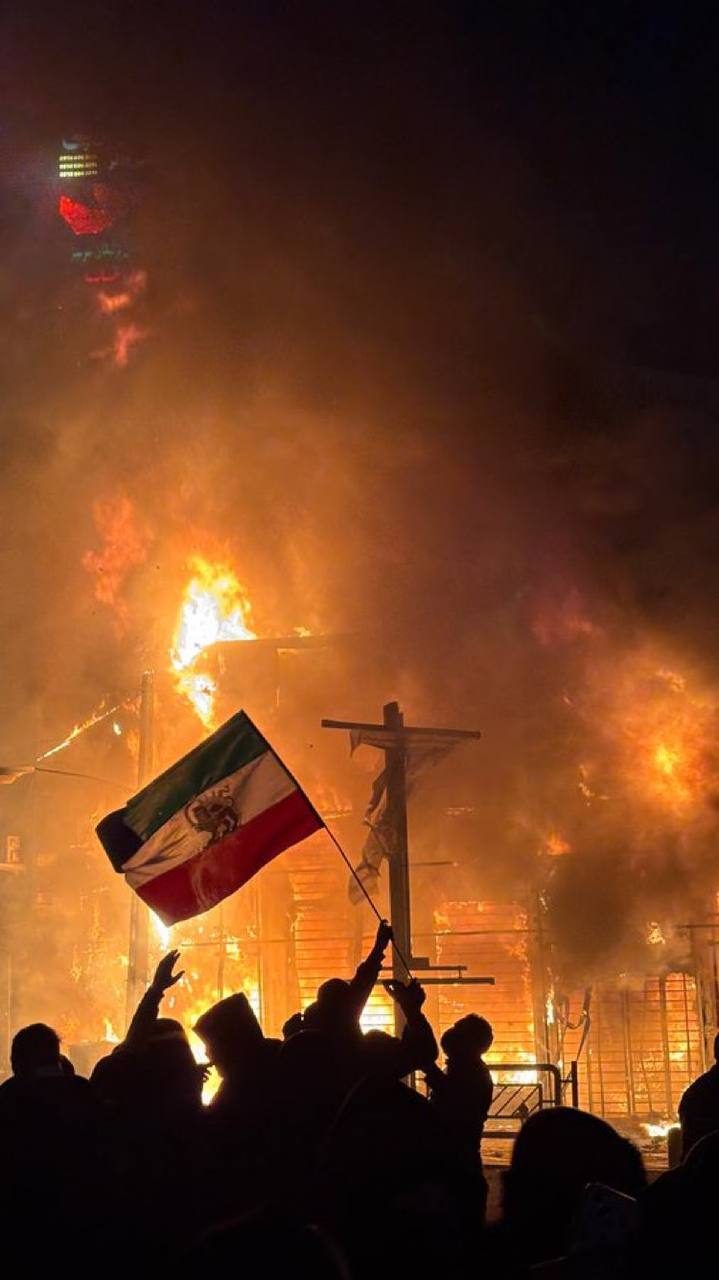
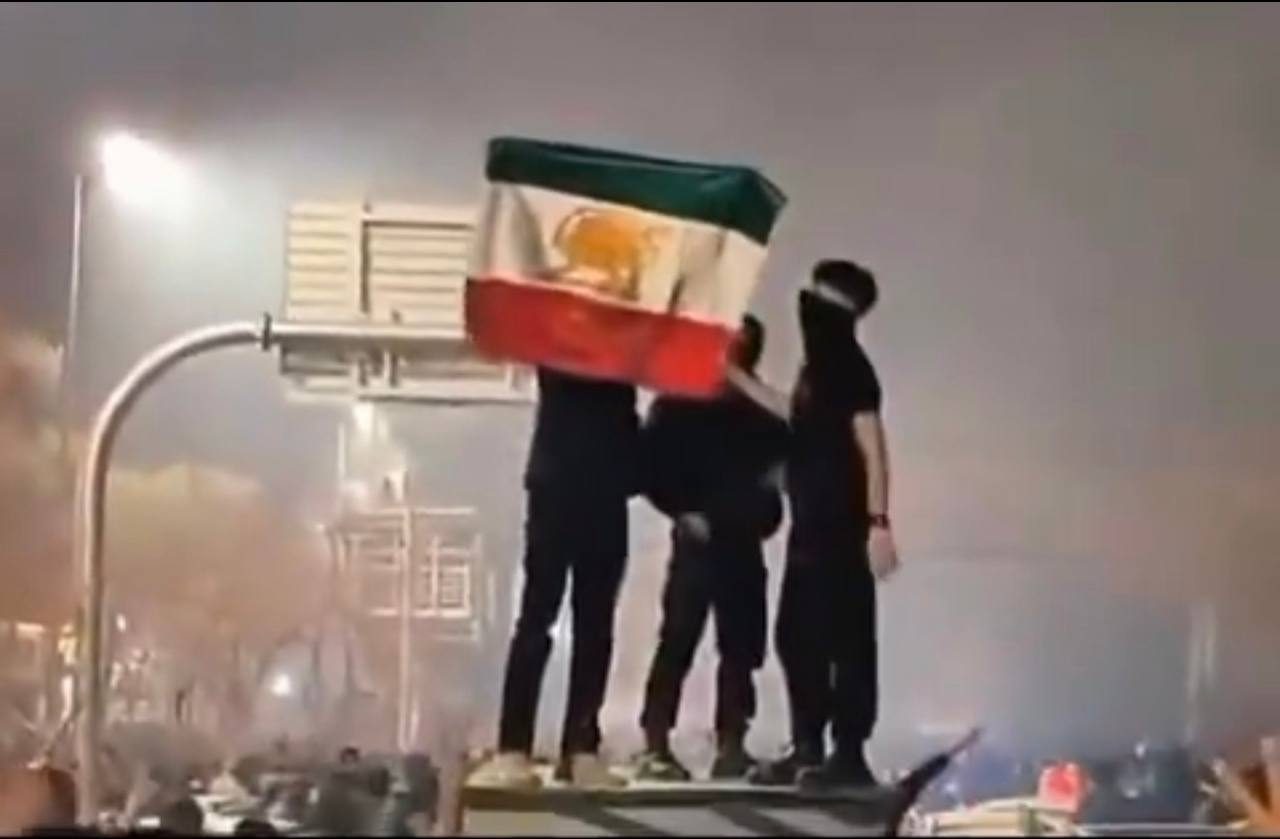
اعتراضات دی ۱۴۰۴؛ پرچم شیر و خورشید برابر آتش — منبع: شبکه‌های اجتماعی و منابع مردمی، دی ۱۴۰۴

اعتراضات از ۲۸ دسامبر ۲۰۲۵ ـــ ۷ دی ۱۴۰۴ در بازار بزرگ تهران [۲۹] شروع شد. دو روز بعد، رویترز گزارش داد که دانشجویان هم به صحنه پیوسته‌اند. تا ۶ ژانویه ـــ ۱۶ دی، اعتراضات به ۲۷ استان و ۳۴۰ شهر گسترش یافته بود. در ۱۲ ژانویه ــــ ۲۲ دی نیز رویترز نوشت که بازار به علت فروپاشی و بی‌ثباتی ارزش ریال و خشم از فاصله‌ی میان زندگی مردم و طبقه امنیتی-مذهبی حاکم، به هسته سخت اعتراض تبدیل شده است. این توالی نشان می‌دهد بازار نقش جرقه تحقیر را داشت، اما خیلی سریع از یک تجمع صنفی فراتر رفت [۳۰].

محرک اقتصادی نیز تقریبا روشن است. ریال در سال ۲۰۲۵ نزدیک به نصف ارزش خود را از دست داد و تورم رسمی دسامبر به ۴۲.۵٪ رسید. همزمان دولت تصمیم گرفته بود نظام ارز ترجیحی را کنار بگذارد و به‌جای آن یارانه مستقیم و کوپن الکترونیک را پیش ببرد؛ رویترز گزارش کرد که اجرای این تغییر برای ۱۰ ژانویه ۲۰۲۶ ـــ ۲۰ دی ۱۴۰۴ برنامه‌ریزی شده بود. بنابراین، بازار صرفا به «قیمت‌های روز» واکنش نشان نداد؛ به افق تورمی بسیار بدتری واکنش نشان داد که قرار بود چند روز بعد رسمی شود [۳۱].

اما دی‌ماه در همان نقطه اقتصادی نماند. رویترز و دفتر کمیساریای عالی حقوق بشر گزارش کردند که اعتراضات از دل بحران معیشتی شروع شد، اما به سرعت به مخالفت با ساختار روحانیت حاکم، شعار علیه خامنه‌ای و مطالبات تغییر سیاسی رسید. در اینجا تفاوت مهمی باید ثبت شود: واقعیت این است که اقتصاد شعله اولیه را مشتعل ساخت؛ و چون این اشتعال در فضای پساجنگ و فرسایش اقتدار افتاد، به ‌سرعت زبان سیاسی پیدا کرد. به همین دلیل، دی‌ماه را می‌توان اعتراضی انقلابی سیاسی با محرک های اقتصادی خواند [۳۲].

موضوع دومِ اعتراض بازار، تاثیر پذیری شدیدِ اقتصاد بازار و تولید و واردات کشور از ماجرای تراستی‌ها بود. تراستی‌ها شبکه‌ای از واسطه‌های مورد اعتماد یعنی افراد، شرکت‌ها یا صرافی‌های خاص در رژیم هستند که در شرایط تحریم‌های بانکی بین‌المللی، وظیفه دریافت، نگهداری و انتقال ارز حاصل از فروش نفت، محصولات پتروشیمی و صادرات دیگر را بر عهده دارند. در واقع به جای استفاده از سیستم بانکی رسمی (مثل سوئیفت) که تحریم شده، این شبکه‌ها به صورت غیررسمی و مبتنی بر اعتماد بین دستگاه سیاسی و شبکه فروش عمل می‌کنند. آن‌ها پول را در حساب‌های خارجی نگه می‌دارند و با تأخیر به ایران برمی‌گردانند. سود اصلی‌شان از رسوب ارز شناور و تأخیر انتقال به دست می‌آید. یعنی حتی بدون کار خاص، از پول متعلق به نفت کشور بهره می‌برند. به عبارت دیگر تراستی‌ها جایگزین موقت سیستم بانکی فلج‌شده هستند، اما به مرور به یک ساختار فسادزا و غیرشفاف تبدیل شدند. شروع اولیه این روش دور زدن تحریم‌ها از اوایل دهه ۸۰ شمسی ــ حدود ۲۰۰۳-۲۰۱۰ با تشدید تحریم‌های نفتی و بانکی علیه رژیم ایران (به‌خصوص بعد از قطع دسترسی به شبکه‌های مالی جهانی) ایجاد شد که نیاز پایداری به راه‌های جایگزین برای فروش نفت و وصول پول آن وجود داشت. ابتدا به صورت محدود و اضطراری شکل گرفت. اما گسترش عمده فعالیت آنها از۲۰۱۰ به بعد، به‌ خصوص از ۱۳۹۷ــ۲۰۱۸ افزایش یافت و تبدیل به یک نیاز تکنیکی برای بقا در شرایط تحریم شد. بعد از تحریم‌های شدید نفتی آمریکا (دوره اوباما) و بعد خروج ترامپ از برجام، فروش نفت به شکل غیررسمی (عمدتا به چین) افزایش یافت. دولت‌ها (از روحانی به بعد) برای دور زدن تحریم‌ها به این شبکه‌ها تکیه کردند. تراستی‌ها حالا دیگر یک تشکیلات موقت نبودند؛ به یک سیستم دائمی و پیچیده تبدیل شدند.

دولت روحانی از راه وزارت نفت (از طریق شرکت نیکو) خودش تراستی‌های کنترل‌شده را ایجاد کرد و مستقیما پول را دریافت می‌کرد. در دولت رییسی (دولت سیزدهم) این کنترل تغییر کرد و تراستی‌ها به شبکه‌های بانکی (زیر نظر بانک مرکزی) سپرده شدند. منتقدان می‌گویند همین تغییر، نظارت را محدود و فساد را پیچیده و غیر قابل ردیابی کرد. تا سال ۱۴۰۴ (۲۰۲۵-۲۰۲۶) با تشدید تحریم‌ها، تراستی‌ها به گلوگاه اصلی بازگشت ارز تبدیل شدند. اولین سری افشاگری‌های مجلس می‌گویند بین ۶٫۷ تا ۱۱ میلیارد دلار به داخل ایران برنگشته است. این موضوع به جنجال بزرگی تبدیل شد. نگاهی به کل رقم نفت فروخته شده در این دوره نشان می‌دهد بررسی حجم دقیقِ دلارهای بازنگشته به دلیل شکاف های تقلب و رانت می‌توانند بسیار عظیم باشند. واقعیت این است که اثر این موضوع بر اقتصادِ چند دولتی شده، اولین اثرات شدید خود را بر ناپایداری شدید برابری ارزی گذاشت.

فراخوان‌های پهلوی و همزمانی با ترامپ

در منابع باز ِقابل اتکا، سه حلقه از فراخوان‌های رضا پهلوی روشن‌تر از بقیه ثبت شده‌اند. نخست، فراخوان برای پنجشنبه و جمعه ۸ و ۹ ژانویه ۲۰۲۶ ـــ ۱۸ و ۱۹ دی ۱۴۰۴، ساعت ۸ شب، که آسوشیتدپرس آن را ثبت کرده است. دوم، پیام‌های ۱۰ ژانویه ـــ ۲۰ دی که در رسانه‌های فارسی برون‌مرزی از ادامه حضور خیابانی برای دو شب دیگر و فشار بر مراکز شهری و دعوت به اعتصاب‌ها خبر می‌دهند؛ این بخش در منابع بین‌المللی درجه‌اول کمتر مستند شده است. این بخش از فراخوان یک نقطه برجسته دارد: دستگاههای تبلیغاتی و ارتباطات رژیم اهداف مشروع محسوب می‌شوند. سوم، ۱۶ ژانویه ـــ ۲۶ دی که از دعوت تازه او به شعارهای شبانه و اعتصاب‌های سراسری خبر دادند. بنابراین، آنچه با اطمینان بالا می‌توان گفت این است که خط فراخوان از «تجمع شبانه» به حضور ماندگار و تاریخی ۱۸ و ۱۹ دی و سپس «فرسایش اجتماعی از راه اعتصاب و تداوم» تغییر کرد [۳۳].

اثر این فراخوان‌ها را باید در نسبت میان پراکندگی و تمرکز سنجید. آسوشیتدپرس، در گزارشی بعدی از ۳۰ ژانویه ـــ ۱۰ بهمن، به نقل از شاهدان نوشت که با فراخوان ساعت ۸ شب، میدان ناگهان از خیابان‌های خلوت به «دریایی از هزاران نفر» تبدیل شد. گزارش‌های تصاویر و ویدیوهای بعدی نشان داد که بخش اصلی از شعارها در حمایت از رضا پهلوی و بازگشت او به کشور بود، بخش دیگر شعارها خواهان پایان حکومت روحانیون و اقدام سیاسی برای آزادی بودند. نتیجه تحلیلی این است که فراخوان‌های پهلوی برای اولین بار پس از جنبش سبز، رهبر سیاسی و به تبع آن امید سیاسی ایجاد کردند، همچنین باید گفت که به اعتراضات زمان‌بندی، تمرکز و لحظه‌ی مشترک دادند [۳۴]. عمده مخالفان رضا پهلوی از جمهوری خواهان و چپ‌ها رهبری سیاسی از بیرون را رد می کنند. آنها همزمان گروه‌های پادشاهی را تمسخر می کردند که رضا پهلوی توان بسیج عمومی حتی تعداد کمی از معترضان را ندارد. اما مرور این دوره سه‌گانه از فراخوان‌ها نشان می‌دهد، اعتراضات شبانه و خیابانی عدد بزرگی از حضور معترضان را در بیش از ۴۰۰ شهر ثبت کردند که پیش از این سابقه نداشت.

در کنار این فراخوان‌ها، پست‌های ترامپ در Truth Social نقش تشدیدکننده‌ی زمانی داشتند. در ۲ ژانویه ۲۰۲۶ ـــ ۱۲ دی ۱۴۰۴ پرزیدنت ترامپ نوشت اگر ایران به معترضان شلیک کند، آمریکا «loaded and locked» یعنی تفنگ را مسلح کرده و آماده شلیک است. در ۹ ژانویه ـــ ۱۹ دی، رویترز از هشدار تازه‌ی او همزمان با قطع اینترنت و گسترش اعتراضات خبر داد. در ۱۳ ژانویه ـــ ۲۳ دی نیز رویترز پست مشهور «Iranian Patriots, KEEP PROTESTING… HELP IS ON ITS WAY» را ثبت کرد. واقعیت این است که همزمانی وجود داشت اما در منابع باز، هنوز سندی برای «هماهنگی عملیاتی» میان پهلوی و ترامپ وجود ندارد. بنابراین، تعبیر درست‌تر «همزمانی سیاسی» یا هم جهتی فشار خارجی و خیابان داخلی است، نه اثبات‌شده‌ی «هماهنگی» [۳۵].

همین همزمانی، ماده خام جنگ روایت شد. حکومت آن را به وابستگی نسبت داد؛ بخشی از مخالفان نیز آن را بهانه‌ای برای حمله به اصل لحظه اعتراضی کردند. رویترز در ۱۵ ژانویه ـــ ۲۵ دی از شکاف تلخ میان جناح‌های اپوزیسیون خارج کشور نوشت: جدال میان پادشاهی خواهان، مجاهدین خلق و جریان‌های چپ و جمهوری‌خواه، در مواردی به ‌جای تقویت روایت خیابان، به منازعه بر سر مالکیت خیابان تبدیل شد [۳۶].

همپوشانی استراتژیک

میان هدف جنگی آمریکا و اسراییل علیه جمهوری اسلامی و خواست مردم ایران برای آزادی، الزاما وحدت پروژه وجود نداشت؛ اما همپوشانی استراتژیک وجود داشت. آمریکا و اسراییل، از زاویه امنیت ملی خود، به دنبال فرسودن دارایی بازدارندگی رژیم بودند: برنامه هسته‌ای، توان موشکی، سپاه پاسداران و موضوع امنیت داخلی و به ویژه شبکه نیابتی. جامعه ایران، از زاویه رهایی سیاسی به دنبال شکستن همان ساختاری بود که سرکوب، فقر، تبعیض، تحقیر، اعدام و انسداد سیاسی را باز تولید می‌کرد. این دو مسیر از یک نقطه آغاز نمی‌شدند، اما به یک مرکز فشار می‌رسیدند: تضعیف ظرفیت بقای جمهوری اسلامی. در گزارش اردیبهشت ۴۰۴ نیز زنجیره بحران چنین صورت‌بندی شده است: جنگ، فرماندهی، رهبری، خیابان؛ یعنی جنگ از سطح ضربه نظامی عبور کرد و به متغیری برای تغییر محاسبه بقا در رژیم تبدیل شد.

از همین‌جا می‌توان فهمید چرا حکومت اعتراضات دی‌ماه را بخشی از جنگ ترکیبی خواند. این فقط یک برچسب تبلیغاتی نبود؛ اعتراف امنیتی رژیم به همزمانی دو فشار بود. از نگاه حاکمیت، خیابان ایرانی وقتی در لحظه پساجنگ فعال می‌شود، دیگر فقط اعتراض معیشتی نیست؛ به ضلع داخلی همان فشاری تبدیل می‌شود که از بیرون بر فرماندهی، بازدارندگی و توان بقا وارد شده است. شواهد نشان می‌دهد که در ادراک رژیم، جنگ خارجی، اگر با شکاف اجتماعی، بحران مشروعیت و حرکت خیابانی پیوند بخورد، از سطح تخریب نظامی فراتر می‌رود و به بحران فرمان، بحران اطاعت و بحران آینده بقای نظام تبدیل می‌شود. به همین دلیل، طبق داده‌های گزارش اردیبهشت ــ می (شماره ۱ ارجاع)، حکومت از تابستان ۱۴۰۴ مساله را همزمان «جنگ خارجی» و «امنیت داخلی» دید؛ در جنگ ۱۲ روزه از هزاران بازداشت و بیش از هزار ایست بازرسی سخن رفت و در دی‌ماه، محله، اینترنت، روایت، بیمارستان، بازداشتگاه و رسانه، همگی به اجزای یک عملیات ضدخیزش تبدیل شدند.

بنابراین دال مرکزی این نیست که مردم ایران ابزار جنگ خارجی بودند؛ چنین فرمولی هم از نظر اخلاقی خطاست و هم از نظر تحلیلی ضعیف است. دقیق‌تر این است که رژیم، به دلیل ماهیت نظامی-ایدئولوژیک خود، هیچ تغییر مسالمت‌آمیزی را به رسمیت نمی‌شناسد و هر مطالبه‌ی آزادی ‌خواهانه را در امتداد جنگ دشمن تعریف می‌کند. در این‌ جا همپوشانی استراتژیک معنا پیدا می‌کند: مردم ایران خواهان آزادی‌اند، آمریکا و اسراییل خواهان فروکاستن تهدید امنیتی رژیم‌اند و جمهوری اسلامی این دو مسیر را در یک میدان واحد می‌بیند، چون بقای خود را بر پیوند ایدئولوژی، سپاه، هسته‌ای، موشک، سرکوب و انسداد سیاسی بنا کرده است. هر ضربه به یکی از این ستون‌ها، ستون‌های دیگر را نیز بی‌ثبات می‌کند. بنابراین اعتراضات دی‌ماه نه ضمیمه جنگ بود و نه صرفا شورش نان؛ لحظه‌ای بود که جامعه ایران از شکاف ایجادشده در ماشین بقا عبور کرد و آزادی را به زبان بحران در قدرت ترجمه کرد.

این صورت‌بندی همچنین خط تمایز میان «همپوشانی» و «وابستگی» را روشن می‌کند. حکومت از همزمانی فشار خارجی و خیابان داخلی، روایت وابستگی می‌سازد تا سرکوب را موجه کند؛ اما تحلیل سیاسی نباید زبان امنیتی رژیم را بپذیرد. همپوشانی استراتژیک یعنی دو نیروی متفاوت، با انگیزه‌های متفاوت، در یک بازه تاریخی به یک نقطه فشار مشترک برسند. مردم برای حق زندگی آزاد، حق انتخاب سیاسی و پایان سلطه ایدئولوژیک به میدان می‌آیند؛ دولت‌های خارجی برای کاهش تهدید امنیتی و تغییر موازنه منطقه‌ای فشار می‌آورند؛ رژیم نیز چون خود را در مرکز هر دو بحران می‌بیند، جامعه را به میدان جنگ ترکیبی ترجمه می‌کند. رژیم پیش از دی‌ماه نه برای شنیدن جامعه، بلکه برای جنگیدن با جامعه آماده شده بود.

روایت دی‌ماه: از زبانه‌های بازار تا آشوب جنایت

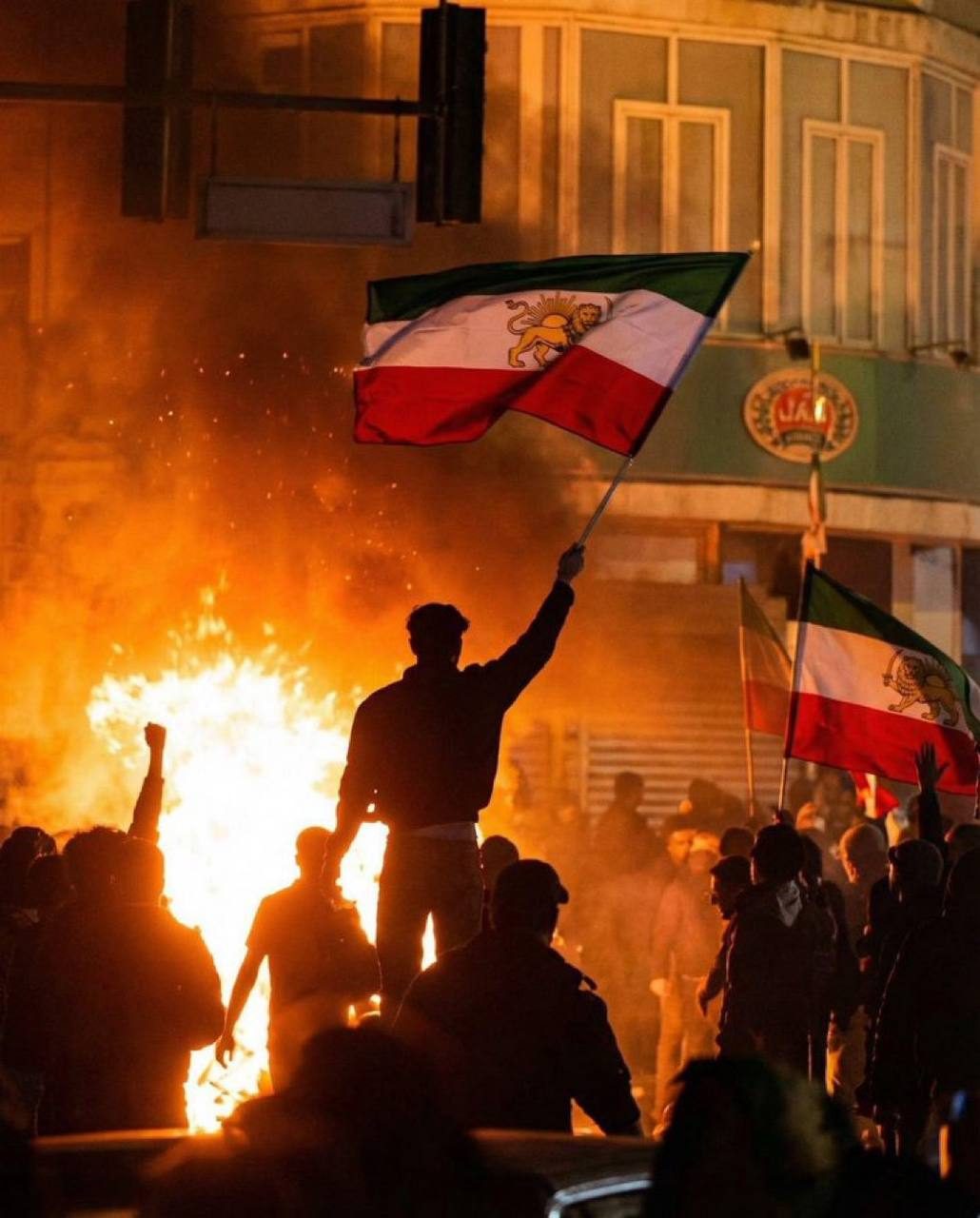
شب‌های اعتراض در خیابان‌های ایران، دی ۱۴۰۴ — منبع: شبکه‌های اجتماعی و منابع مردمی، دی ۱۴۰۴

نامی که بر این رخداد تاریخی ماند، «انقلاب شیر و خورشید» بود. این نام‌گذاری دو ریشه داشت. نخست، هواداران ایران‌گرایی و در بخش غالب آن هواداران شاهزاده رضا پهلوی آن را انتخاب کردند. دوم و مهم‌تر: برای اولین بار پرچم شیر و خورشید نشان، نماد ایران پیش از جمهوری اسلامی در تظاهرات روزهای ۱۸ و ۱۹ دی در خیابان‌های شهرهای مختلف ایران برافراشته شد. این انتخاب نمادین خودش یک داده سیاسی است: جامعه‌ای که پرچم ایرانی را در برابر پرچم جمهوری اسلامی بلند می‌کند، در حال انتخاب هویت است، نه فقط اعتراض. مردم با برافراشتن شیر و خورشید، هم از رژیم فاصله گرفتند و هم آینده‌ای را تصویر کردند که ریشه در ایران داشت نه در اسلام سیاسی. اینکه آیا این نماد به‌ تنهایی ظرفیت بسیج فراگیر دارد یا فقط بخشی از جامعه را نمایندگی می‌کند، پاسخی دارد که به گستردگی حضور لایه‌های مختلف مردم و گروه‌های متنوع اجتماعی و شهری دلالت داشت؛ اما واقعیت بنیادی آن است که در لحظه اوج بحران، خیابان نمادی را انتخاب کرد که ذاتا ضد اسلامی‌ سازی بود.

روایت دی‌ماه باید از همان نقطه‌ای آغاز شود که بازار زبانه‌های کوچک آن را شعله‌ور کرد، اما خیابان از بازار عبور کرد. اعتراضات از ۷ دی ۱۴۰۴ در بازار بزرگ تهران آغاز شد، سپس دانشجویان وارد صحنه شدند و تا ۱۶ دی به ۲۷ استان گسترش یافت. همزمان، بحران ارزش ریال، تورم رسمی ۴۲.۵ درصدی در دسامبر و تصمیم دولت برای تغییر نظام ارز ترجیحی، سطح تحمل اجتماعی را پایین آورد. اما دی‌ماه در همان نقطه اقتصادی نماند. شعارها علیه رأس قدرت، ساختار روحانیت حاکم و کلیت نظام سیاسی رفت. بنابراین فرمول دقیق‌تر این است: اقتصاد، آستانه انفجار را پایین آورد؛ جنگ و فرسایش اقتدار، احساس امکان‌پذیری را بالا برد؛ و سرکوب، اعتراض اقتصادی را به رخداد سیاسی تمام‌عیار تبدیل کرد.

آمارهای اولیه نشان می‌دادند رژیم از همان روزهای نخست با منطق گلوله وارد میدان شد. ایران‌اینترنشنال در ۱۸ دی به نقل از سازمان حقوق بشر ایران گزارش کرد که از آغاز اعتراضات دست‌کم ۴۵ معترض، از جمله ۸ کودک، کشته، صدها تن مجروح و بیش از دو هزار نفر بازداشت شده‌اند. در همان روز، گزارش‌ها از تیراندازی مستقیم، استفاده از گلوله جنگی و ساچمه‌ای در شامگاه ۱۸ دی سخن می‌گفتند. اهمیت این داده‌ها در رقم نهایی نیست؛ در نشان دادن الگوی اولیه سرکوب است: رژیم پیش از آنکه اعتراض به یک جنبش کاملا سراسری و سازمان‌یافته تبدیل شود، تصمیم گرفت هزینه خیابان را خونین کند [۳۷].

۱۸ و ۱۹ دی نقطه‌ای بود که حکومت تصمیم گرفت اعتراض را نه مدیریت، بلکه به طور مطلق خاموش کند. اینترنت قطع شد، تماس‌ها مختل شد، بیمارستان‌ها و مراکز درمانی به میدان امنیتی تبدیل شدند و گزارش‌ها از شلیک مستقیم، استفاده از گلوله جنگی، حمله به زخمی‌ها، بازداشت مجروحان و تهدید خانواده‌ها حکایت داشتند. جنایت فقط در خیابان انجام نشد؛ مسیر درمان، مسیر اطلاع‌رسانی، مسیر سوگواری و مسیر ثبت حقیقت نیز هدف قرار گرفت. به همین دلیل، آمار کشته‌ها را باید در نسبت با مهندسی پنهان‌سازی خواند، نه فقط در نسبت با عددهای اعلام‌شده.

در مورد آمار نهایی، عددهای حقوق بشری در روزهای نخست از ده‌ها کشته و هزاران بازداشت سخن می‌گفتند؛ هرانا در گزارش روز پنجاهم از آغاز اعتراضات، از ثبت ۲۲۶ کودک در میان جان‌باختگان خبر داد؛ و برخی گزارش‌های رسانه‌ای ــ پزشکی بعدی ارقام بسیار بزرگ‌تری را مطرح کردند. این ارقام را نباید در یک سطح نشاند. پیشنهاد روش‌شناختی به نظرم این است که گزارش‌های مرتبط گوناگونی که ممکن است بعدتر منتشر شوند باید سه سطح آماری داشته باشد: حداقل‌های تأییدشده، برآوردهای تجمیعی حقوق بشری، و برآوردهای پزشکی ــ رسانه‌ای نهادی در شرایط خاموشی. با این کار، بزرگی جنایت حفظ می‌شود، اما متن در دام عدد قطعی غیرقابل دفاع نمی‌افتد [۳۸].

دی‌ماه از نظر تاریخی فقط با تعداد کشته‌ها تعریف نمی‌شود؛ با کیفیت سرکوب و وحشیگری ساختار تعریف می‌شود. وقتی حکومت همزمان از قطع اینترنت، گلوله، بازداشت، اعتراف اجباری، حمله به درمان، روایت جنگ ترکیبی و تهدید قضایی استفاده می‌کند، یعنی معترض را نه شهروند ناراضی، بلکه عنصر جنگی تعریف کرده است. جنایت دی‌ماه محصول خطای لحظه‌ای یا خشونت میدانی چند فرمانده نبود؛ نتیجه طبیعی دولتی بود که سیاست را با امنیت، جامعه را با دشمن و آزادی را با جنگ ترکیبی یکی می‌گیرد. در چنین ساختاری، مطالبه مسالمت‌آمیز نیز به زبان نظامی ترجمه می‌شود، چون رژیم امکان تغییر مسالمت‌آمیز را تهدیدی علیه تمام بقای خود می‌فهمد [۳۹].

هیجدهم و نوزدهم دی

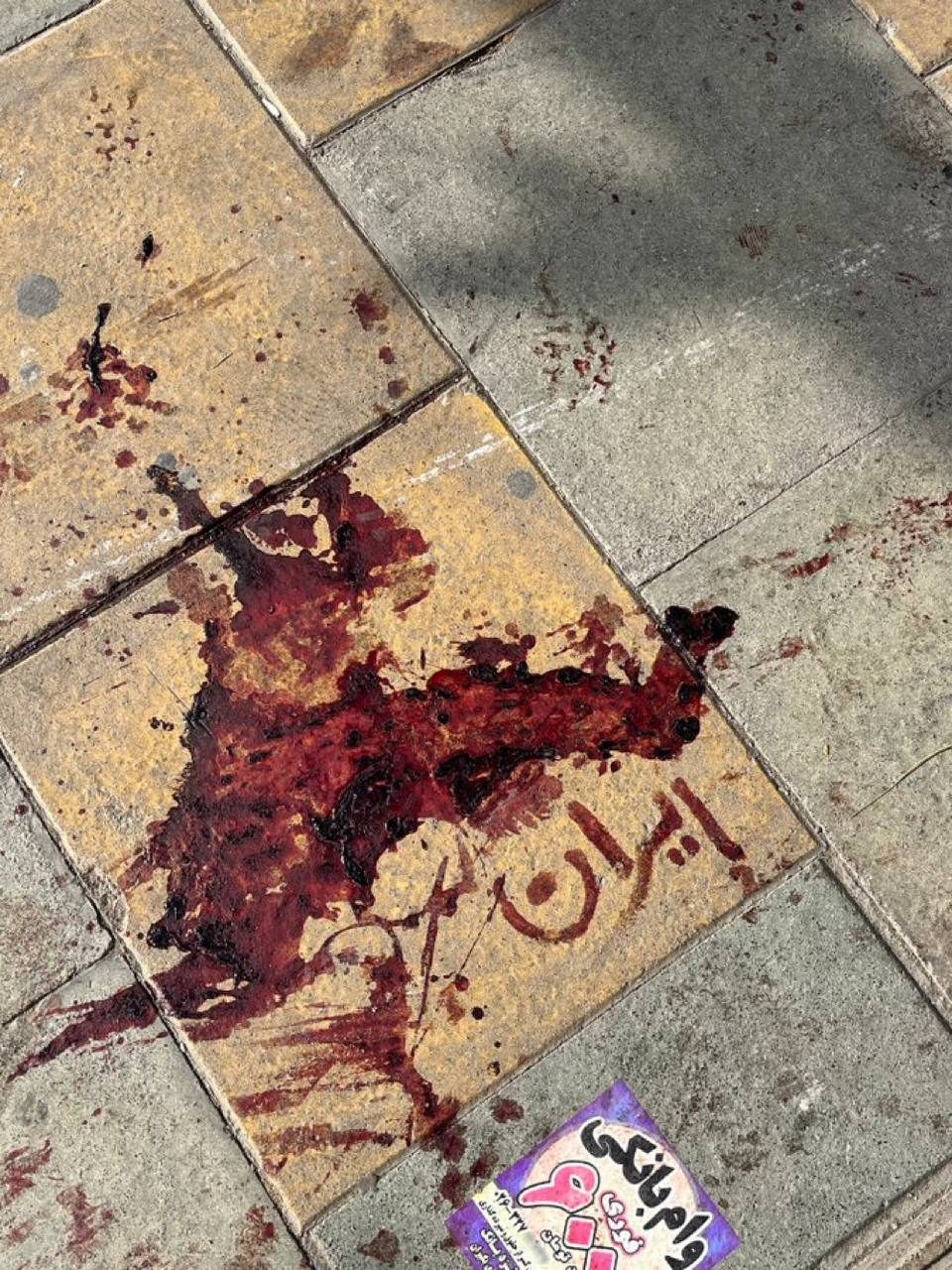
رد خون بر سنگ‌فرش خیابان در کنار واژه «ایران»، دی ۱۴۰۴ — منبع: شبکه‌های اجتماعی و منابع مردمی، دی ۱۴۰۴

۸ ژانویه ۲۰۲۶ ــ ۱۸ دی ۱۴۰۴ نقطه‌ی گذار از اعتراض ممتد به لحظه بحرانی بود. آسوشیتدپرس گزارش کرد که پس از فراخوان شبانه، مردم در خانه‌ها و خیابان‌ها شعار دادند؛ ساعتی بعد، اینترنت و خطوط تلفن قطع شد. رویترز نیز در همان روز از خاموشی سراسری اینترنت خبر داد. در ۹ ژانویه ــ ۱۹ دی، رویترز گزارش کرد که با وجود قطع ارتباطات، اعتراضات ادامه یافت و خامنه‌ای در تلویزیون معترضان را مزدور خارجی خواند و هشدار داد که حکومت عقب نمی‌نشیند. از نظر ترتیب وقایع، توالی این‌گونه بود: فراخوان، ظهور خیابان، قطع ارتباط، سپس لحن صریح ِسرکوب [۴۰].

نوع سرکوب چندلایه بود. از یکسو، اینترنت و تماس‌های بین‌المللی قطع شد؛ گاردین و Filterwatch این قطع را بسیار پیچیده و نزدیک به قطع کامل توصیف کردند و از افت ۹۰درصدی ترافیک گفتند. از سوی دیگر، گزارش‌های حقوق بشری و رویترز از استفاده از گلوله جنگی و شاتگان، شلیک به معترضان و رهگذران، استقرار نیروها بر خیابان‌ها و بام‌ها، موج بازداشت‌های گسترده و حمله به بیمارستان‌ها برای بازداشت زخمی‌ها خبر دادند. عفو بین‌الملل از «کشتارهای غیرقانونی در مقیاس بی‌سابقه» سخن گفت؛ دیده‌بان حقوق بشر از «کشتار سراسری معترضان و رهگذران» در ۸ و ۹ ژانویه؛ و یک کارشناس سازمان ملل در گفت‌وگو با رویترز از یورش به بیمارستان‌ها و بازداشت مجروحان گزارش داد [۴۱].

پرسش اصلی این نیست که آیا حکومت توان سرکوب داشت؛ پرسش این است که آیا برای این سطح از سرکوب از قبل آماده شده بود؟ پاسخ، بر اساس شواهد باز، مثبت است؛ اما باید در سه سطح تفکیک شود.

در سطح ساختاری، حکومت از تابستان ۱۴۰۴ ــ ۲۰۲۵ به بعد امنیت داخلی را به اولویت ارتقا داد. رویترز در ۲۵ ژوئن ــ ۴ تیر از استقرار نیرو، بازداشت‌ها، اعدام‌ها و آماده‌باش در مناطق حساس نوشت. بعدتر، آسوشیتدپرس گزارش کرد پلیس رژیم ایران در جنگ ۱۲ روزه از برپایی بیش از هزار ایست بازرسی و بازداشت ۲۱هزار مظنون خبر داده است. در سطح سازمانی نیز فرماندهی سپاه در ۱ دی ۱۴۰۴ بر «اجرای درست طرح محله‌محور بسیج» تأکید کرد و پوشش محله را پل میان نهاد دولت و محله دانست؛ در آذر ۱۴۰۴ نیز گزارش‌های رسمی از شبکه مدیریت محله‌محور با کمیته‌ی «امنیت عمومی و آسیب‌های اجتماعی» خبر دادند. این‌ها سند ِبرنامه‌ی مشخص برای ۱۸ و ۱۹ دی نیستند، اما تغییرات و آماده‌باش زیرساخت نهادی کنترل شهری را نشان می‌دهند [۴۲].

در سطح روایی و روانی، از ماه‌ها پیش ادبیات «جنگ شناختی»، «جنگ ترکیبی»، «نفوذ» و «اغتشاش» دائما بازتولید می‌شد. در بهمن ۱۴۰۳، مقام‌های انتظامی از جنگ شناختی گفتند. در دی ۱۴۰۳، رئیس دانشگاه صنعتی مالک اشتر [۴۳] گفت عرصه جنگ شناختی، مغز و ادراک انسان را هدف می‌گیرد. در شهریور ۱۴۰۳، دانشگاه علوم انتظامی امین [۴۴] همایش ملی «جنگ ترکیبی» برگزار کرد؛ در دی ۱۴۰۳ نیز مالک‌اشتر همایش ملی «عرصه جنگ شناختی: علم و فناوری» را با ۹۵ مقاله برپا کرد. در اکوسیستم وابسته به دانشگاه جامع امام حسین [۴۵] هم مقالاتی با عنوان «عملیات روانی و تأثیر آن بر اغتشاشات شهری» و نشریات بحران‌محور با محور امنیت اجتماعی منتشر شده بود. پس از دی‌ماه نیز متون رسمی بیت خامنه‌ای و رسانه‌های نزدیک به حاکمیت، وقایع را «شورش ترکیبی»، «فتنه آمریکایی-صهیونی» و پیامد جنگ شناختی خواندند. این مجموعه نشان می‌دهد رژیم پیش از دیماه، از نظر مفهومی و تبلیغی، جامعه را در قالب یک منازعه امنیتی-شناختی می‌دید [۴۶].

در سطح عملیاتی، شواهد حتی عینی‌تر است. در ۶ ژانویه ــ ۱۶ دی، پلیس وعده داد با «آخرین اغتشاشگر» برخورد می‌کند. در ۸ ژانویه ــ ۱۸ دی، اینترنت و خطوط تلفنی قطع شد. این قطعی را می‌توان «جامع‌ترین خاموشی ارتباطی تاریخ ایران» توصیف کرد و گاردین از برنامه‌ی بلندمدت‌تر برای جداشدن کنترل‌شده از اینترنت جهانی نوشت. دولت در ۱۸ بهمن ۱۴۰۴ البته در ایرنا گفت «شبکه ملی اطلاعات جایگزین اینترنت نیست»، اما همین تأکید بر تاب‌آوری و امنیت شبکه نشان می‌دهد زیرساخت بومی‌سازی کنترل از پیش موجود بود. در سطح تجهیزات و نظارت نیز گزارش سپتامبر ۲۰۲۵ مرکز اسناد حقوق بشر ایران از دسترسی نیروهای امنیتی به تجهیزات سرکوب و نظارت از مسیرهای بین‌المللی سخن گفت، و گزارش‌های سازمان ملل و خبرگزاری‌ها از استفاده فزاینده از پهپاد، تشخیص چهره و زیرساخت گزارش‌دهی دیجیتال پس از ۲۰۲۲ خبر داده بودند. به زبان ساده: جعبه‌ابزار سرکوب ۱۸ و ۱۹ دی از پیش ساخته شده بود؛ فقط فعال شد [۴۷].

افزون بر این، یک سند روایی مهم از خود ِحاکمیت وجود دارد: در گفت‌وگوی ۱۸ فوریه ۲۰۲۶ ــ ۲۹ بهمن ۱۴۰۴ در سایت خامنه‌ای، رئیس اطلاعات سپاه گفت «قبل از آشوب اخیر» به دیدار خامنه‌ای رفته و گزارشی از جنگ ۱۲ روزه، وضعیت دشمن و «طرح‌ریزی برای آینده» داده است و همچنین از اجرای سریع رزمایش «امیرالمؤمنین ۲» یاد کرد. به همین دلایل مهم است که خود ِرژیم می‌خواهد نشان دهد که واقعه را از پیش در قالب سناریوی امنیتی می‌دیده است [۴۸].

نتیجه این بخش روشن است. سرکوب ۸ و ۹ ژانویه واکنش آنی به یک شب اعتراض نبود. ترکیب آماده‌باش پساجنگ، بسط محله‌محوری، دکترین جنگ شناختی، خاموشی دیجیتال و داده‌های رسمی درباره هزاران بازداشت و صدها ایست بازرسی، نشان می‌دهد رژیم به‌صورت چندماهه و حتی چندساله برای لحظه‌ای از این جنس آماده شده بود. اینکه از دسامبر ۲۰۲۵ تا ژانویه ۲۰۲۶ چه دستورهای جزئی‌تری درون سلسله‌مراتب امنیتی صادر شده، هنوز روشن نیست؛ اما برای اثبات «وجود آمادگی قبلی» نیازی به آن سطح از سند هم نیست. شواهد موجود کافی‌اند [۴۹].

موضوعی که در پایان این بخش باید گفت: انتقادات و اتهاماتی است که بر ضد رضا پهلوی رهبر غالب معترضان در خیابان‌های ایران مطرح می‌شود. اینکه «اگر بپذیریم چنین آمادگی از قبل وجود داشته است، چرا او تیم عملیاتی اش همچنان در فراخوان و مدیریت اعتراضات پیشروی کردند؟» به نظرم شواهد پیشین تایید کننده تنها این موضوع هستند که آمادگی پیشین وجود داشته است. تایید این موضوع نیست که رضا پهلوی می‌توانست از بروز اعتراضات و شدت یافتن آن جلوگیری کند! چه بسا معترضان روز ۷ ژانویه ــ ۱۷ دی هم با جمعیت بزرگی به میدان آمدند. ضمن اینکه خالی گذاشتن صحنه رهبری اعتراضات مانند جنبش مهسا، سلبریتی‌ها را برای فراخوان به میدان می‌آورد که آسیب‌های ویژه خود را داشت. وجود رهبری او دست‌کم برای معترضان، یک تکیه‌گاه سیاسی ساخت. به نظر می‌رسد همچنان اگر فراخوانی برای اعتراضات از سمت او صادر نمی‌شد، موضوعات دیگری از سمت منتقدان مطرح می‌شد: اینکه چرا او مداخله نکرده پس بنابراین او از عدم همراهی معترضان واهمه دارد یا اصلا هوادار چندانی برای تصرف خیابان ندارد. به هر حال روشن است که مسائل اپوزیسیون رژیم ایران، بیش از آنکه از نظر ساخت گفتمان قدرتمند بر ضد رژیم عمل کند، انرژی یکدیگر را خنثی می‌کنند. سمت نیروی چپ و جمهوری‌خواه این موضوع حادتر است. از این نظر که دارایی سازمانی برای مقابله با رژیم نسبت به گروههای پادشاهی خواه چندان ندارند اما در بخش رسانه‌ای و شبکه‌های اجتماعی و همچنین لابی‌های اروپاییِ ضد جنگ، بسیار خوب عمل می‌کنند. شکاف مسموم این ادعا از سوی چپ‌ها و جمهوری خواهان این است که نمی‌توانند بین ضد جنگ بودن و حامی رژیم بودن، یک خط تمایز بکشند.

۱. مهندسی یکپارچه سرکوب

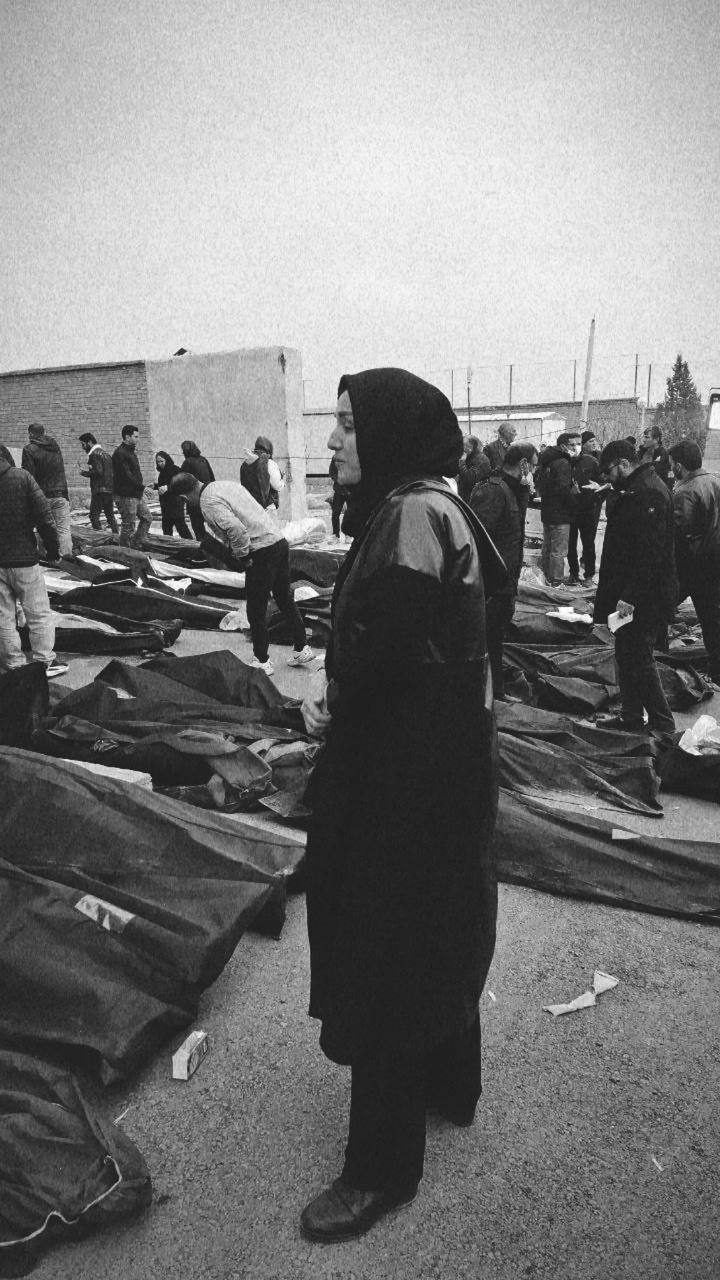
پیکر جان‌باختگان اعتراضات دی ۱۴۰۴ — منبع: شبکه‌های اجتماعی و منابع مردمی، دی ۱۴۰۴

تحلیل دی‌ماه ۱۴۰۴ تنها زمانی از سطح روایت اخلاقی به سطح تشریح راهبردی می‌رسد که جنایت‌ها را نه به‌صورت رخدادهای پراکنده، بلکه به‌صورت اجزای یک نظام با قصد بقای اقتدارگرا فهمیده شوند. آنچه در ۸ و ۹ ژانویه و در روزهای پس از آن اتفاق افتاد، نه عصیان لحظه‌ای فرماندهان میدانی بود، نه واکنش بداهه به یک تجمع. تمام داده‌هایی که عفو بین‌الملل در ۲۰ و ۲۲ ژانویه منتشر کرد، گزارش ۱۳۵۰ صفحه‌ای هرانا تحت عنوان «زمستان سرخ»، گزارش جداگانه دیده‌بان حقوق بشر در ژانویه و فوریه، یافته‌های مرکز حقوق بشر در ایران، و یافته‌های فنی Filterwatch و NetBlocks یک نکته را در سطوح متفاوت تأیید می‌کنند: سرکوب دی ۱۴۰۴ یک مهندسی چندلایه و هماهنگ بود که اجزای آن در محله، خیابان، بیمارستان، بازداشتگاه، رسانه و شبکه ارتباطی همزمان فعال شدند[۹۱]. در ادبیات مقایسه‌ای اقتدارگرایی، چنین الگویی به‌نام «سرکوب یکپارچه» (integrated repression) شناخته می‌شود ـ مدلی که در آن چند سازوکار جداگانه با هدف واحد، تثبیت بقای رژیم در شرایط بحران حاد به‌صورت همزمان بسیج می‌شوند. پرسش محوری که یک تحلیلگر گذار باید بپرسد، این نیست که چند نفر کشته شدند؛ این است که چه ساختاری توانست در یک بازه ۴۸ ساعته، چنین حجمی از کشتار، بازداشت، خاموشی و پنهان‌سازی را اجرا کند و این ساختار از کجا آمد؟

پاسخ، حداقل سه پایه دارد. اول، آمادگی نهادی پیشینی: گزارش رویترز در ۲۵ ژوئن ۲۰۲۵ از چرخش رژیم به سمت سرکوب داخلی پس از جنگ ۱۲ روزه، آمار رسمی پلیس درباره ۲۱ هزار «مظنون» بازداشت‌شده و بیش از هزار ایست بازرسی در همان جنگ، تأکید فرماندهی سپاه در ۱ دی ۱۴۰۴ بر «اجرای درست طرح محله‌محور بسیج»، و گزارش ایرنا در آذر ۱۴۰۴ از کمیته «امنیت عمومی و آسیب‌های اجتماعی» در شبکه مدیریت محله‌محور، همگی نشان می‌دهند که رژیم از تابستان ۱۴۰۴ به بعد، زیرساخت یک عملیات ضدخیزش گسترده را بنا کرده بود. دوم، آمادگی روایی-روانی: تکرار ادبیات «جنگ شناختی» و «جنگ ترکیبی» در سخنرانی‌های رئیس دانشگاه صنعتی مالک اشتر، همایش‌های دانشگاه علوم انتظامی امین، نشریات وابسته به دانشگاه جامع امام حسین و سپس متن‌های رسمی پس از دی‌ماه که دقیقا از همین واژگان استفاده کردند، نشان می‌دهد رژیم از قبل خود را در یک نبرد امنیتی-شناختی می‌دید، نه در یک بحران مدنی. سوم، آمادگی فنی-عملیاتی: جامع‌ترین خاموشی ارتباطی تاریخ ایران در ۸ ژانویه، اعلام برنامه «انزوای دیجیتال مطلق» توسط Filterwatch بر پایه اسناد رسمی رژیم، طراحی پیشینی سامانه «لیست سفید» و تحلیل پژوهشگران دانشگاهی که این رویداد را «گسترده‌ترین خاموشی هماهنگ ارتباطی در تاریخ» توصیف کردند، نشان می‌دهد ابزار خاموشی نه در ۸ ژانویه ساخته شده، بلکه فقط در آن روز فعال شده است[۹۲]. این سه پایه ساختاری، نهادی، روایی و فنی کنار هم به یک نتیجه منتهی می‌شوند: آنچه در دی‌ماه دیده شد، خروجی یک پروژه چندساله بود که فقط منتظر «شوک» مناسب ماند تا اجرا شود.

۲. پنج لایه‌ی فیزیکی جنایت

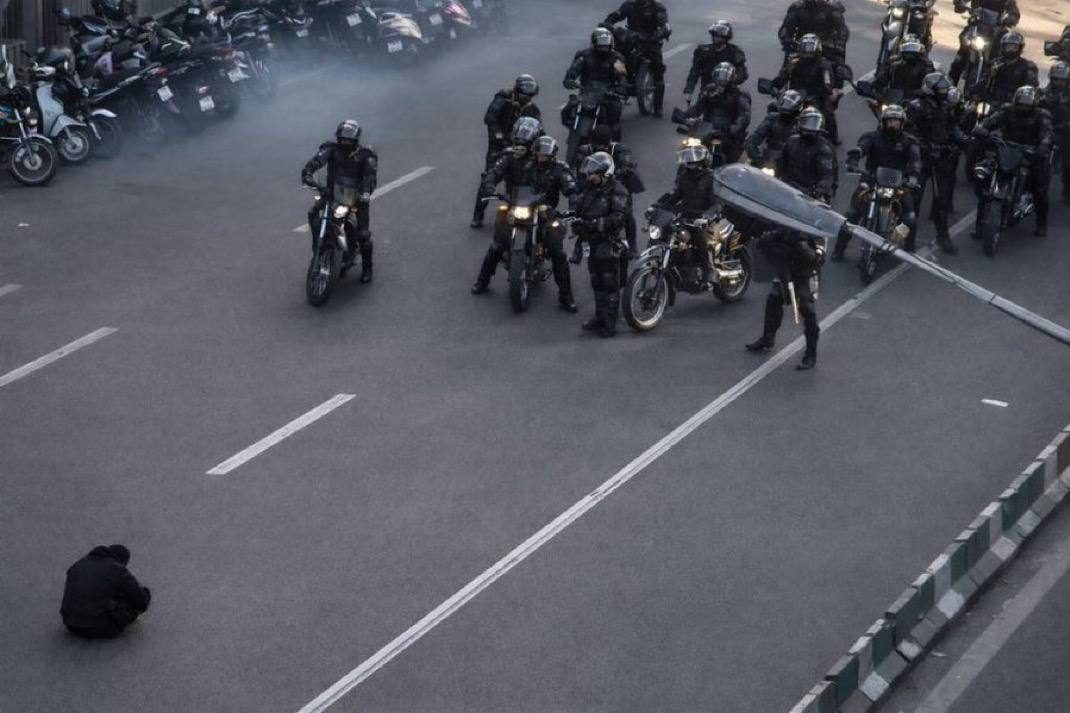
استقرار یگان‌های موتوری سرکوب در خیابان — منبع: شبکه‌های اجتماعی و منابع مردمی، دی ۱۴۰۴

برای فهم گستره و کیفیت جنایت دی‌ماه، تحلیل را باید در پنج لایه ساختاری جداگانه اما به‌هم پیوسته صورت‌بندی کرد. هیچ‌کدام از این لایه‌ها بدون لایه‌های دیگر کارکرد کامل نداشت؛ در ترکیب، یک ماشین یکپارچه می‌ساختند که هدف آن نه فقط خاموش‌کردن خیابان، بلکه پاک‌کردن لحظه از حافظه ملی بود.

لایه اول، شلیک مستقیم در فضای شهری. عفو بین‌الملل و دیده‌بان حقوق بشر در گزارش مشترک ۸ ژانویه ۲۰۲۶ مستند کردند که از ۳۱ دسامبر تا ۳ ژانویه، دست‌کم ۲۸ معترض و رهگذر شامل کودکان در ۱۳ شهر و هشت استان توسط نیروهای امنیتی کشته شدند. یک پاتولوژیست مستقل که عکس‌های زخمی‌ها و کشتگان را بررسی کرد، الگوی شلیک به سر و قفسه سینه را تأیید کرد، الگویی که از منظر حقوقی، نشانه شلیک عمدی برای کشتن است نه شلیک کنترلی[۹۳]. در ۸ و ۹ ژانویه، الگو از شلیک اشتباه به الگوی شلیک سیستماتیک تغییر کرد: نیروهای امنیتی روی پشت‌بام خانه‌ها، مساجد و کلانتری‌ها مستقر شدند و با تفنگ و شاتگان حاوی ساچمه فلزی به جمعیت شلیک کردند. شواهد ویدیویی و شهادت ساکنان از تهرانپارس، نارمک، فردیس، کرمانشاه، مشهد، نیشابور، سنندج و ملکشاهی، الگوی واحدی را نشان می‌دهد: گذار از مهمات غیرکشنده به مهمات جنگی واقعی، استقرار از زاویه بالا که گریز را غیرممکن می‌کرد، و شلیک به سمت جمعیت در حال فرار[۹۴]. این لایه به‌ تنهایی برای بحران مشروعیت کافی است، اما رژیم می‌دانست که شلیک خیابانی بدون لایه‌های بعدی، ماشین جنایت را کامل نمی‌کند. هماهنگی‌ها برای قتل‌عام در بیش از ۴۰۰ شهر به طور همزمان و سراسری، از ساعت ۱۰ شب به بعد موضوع لایه اول را تایید می‌کند.

لایه دوم، تبدیل بیمارستان‌ها به میدان امنیتی. آنچه گزارش‌های هرانا، ایران اینترنشنال، عفو بین‌الملل و دیده‌بان حقوق بشر مستند کرده‌اند، نه درگیری در نزدیکی بیمارستان بلکه طراحی نظام‌مند برای محروم‌کردن مجروحان از مسیر درمان است. یورش به بیمارستان خمینی ایلام در ۴ و ۵ ژانویه، دستور نیروهای امنیتی به کادر درمانی اصفهان برای گزارش مجروحان دارای زخم گلوله و ساچمه، بازداشت پزشکان و پرستارانی که در محیط‌های غیربیمارستانی به مجروحان رسیدگی کرده بودند و گزارش‌های موثق درباره ربودن مجروحان از تخت بیمارستان‌ها در اصفهان و چهارمحال و بختیاری همگی نشان می‌دهد که بیمارستان از فضای خنثای پزشکی به مرکز عملیات شناسایی و بازداشت تبدیل شد[۹۵]. عفو بین‌الملل به نقل از یک کادر درمانی در کرج مستند کرد که در شب ۸ ژانویه فقط در یک بیمارستان ۸۷ جسد و در بیمارستانی دیگر بیش از ۴۰۰ مجروح ثبت شد. وال‌استریت ژورنال در ۳۱ ژانویه و نیویورکر در ۱۱ فوریه، گزارش‌هایی منتشر کردند که الگوی هدف‌گیری کادر درمانی و قتل مجروحان (اصطلاح تیر خلاص) در داخل بیمارستان‌ها را تأیید می‌کرد. اعتراف رسمی عباس عراقچی در ۱۱ ژانویه که برخی مجروحان را «تروریست‌ها از پای درآوردند»، اگر در بستر این شواهد خوانده شود، نه دفاع رژیم بلکه پوشش رسمی برای قتل مجروحان توسط نیروهای خود رژیم است. در ادبیات حقوق بین‌الملل بشردوستانه، حمله به بیمارستان و کادر درمانی نقض ذاتی اصل بی‌طرفی پزشکی است؛ در ادبیات اقتدارگرایی تطبیقی، این الگو نشان می‌دهد رژیم، علاوه بر کشتن، مسیر ثبت کشتار را نیز هدف گرفته است.

لایه سوم، بازداشت گسترده، ناپدیدسازی قهری و خشونت جنسی. هرانا تا ۱۸ ژانویه ۲۴۶۶۹ بازداشتی را ثبت کرد، تا ۲۷ ژانویه عدد به ۴۲۳۲۴ رسید و تا ۹ فوریه از ۵۱۷۹۰ بازداشت گزارش داد. از جمله ۳۲۶ کودک، نوجوان و دانش‌آموز[۹۶]. اما عدد، فقط مدخل ورود به مساله است. شیوه بازداشت‌ها، یورش‌های شبانه به منازل، ایست‌های بازرسی، بازداشت در محل کار و بازداشت از داخل بیمارستان نشان می‌دهد رژیم به ‌جای واکنش به حضور خیابانی، در حال پاک‌سازی پسینی در شبکه‌های اجتماعی و خانوادگی معترضان بود. در حداقل یک پرونده مستندشده توسط عفو بین‌الملل، نیروهای امنیتی در ۹ ژانویه به منزل خانواده امیرحسین قادرزاده در رشت یورش بردند، او و دو خواهرش (یکی ۱۴ ساله) را در حضور خانواده برهنه کردند تا «اثبات» کنند بدنشان نشانه ساچمه دارد و سپس امیرحسین را ربودند. تا روزها بعد هیچ خبری از او در دسترس نبود[۹۷]. این پرونده تنها یکی از موارد متعدد ناپدیدسازی قهری است که عفو بین‌الملل و هرانا الگوی آن را تأیید کرده‌اند. در سطح بازداشتگاه، گزارش‌های همگرا از ایران اینترنشنال (نقل از منابع آگاه)، هه‌نگاو، سازمان حقوق بشر کردستان و بخش بی‌بی‌سی فارسی نشان می‌دهد که خشونت جنسی علیه بازداشت‌شدگان شامل تجاوز گروهی، تجاوز با اشیاء، شکنجه جنسی به‌ عنوان ابزار اعتراف‌گیری و بازگرداندن اجساد زنان با علائم خشونت جنسی به خانواده‌ها یک الگوی نظام‌مند است، نه استثناء فردی[۹۸]. مأموریت حقیقت‌یاب مستقل سازمان ملل به ریاست سارا حسین اعلام کرد که شواهد آن‌ها به سوی ارتکاب جنایت علیه بشریت اشاره می‌کند. یک سطح حقوقی که فقط با اثبات نظام‌مند بودن اقدامات قابل دستیابی است، نه با شواهد پراکنده.

لایه چهارم، اعدام‌های شتاب‌زده و دادگاه‌های نمایشی. هرانا گزارش داد که در فاصله ۵ تا ۱۴ ژانویه، رژیم دست‌کم ۵۲ اعدام انجام داد. در ۱۳ ژانویه، دفتر دادستان تهران اعلام کرد که شماری از معترضان به اتهام «محاربه» متهم خواهند شد، اتهامی که طبق ماده‌های قانون مجازات اسلامی مجازات اعدام دارد. تا ۱۶ فوریه، دست‌کم ۱۶ معترض بازداشتی به اعدام محکوم شدند و در ۱۸ و ۲۰ فوریه، احکام تازه برای سه برادر شاهین‌شهری و هفت معترض دیگر، از جمله یک نوجوان ۱۹ ساله، صادر شد، احکامی که هه‌نگاو آن‌ها را «آلوده به نقض گسترده آیین دادرسی» توصیف کرد[۹۹]. گزارش‌های هرانا و عفو بین‌الملل نشان می‌دهد که اعتراف اجباری اغلب از طریق شکنجه، خشونت جنسی، و تهدید خانواده در غالب این پرونده‌ها مبنای حکم بوده است. ۲۶۱ مورد اعتراف اجباری پخش‌شده تا ۲۷ ژانویه، که هرانا ثبت کرد، سند تولید مشروعیت برای اعدام است. این تمایز در حقوق بین‌الملل کیفری اهمیت بنیادین دارد: مجموعه اعدام‌هایی که با شکنجه و شواهد ساختگی صورت می‌گیرند در ادبیات دادگاه‌های بین‌المللی به‌ نام «اعدام فراقضایی پوشانده در جامه قضایی» شناخته می‌شوند.

لایه پنجم، تهدید و تحقیر خانواده‌های قربانیان. اگر چهار لایه قبل را بتوان جنایت اولیه خواند، این لایه جنایت ثانویه است: حمله به فضای سوگ، خاطره و دادخواهی. عفو بین‌الملل گزارش کرد که خانواده‌ای در استان تهران بیش از دو هفته پس از کشته‌شدن فرزندشان نتوانسته بودند جسد را تحویل بگیرند، چون توانایی پرداخت مبلغی که مقامات طلب کرده بودند را نداشتند. در پرونده‌ای که در ۹ ژانویه در نیشابور رخ داد، دختربچه‌ای دو ساله به نام «بهار» با شلیک مستقیم به سر کشته شد؛ رسانه‌های دولتی چندین ویدیو با اظهارات پدر منتشر کردند که در یکی از آن‌ها صدای فردی خارج از قاب شنیده می‌شود که جملاتی را به پدر داغ‌دیده دیکته می‌کند[۱۰۰]. هرانا و ایران اینترنشنال موارد متعددی از فشار رژیم بر خانواده‌ها برای پذیرش روایت رسمی، بازداشت در صورت مخالفت با روایت، تدفین اجساد در فاصله جغرافیایی دور از محل کشته‌شدن و امتناع از تحویل اجساد تا زمانی که خانواده روایت رژیم را نپذیرد، ثبت کرده‌اند. در ۱۱ فوریه، رژیم خانواده‌های بازداشت‌شدگان را تحت فشار گذاشت تا در راهپیمایی ۲۲ بهمن (سالگرد انقلاب رژیم) شرکت کنند. تهدید این بود که در صورت عدم شرکت، عزیزانشان اعدام می‌شوند یا حکم سنگین‌تری می‌گیرند. این لایه در ادبیات حقوق بشر، به ‌صراحت ذیل تعریف شکنجه روانی قرار می‌گیرد. اما در تحلیل راهبردی، کارکرد اصلی آن چیز دیگری است: شکستن «جامعه سوگ» و جلوگیری از تبدیل اشک به حافظه و حافظه به سیاست.

۳. خاموشی، اهرم جنایت

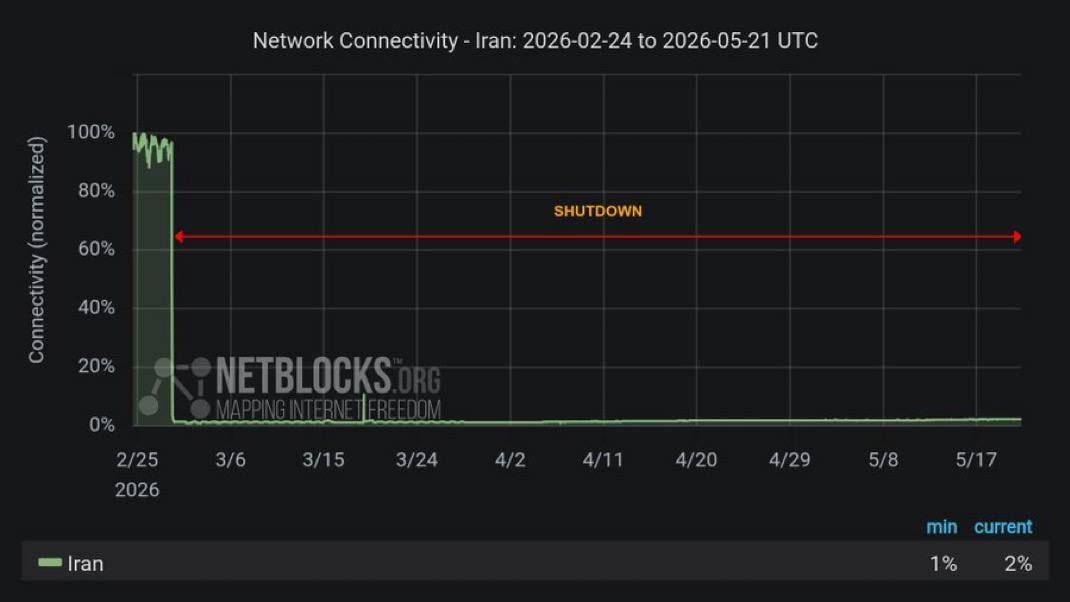
افت اتصال اینترنت ایران به حدود ۱٪ از ۸ ژانویه ۲۰۲۶ (منبع: NetBlocks) — منبع: شبکه‌های اجتماعی و منابع مردمی، دی ۱۴۰۴

اگر پنج لایه فیزیکی، بدنه ماشین جنایت دیماه را تشکیل می‌دادند، خاموشی اینترنتی ۸ ژانویه قلب آن بود. تحلیل فنی مستند Filterwatch همراه با داده‌های NetBlocks، Cloudflare Radar، IODA و گزارش‌های دانشگاهی منتشرشده در arxiv نشان می‌دهد که آنچه در ۸ ژانویه رخ داد، نه «اختلال شبکه» بود و نه «حفاظت در برابر حملات سایبری» (روایت رسمی رژیم)؛ یک پروژه مهندسی‌شده در سطح حداکثری بود. در حدود ساعت ۱۲ به وقت جهانی، حدود ۹۸.۵ درصد از فضای آدرس IPv6 ایران در BGP اعلام نشد، ترافیک IPv6 از حدود ۱۲ درصد به ۱.۸ درصد سقوط کرد، شرکت زیرساخت ارتباطات (TIC) ارتباط خود را با چندین provider transit از جمله Rostelecom روسیه و Gulf Bridge International قطع کرد و در فاصله کمتر از دو ساعت، ترافیک ورودی و خروجی به یک نقطه نزدیک به صفر رسید[۱۰۱]. این اعداد یک تشخیص فنی قطعی به دست می‌دهند: خاموشی، نه نتیجه جنگ سایبری بود و نه تصادف؛ نتیجه دستور سیاسی-امنیتی مستقیم بود که توسط شبکه‌ای از مقامات شناسایی‌شده از جمله علی آرام در دبیرخانه شورای عالی امنیت ملی طراحی و اجرا شد. تا ۱۸ می، خاموشی به ۸۰ روز متوالی (بیش از ۱۹۲۰ ساعت) رسید و طبق آمار، تبدیل به طولانی‌ترین قطع سراسری اینترنت در تاریخ هر کشور شد[۱۰۲].

اما اهمیت تحلیلی خاموشی، فقط در ابعاد فنی آن نیست. در مهندسی جنایت دی‌ماه، خاموشی سه کارکرد همزمان داشت: اول، شکستن قابلیت هماهنگی معترضان (کارکرد عملیاتی)؛ دوم، حذف امکان مستندسازی همزمان (کارکرد پنهان‌سازی)؛ و سوم، انحصار روایت در دست رسانه دولتی (کارکرد روایی). به همین دلیل عفو بین‌الملل، دیده‌بان حقوق بشر و کارشناس ویژه سازمان ملل مای ساتو هر سه به‌صراحت گفته‌اند که خاموشی ابزار «پنهان‌سازی جنایت» بوده است[۱۰۳]. آنچه این تشخیص را از یک ادعای سیاسی به یک گزاره اثبات‌پذیر تبدیل می‌کند، شکاف عددی است که خاموشی تولید کرد: شورای عالی امنیت ملی رژیم از عدد پرتکرار در رژیم یعنی ۳۱۱۷ کشته سخن گفت، مای ساتو گزارشگر ویژه بخش ایران تا ۱۶ ژانویه از حداقل ۵۰۰۰ کشته (با احتمال ۲۰ هزار طبق منابع پزشکی) خبر داد، تا اواخر ژانویه گاردین، تایم و ایران اینترنشنال به نقل از مقامات بهداشت محلی از ۳۰ تا ۳۶.۵ هزار کشته نوشتند و تا ۵ فوریه هرانا ۷۰۱۵ مرگ تأیید کرد و ۱۱۷۴۴ مورد در حال بررسی داشت[۱۰۴]. این شکاف که بین رقم رسمی و رقم تخمینی به نسبت ۱ به ۱۰ می‌رسد خود یکی از پیامدهای مستقیم خاموشی و دلایل دیگر است: در غیاب جریان آزاد اطلاعات، رژیم می‌تواند رقم رسمی را در سطحی نگه دارد که با رقم واقعی فاصله ساختاری داشته باشد و این فاصله را به ابزار سیاست تبدیل کند. در منطق سرکوب اقتدارگرا، ابهام عددی، خود سلاح است.

علاوه بر این، Filterwatch در ۱۵ ژانویه گزارش کرد که مستندات داخلی نشان می‌دهد رژیم در حال پیاده‌سازی برنامه «انزوای دیجیتال مطلق» است: تبدیل اینترنت ایران به «اینترنت پادگانی» که در آن دسترسی به جهان خارج فقط برای افراد و سازمان‌های دارای مجوز امنیتی، از طریق «لیست سفید» سختگیرانه ممکن است[۱۰۵]. این سیستم، در ساده‌ترین صورت، اینترنت را از یک حق عمومی به یک امتیاز انحصاری تبدیل می‌کند. مدلی که در ادبیات اقتدارگرایی دیجیتال «اینترنت لایه‌بندی شده» (tiered internet) خوانده می‌شود و تا کنون فقط در کره شمالی به‌ صورت کامل اجرا شده است. به این ترتیب، خاموشی دی‌ماه را نباید به ‌عنوان یک واکنش امنیتی مقطعی فهمید؛ باید آن را به‌ عنوان یک گذار راهبردی به الگوی جدیدی از کنترل اقتدارگرا فهمید: کنترلی که در آن، حق ارتباط، حق دیده‌شدن و حق ثبت حقیقت، همگی به دارایی‌های امنیتی رژیم تبدیل می‌شوند.

۴. حذف شواهد و ساز و کار حقیقت‌زدایی

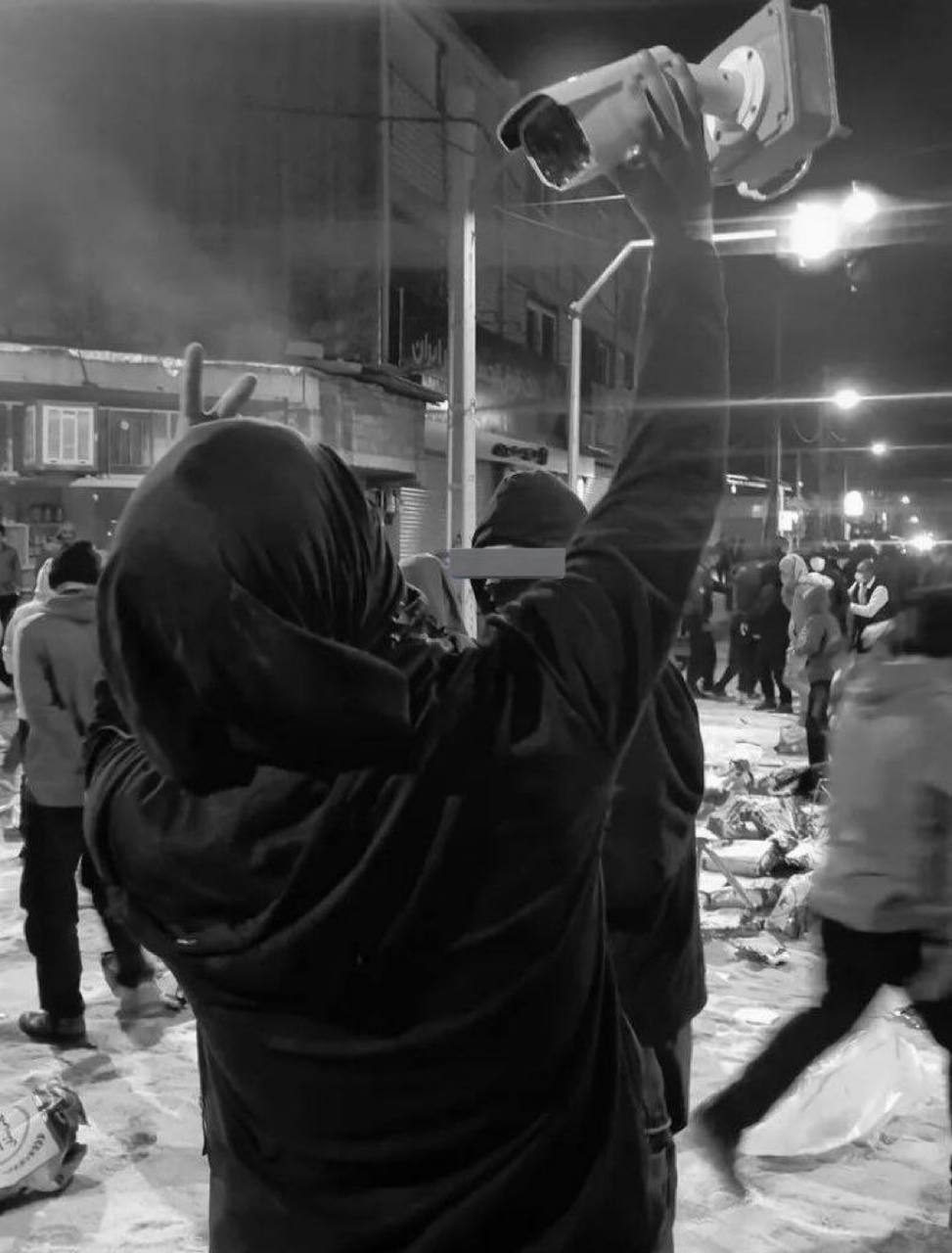
مقابله‌ی معترضان با دوربین‌های نظارتی در خیابان — منبع: شبکه‌های اجتماعی و منابع مردمی، دی ۱۴۰۴

تحلیل دقیق نشان می‌دهد که در دی‌ماه، تخریب شواهد و حقیقت‌زدایی نه پیامد فرعی سرکوب، بلکه یک محور مستقل از پروژه بقای رژیم بود. منطق این محور را می‌توان در یک گزاره فشرده کرد: نظام‌های اقتدارگرای در مرحله بحران، می‌دانند که تا حافظه ملی تثبیت نشده، فضای حقوقی برای تغییر شواهد باز است؛ بنابراین حمله به شواهد را در همان لحظه ارتکاب جنایت آغاز می‌کنند، نه پس از آن. در ایران دی‌ماه، این حمله در پنج جبهه همزمان جریان داشت.

جبهه اول، اجساد به ‌عنوان شواهد فیزیکی. عفو بین‌الملل در ۲۲ ژانویه گزارش کرد که در سردخانه موقتی که در ساختمان جانبی سازمان پزشکی قانونی در کهریزک راه‌اندازی شد، در فاصله ۱۰ تا ۱۱ ژانویه دست‌کم ۲۰۵ کیسه پیکر قابل تشخیص توسط تحلیل ویدیویی بود. اعمال فاصله جغرافیایی میان محل کشته‌شدن و محل تدفین، تأخیر در تحویل پیکرها، گزارش‌هایی درباره دفن دسته‌جمعی، گرفتن مبالغ هنگفت برای آزادسازی پیکر و امتناع از تحویل تا زمانی که خانواده روایت رسمی را تأیید کند، همگی اجزای یک نظام واحد برای جداکردن بدن قربانی از زمینه واقعی مرگش بودند[۱۰۶]. در ادبیات تطبیقی، این الگو در آرژانتین دوران ویدلا (دفن مخفی در گورهای بی‌نام)، شیلی پینوشه (پرتاب‌های دریایی) و سری‌لانکا ۲۰۰۹ (مدیریت دسترسی به اجساد در پایان جنگ) دیده شده است؛ کارکرد مشترک، ساخت ابهام دائمی درباره سرنوشت قربانیان است.

جبهه دوم، اعتراف اجباری و روایت‌سازی معکوس. هرانا تا ۲۷ ژانویه ۲۶۱ مورد اعتراف اجباری پخش‌شده را ثبت کرد. اما کارکرد راهبردی این اعترافات فقط محکومیت قضایی نیست؛ تولید روایت معکوس است. در پرونده دختربچه دو ساله نیشابوری (بهار سیفی)، رژیم چند ویدیو با حضور پدر داغ‌دیده پخش کرد که در آن قتل به «تروریست‌ها» نسبت داده می‌شد، روایتی که در صورت پذیرش جامعه، نه تنها مسوولیت رژیم را پاک می‌کرد، بلکه قربانی را به ابزار توجیه سرکوب تبدیل می‌کرد[۱۰۷]. این الگو در سراسر دی‌ماه تکرار شد: تولید ویدیوهایی که در آن خانواده‌های داغ‌دیده، تحت اجبار، روایت رسمی را تکرار می‌کردند، اعترافاتی که شرایط ضبط آن «نامشخص» باقی می‌ماند و دستکاری تصاویر و ویدیوهای راهپیمایی‌های دولتی برای نمایش حضور حداکثری. در سطح عملیاتی، رژیم نیروهایی را با لباس و ابزار خاص از جمله ماسک‌های مواد شیمیایی در ۱۷ ژانویه به صحنه فرستاد که الگوی پوشش حقیقی را با ابهام درآمیخت. در سطح روایی، خبرگزاری‌های رژیم با تأکید بر «۲۱۴ نیروی حکومتی کشته‌شده» (طبق ثبت هرانا) تلاش کردند تصویر «دو طرف درگیری» را بسازند. تصویری که در غیاب جریان آزاد اطلاعات، می‌تواند به یک روایت رقیب در میان مخاطبان غیرمتخصص و ناآگاه از مسائل ایران تبدیل شود.

جبهه سوم، حمله به ساختار تولید حقیقت مدنی. بازداشت پزشکانی که به مجروحان رسیدگی کرده بودند، بازداشت روزنامه‌نگاران، بازداشت وکلا (شبکه «یک کلمه» وکلا که در ۱۰ ژانویه نسبت به دادگاه‌های نمایشی هشدار داد، خود به‌ سرعت هدف فشار قرار گرفت)، بازداشت فعالان حقوق بشر و بازرسی موبایل‌های شهروندان در ایست‌های بازرسی برای یافتن تصاویر اعتراضی، همگی نشان می‌دهد که رژیم نه فقط سرکوبگران فیزیکی، بلکه ثبت‌کنندگان مدنی را نیز هدف گرفت[۱۰۸]. در سطح زیرساختی، حمله به فضای ابری ایرانیان و درخواست از کسب‌وکارها و خانه‌ها برای تحویل تصاویر دوربین‌های مدار بسته (طبق گزارش ایران اینترنشنال در ۱۷ ژانویه)، تلاش هماهنگ برای حذف لایه ثبت محلی واقعه را کامل کرد. وقتی بدنه پزشکی به دلیل ترس از بازداشت، از ثبت زخم گلوله امتناع می‌کند، وقتی روزنامه‌نگار از ثبت کشته می‌ترسد، وقتی وکیل از پذیرش پرونده می‌هراسد و وقتی شهروند از حضور با موبایل در صحنه ترسیده، نتیجه نه «نبود حقیقت»، بلکه «نبود معمار حقیقت» است. تفاوت این دو برای فهم بحران حیاتی است: حقیقت رخ داده، اما زیرساخت تولید روایت مستند آن، تخریب شده است.

جبهه چهارم، تخریب پلتفرم رسانه‌ای جایگزین. خاموشی سراسری، حمله شدید به ترمینال‌های Starlink (بنا به گزارش Filterwatch در ۱۳ ژانویه ـ به‌خصوص در تهران)، فشار به اپراتورهای مخابراتی برای اجرای دستور قطع (از جمله ماجرای برکناری مدیرعامل MTN-ایرانسل به‌ دلیل تأخیر در اجرای فرمان) و حمله سایبری به IRIB در ۱۷ ژانویه (که خود رژیم آن را به نیروهای خارجی نسبت داد، اما الگوی پاسخ آن مشخص می‌سازد که رژیم قصد بازسازی انحصار رسانه‌ای را داشت)، نشان می‌دهد که رژیم نه‌تنها روایت‌های جایگزین، بلکه ابزارهای بنیادی روایت‌گری را هدف قرار داد[۱۰۹]. حتی پس از بازگشت تدریجی اینترنت از ۱۷ ژانویه، NetBlocks و Filterwatch هشدار دادند که بازگشت ناقص و انتخابی است و رژیم در حال «تولید ترافیک ساختگی» برای القای روایت بازگشت گسترده‌تر است. این الگو، مدلی است که در ادبیات اقتدارگرایی دیجیتال «خاموشی استراتژیک با بازگشت کنترل‌شده» نامیده می‌شود.

جبهه پنجم، حمله به حافظه تاریخی پسارخداد. نکته‌ای که در ادبیات اپوزیسیون ایران کمتر صورت‌بندی شده، اما در مطالعات تطبیقی محوری است، این است که سرکوب موفق، نه با پایان خشونت، بلکه با تثبیت روایت رسمی به سرانجام می‌رسد. کشتار حما (سوریه ۱۹۸۲) که در آن رژیم حافظ اسد در فوریه ۱۹۸۲ بین ۱۰ تا ۴۰ هزار نفر را کشت، تا دو دهه پس از وقوع، در روایت رسمی حتی به‌ عنوان «حادثه» نیز پذیرفته نشد. روبرت فیسک، تنها روزنامه‌نگار بین‌المللی که از حما گزارش زنده تهیه کرد، عبارتی به‌ کار برد که در متن مقاله نیز به آن اشاره شده است: جامعه می‌داند جنایتی رخ داده، اما هنوز نمی‌داند چگونه آن را توضیح دهد. این فاصله میان «دانستن» و «توان توضیح» همان فضایی است که رژیم اقتدارگرا برای ساخت روایت رقیب از آن بهره می‌برد. در ایران دی‌ماه، تأخیر طولانی در آزادشدن جریان اطلاعاتی، فشار بر خانواده‌ها برای پذیرش روایت رسمی، اعتراف‌های اجباری، تولید ویدیوهای تحریف‌شده و انکار رسمی ابعاد جنایت توسط شورای عالی امنیت ملی، همگی اجزای یک حمله ساختاری به فرایند تثبیت حافظه تاریخی هستند. تنها سندی که در برابر این حمله ساختاری مقاومت می‌کند، آرشیو مستندسازی است: گزارش ۱۳۵۰ صفحه‌ای «زمستان سرخ» هرانا که از ۱۴۳۳۳۰ گزارش پایه استخراج شده، گزارش‌های هفتگی عفو بین‌الملل، یافته‌های مستند مأموریت حقیقت‌یاب سازمان ملل و آرشیوهای فنی Filterwatch، همگی نقش پادسلاح حافظه را ایفا می‌کنند. به همین دلیل، در ادبیات حقوق بین‌الملل کیفری، اولویت اصلی پس از وقوع جنایت گسترده، نه دادرسی فوری بلکه حفظ شواهد است.

جنگ بر سر روایت

پس از شلیک و قطع اینترنت، نبرد بر سر تعریف آنچه رخ داده بود شروع شد. خامنه‌ای معترضان را عامل آمریکا و خارج‌نشین‌ها خواند؛ متن‌های رسمی بعدی بیت او از «فتنه آمریکایی-صهیونی»، «شورش ترکیبی» و «توهم اکثریت مجازی» حرف زدند؛ تحلیلگران نزدیک به حکومت در فارس و تسنیم نیز وقایع را پروژه‌ای خارجی علیه «هسته سخت نظام» خواندند. واقعیت این است که رژیم دی‌ماه را از نظر روایی به مساله امنیت ملی و جنگ خارجی ترجمه کرد؛ و چنین ترجمه‌ای البته ابزار حقوقی و روانی لازم برای سرکوب حداکثری را فراهم می‌کرد [۵۰].

در سوی دیگر، بخشی از اپوزیسیون و رسانه‌های مخالف نیز به‌ جای آنکه بر حقانیت خودِ خیابان تمرکز کنند، درگیر نزاع بر سر این شدند که «چه کسی صاحب این لحظه است.» گزارش رویترز درباره شکاف اپوزیسیون خارج از کشور نشان می‌دهد این جدال بعضا از نقد سیاسی فراتر رفت و به تضعیف نفس لحظه اعتراضی انجامید. دیدگاه انتقادی می‌توانست در یک همکاری سازمانی بگوید که رهبری، سازمان و برنامه چگونه می‌تواند پیروزمند باشد؛ اما رویدادهای پس از دی‌ماه موید این بود که بسیاری در اپوزیسیون، تصمیم گرفتند اصل رخداد را کوچک یا آلوده نشان دهند. حکومت از این شکاف سود برد، چون هر قدر روایت خیابان در بیرون مخدوش‌تر باشد، سرکوب در درون آسان‌تر می‌شود [۵۱].

جنگ روایت رژیم و نفوذ آن در اپوزیسیون

۱. دستگاه چهارلایه‌ی جنگ روایت

جنگ روایت در ادبیات تحلیلی اپوزیسیون ایران اغلب به‌ عنوان «تبلیغات» فهمیده می‌شود. یعنی به‌ عنوان رفتار رسانه‌ای ابزاری که هدفش تحریف اخبار است. این تقلیل، خطایی بنیادین است که فهم ما از کاری که رژیم ایران در دی‌ماه ۱۴۰۴ انجام داد را ضعیف می‌کند. آنچه میان ۸ ژانویه و پایان فوریه ۲۰۲۶ رخ داد، نه تبلیغات معمول، بلکه به‌ کارگیری یک سامانه چهارلایه‌ی راهبردی بود که از سال‌ها پیش با مفاهیم «جنگ شناختی»، «جنگ ترکیبی» و «عملیات روانی» در دانشگاه مالک اشتر، دانشگاه علوم انتظامی امین و دانشگاه جامع امام حسین تئوریزه شده بود. درک این چهار لایه، شرط لازم برای فهم چراییِ موفقیت نسبی رژیم در «حفظ موجودیت» است، حتی در شرایطی که از نظر تجربی، رویداد دی‌ماه به ‌قدری گسترده بود که در مقیاس روایی نمی‌توانست انکار شود.

لایه نخست، تقلیل سیاسی به امنیتی. نخستین حرکت روایی رژیم در ۱۳ دی، تمایز ساختگی میان «معترض» و «اغتشاشگر» بود. تمایزی که خامنه‌ای صریحا اعلام کرد و بنیان حقوقی-روانی سرکوب حداکثری را گذاشت[۱۱۰]. این تمایز ظاهرا ساده، اما کارکرد راهبردی‌اش بسیار عمیق است. به‌محض پذیرفتن تمایز، پرسش از دادگاه به این تغییر می‌کند که «آیا فلان معترض، اغتشاشگر بوده یا نه». پرسش از مشروعیت اعتراض، حق تجمع و حق پرسش، در پس‌زمینه حذف می‌شود. به‌ بیان دیگر، این تمایز، دستگاه قضایی رژیم را از مرحله «دفاع از بخشنامه سرکوب» به مرحله «اثبات تک‌تک محکومیت‌ها» منتقل می‌کند. مرحله‌ای که در آن، رژیم با اعتراف اجباری، شکنجه و دادگاه نمایشی، توان ساخت روایت تک‌نفره دارد. اما کار اصلی روایت، تقلیل سیاسی به امنیتی، حذف اپوزیسیون داخلی نیست؛ تخریب همدلی است. با تبدیل معترض به مظنون امنیتی، رژیم «حق همدردی» را از معترض می‌گیرد و این کارکرد فرهنگی نه قضایی، هدف اصلی است.

لایه دوم، توطئه‌ی خارجی در قامت قاب کلان. در ۱۹ دی، خامنه‌ای اعتراض را «فتنه آمریکایی» خواند و بخشی از معترضان را به ارتباط با نهادهای اطلاعاتی خارجی متهم کرد. مسعود پزشکیان آن را «تروریست‌های آموزش‌دیده» نامید که از آمریکا و اسراییل دستور می‌گیرند، و در یک مصاحبه تلویزیونی بی‌سابقه از «سر بریدن» توسط معترضان سخن گفت[۱۱۱]. سپس در ۲۹ بهمن ۱۴۰۴، رییس اطلاعات سپاه در سایت خامنه‌ای از «شبه‌کودتا» سخن گفت. تعبیری که با تعریف ارائه‌ شده توسط خود او («دخالت قهرآمیز خارجی با هدف براندازی با استفاده از نیروهای نیابتی») اعتراضات را در سطح حقوقی-بین‌المللی به یک حمله نظامی تشبیه کرد[۱۱۲]. این لایه، ارتباط همزمانی فراخوان‌ های رضا پهلوی و پست‌های ترامپ را به ابزار اثبات روایت تبدیل کرد. به این معنا که رژیم، همزمانی سیاسی را به «هماهنگی عملیاتی» ارتقا داد، حتی در غیاب هر سندی برای چنین هماهنگی. کارکرد راهبردی این قاب کلان، تولید موجه‌سازی برای چهار اقدام همزمان است: قطع اینترنت (به نام «دفاع سایبری»)، اعدام فوری («مقابله با عوامل دشمن»)، بازداشت دسته‌جمعی («پاکسازی شبکه‌های نیابتی»)، و کشتار خیابانی («دفاع از امنیت ملی»). در ادبیات حقوق بین‌الملل، این الگو، نزدیک‌ترین چیز به آن چیزی است که Mark Galeotti «جنگ سیاه» (black war) می‌خواند: اقدامات داخلی که با لباس دفاع امنیتی پوشیده می‌شوند تا از سپر حقوقی «امنیت ملی» استفاده کنند.

لایه سوم، توزیع روان‌شناختی گناه و معادل‌سازی اخلاقی. این لایه ظریف‌تر اما خطرناک‌تر است. خبرگزاری‌های رژیم، با تأکید مکرر بر «۲۱۴ نیروی حکومتی کشته‌شده» (طبق ثبت هرانا)، تلاش کردند تصویر «دو طرف درگیری» را بسازند[۱۱۳]. اعداد پخش‌ شده توسط دبیر شورای عالی امنیت ملی که در آن از «۶۹۰ نفر تروریست و اغتشاشگر» سخن رفت همان منطق تقلیل را دنبال می‌کرد، اما با لایه‌ای جدید: نه فقط «اغتشاشگر»، بلکه «حمله‌کننده به اماکن نظامی». روایت ساخته‌شده درباره «تیم‌های تروریستی وابسته به اسراییل» در دی‌ماه، که تحلیلگران اپوزیسیون مانند م. رستگار به‌ درستی به آن اشاره کرده‌اند، یک هدف داشت: توجیه کشتار چند هزار نفر در رسانه داخلی[۱۱۴]. کارکرد روان‌شناختی این لایه، ساخت شک در ذهن مخاطب بی‌طرف است. هدف نه قانع کردن، بلکه ابهام‌سازی است. اگر مخاطب بپرسد «آیا واقعا اسراییل دست داشت؟»، روایت رژیم به نیمی از هدف خود رسیده است. زیرا اکنون به‌ جای پاسخ به جنایت، باید درباره مسوولیت ‌پذیری دفاع کرد. در ادبیات روان‌شناسی سیاسی این الگو با عنوان manufactured ambiguity شناخته می‌شود ـ تولید تعمدی ابهام برای فلج‌کردن قضاوت اخلاقی.

لایه چهارم، توهم اکثریت مجازی و دستکاری حضور عمومی. پس از ۱۹ دی، رژیم تجمعات حکومتی موازی را در سراسر کشور برگزار کرد، تشییع علنی نیروهای امنیتی کشته‌شده را به ابزار رسانه‌ای تبدیل کرد، و تصاویر این تجمعات را چنان دستکاری کرد که نشان‌ دهنده «اکثریت واقعی ملت» باشند[۱۱۵]. بنیاد شهید با تمام خانواده‌های جان‌باختگان تماس گرفت و درخواست کرد عزیزانشان به ‌عنوان «شهید» بنیاد ثبت شوند. مدیرکل تولیدات رسانه‌ای دفتر رییس‌جمهوری در ۳ بهمن اعلام کرد ۲۴۲۷ خانواده پذیرفته‌اند. اما نکته راهبردی اینجاست: این پذیرش زیر فشار، نه برای بزرگ‌داشت قربانیان، بلکه برای «بازنویسی هویت قربانی» انجام شد. فردی که در خیابان به‌ دلیل اعتراض کشته شده، ناگهان به «شهید بسیج» تبدیل می‌شود یعنی نه فقط کشته شده، بلکه «در سمت و برای رژیم کشته شده». این عملیات بازنویسی در سطح روایی همان کاری را انجام می‌دهد که در سطح فیزیکی پاک‌کردن پرونده‌های پزشکی از سیستم بیمارستان (که در گزارش‌های ۱۸ دی مستند شده) انجام می‌دهد: حذف فرد از روایت اصلی. خامنه‌ای در سخنرانی ۲۷ دی، در حالی که چند هزار نفر را در «سرکوب اعتراضات» تأیید کرد، از همین چارچوب «توهم اکثریت مجازی» استفاده کرد و گفت اکثریت واقعی ایرانیان طرف رژیم‌اند و معترضان «اقلیتی فریب‌خورده» هستند[۱۱۶]. این لایه، نقطه پایان منطق روایی رژیم است: تولید واقعیت موازی که در آن، نه‌تنها سرکوب موجه است، بلکه اساسا معترض «وجود ندارد» مگر در حد یک اقلیت ناچیز خارجی-آلوده.

۲. نفوذ روایت رژیم در اپوزیسیون

بحث نفوذ روایت رژیم در گفتمان بخش‌هایی از اپوزیسیون به ‌دلیل ماهیت حساس آن، در ادبیات تحلیلی اپوزیسیون عمدتا یا با شمشیر برهنه (اتهام مستقیم) صورت می‌گیرد یا با سکوت کامل. هر دو رویکرد، تحلیلی نیستند. نقد ساختاری، اتهام نیت‌خوانی نیست، بلکه نشان دادن الگوهای بازتولید است. سه الگو در دی‌ماه ۱۴۰۴ به‌ وضوح قابل ردیابی بودند.

الگوی اول، بازتولید قاب «جنگ» در ادبیات صلح‌گرایانه. بخشی از طیف‌ چپ و جمهوری‌خواه، در میانه جنگ ۱۲ و سپس جنگ ۳۹ روزه، روایتی ساختند که در آن «مخالفت با جنگ»، «مخالفت با مداخله خارجی» و «دفاع از تمامیت ارضی» محورهای اصلی بود. این محورها، فی‌نفسه قابل دفاع‌اند. اما در زمان‌بندی و وزن نسبی، یک پیامد ساختاری داشتند: مخاطب مردد ایرانی، شنید که جنگ علیه رژیم، در سطح اخلاقی، به اندازه‌ی سرکوب رژیم شنیع است. این همان «معادل‌سازی اخلاقی» است که در لایه سوم جنگ روایت رژیم نشان دادم. اعتراف صادقانه این است که بخشی در طیف چپ شاید نیت بازتولید روایت رژیم را نداشت اما بخش بزرگی در صف روایت رژیم قرار گرفت. نتیجه ساختاری این شد که فاصله گرفتن مخاطب از تشخیص اینکه مسوول اصلی فاجعه در ایران، رژیم مستقر در ایران است، نه قدرت خارجی، همان‌چیزی شد که رژیم برای بقای خود نیاز داشت. بیانیه ۵ اسفند ۱۴۰۴ حزب چپ ایران که کلیت آن از منظر گفتمانی نقد قدرت‌گرایی پادشاهی‌خواهان را در اولویت می‌گذارد، در همان روزهایی منتشر شد که آذر منصوری و سایر اصلاح‌طلبان منتقد در زندان بودند و گزارش‌های روزانه از کشتار دی‌ماه به دست می‌رسید. تشخیص اولویت‌های راهبردی، در این لحظه، خود یک کنش سیاسی سنجیده می‌توانست باشد.

الگوی دوم، تبدیل نگرانی از تجزیه به سپر سیاسی رژیم. مساله تمامیت ارضی ایران، یک نگرانی واقعی و قابل دفاع است؛ این بحث جدا از آن چیزی است که در گفتمان سیاسی دی رخ داد. واکنش رضا پهلوی به اعلام موجودیت ائتلاف احزاب کُرد در ۲۲ فوریه ۲۰۲۶ این بود که شوربختانه در تلاش برای نقد ائتلاف کُردی، آنها را به ارتش رژیم برای سرکوب حواله داد[۱۱۷]. اینکه مرام سیاسی یک گروه سیاسی، نفی یکپارچگی قلمرو سرزمینی باشد از جهات گوناگون حقوقی، سیاسی و اخلاقی قابل نقد و حتی سرزنش است. به نظرم حتی نباید واژگان تجزیه طلبی را برای نرمال شدن یا پذیرش اجتماعی با کلمات نرم جایگزین کرد، تعارض سیاسی و اخلاقی اما این است که مخالف جمهوری اسلامی را به ارتش جنایتکار رژیم بسپریم و از او بخواهیم که هم برابر جمهوری اسلامی و هم تجزیه طلبان بایستد. مسلما ارتش جنایتکار رژیم در برابر رژیم تاکنون نایستاده و همواره شریک جنایت‌های آن بوده است اما قطعا یک تجزیه طلب را مجازات می‌کند. این یک سقوط اخلاقی است و باید به هر عنوان در سرزمینی که حق حیات، لغو شده است، جان و کرامت مخالف رژیم توتالیتر را محترم دانست.

الگوی سوم، اولویت‌بندی نقد رقبای اپوزیسیون بر نقد رژیم. این الگو، که در فاز ۱ این مجموعه نیز تحلیل شد، بدنه گسترده‌ای از فعالیت رسانه‌ای اپوزیسیون در دی‌ماه را شامل می‌شود. تجربه کیفی ساده، گویاست: حجم محتوای منتشر شده توسط بخش‌های چپ، جمهوری‌خواه، اصلاح‌طلب خارج از کشور و حتی بخش‌هایی از پادشاهی‌خواهان که هدف اصلی‌اش «نقد رقیب اپوزیسیون» بود، در فاصله ۸ ژانویه تا پایان فوریه ۲۰۲۶، با حجم محتوای متمرکز روی نقد رژیم قابل مقایسه بود. این یک خطای زمان‌بندی نیست؛ بلکه نشانه‌ای از چیستی غم‌انگیز در توازن محتوا به سود رژیم است. در شرایطی که رژیم در حال کشتار است و خاموشی ارتباطی برقرار است، تمرکز روایی روی نقد ساختاری رقیب اپوزیسیون، در سطح کارکردی به نفع کیست؟ پاسخ صادقانه، ناخوشایند است: به نفع رژیم. زیرا انرژی نقد را از تنها نیرویی که در حال کشتار است، منحرف می‌کند و دقیقا همان «شکاف اپوزیسیون» را تولید می‌کند که مطالعه رویترز در ۱۵ ژانویه به آن اشاره کرد و رژیم برای روایت‌سازی از آن بهره برد. این بازتولید ناخواسته، از تمام بازتولیدهای دیگر خطرناک‌تر است، چون مستقیما دست رژیم را در ابعاد کلان روایت تقویت می‌کند.

نکته نهایی این بخش، تحلیلی است. ادبیات تحلیلی مدرن نفوذ روایی، عمدتا در ادبیات «جنگ ترکیبی» (hybrid warfare) و «دستکاری اطلاعاتی» (information manipulation) توسط نظریه‌پردازان همچون Thomas Rid و Peter Pomerantsev صورت‌بندی شده است. نتیجه مرکزی این ادبیات، گزاره مشخصی است: نفوذ روایت بر اپوزیسیون، نیاز به همکاری مستقیم ندارد؛ کافی است اپوزیسیون در ساختار شناختی خود قاب‌های ارائه‌ شده توسط رژیم را بازتولید کند. شناسایی این الگوها، نه برای محکومیت اخلاقی نیروها، بلکه برای اصلاح راهبردی الگوهاست. اپوزیسیونی که از این آینه‌ گرفتن خود غفلت کند، جنگ روایت را قبل از آنکه شروع شود، باخته است.

انسداد ساختاری مقاومت مدنی

۱. مکانیسم جرم‌انگاری سیاست مسالمت‌آمیز

نکته راهبردی که در ادبیات اپوزیسیون ایران هنوز به ‌اندازه کافی صورت‌بندی نشده، این است: انسداد مقاومت مدنی در ایران، نتیجه فرسایش تدریجی نیست؛ نتیجه یک ساختار حقوقی-سیاسی برنامه‌ریزی‌شده است که از سال ۱۳۸۸ تاکنون به ‌صورت لایه به ‌لایه ساخته شده است. در مرکز این ساختار، یک گزاره ساده اما مرگبار قرار دارد: در منطق رژیم ایران، هیچ مرز روشنی میان «اعتراض مشروع» و «اقدام علیه امنیت ملی» وجود ندارد. این عدم تمایز، نه ضعف حقوقی، بلکه ویژگی برنامه‌ریزی‌شده است.

سه نشانه از این برنامه‌ریزی ساختاری در دی‌ماه ۱۴۰۴ مشاهده شد. نخست، اتهام «محاربه» که دفتر دادستان تهران در ۱۳ ژانویه برای معترضان مطرح کرد. اتهامی که مجازات اعدام دارد و بنا به تفسیر سنتی فقهی، حتی شامل کسی که «سلاح ندارد اما ترس عمومی ایجاد کند» نیز می‌شود[۱۱۸]. دوم، طرح مجلس در سال ۱۴۰۴ برای «تشدید مجازات جاسوسی» که ۵۷ حقوقدان نسبت به «فاجعه‌ای بزرگ در راه» نسبت به آن هشدار دادند[۱۱۹]. سوم، بازداشت آذر منصوری (رئیس جبهه اصلاحات)، محسن امین‌زاده، ابراهیم اصغرزاده، جواد امام و سایر چهره‌های اصلاح‌طلب با اتهام «هدف‌گیری انسجام ملی، موضع‌گیری علیه قانون اساسی، هماهنگی با تبلیغات دشمن و ایجاد سازوکارهای مخفی براندازانه» (طبق گزارش خبرگزاری فارس)[۱۲۰]. این سه نشانه، در کنار هم، یک پیام واحد می‌فرستند: حتی منتقد وفادار درون‌ساختار، در شرایط بحران، به همان «دشمن خارجی» تبدیل می‌شود. یعنی منطق حقوقی رژیم، فضای مسالمت‌آمیز را به‌ صورت ساختاری تنگ می‌کند تا جایی که عملا صفر می‌شود.

این پدیده، در ادبیات اقتدارگرایی تطبیقی، با نام «Securitization of dissent» (امنیتی‌سازی نارضایتی) شناخته می‌شود ـ مدلی که Barry Buzan و سایر نظریه‌پردازان مکتب کپنهاگ آن را به‌ عنوان «جابجایی موضوعات از حوزه سیاست عادی به حوزه امنیتی فوق‌العاده» تعریف کرده‌اند. کارکرد راهبردی این جابجایی، روشن است: در حوزه سیاست عادی، اعتراض حق است و حکومت موظف به پاسخ‌گویی است. در حوزه امنیتی، اعتراض تهدید است و حکومت اختیار سرکوب نامحدود دارد. رژیم ایران، با امنیتی‌سازی همه اشکال نارضایتی، از تجمع کارگری در زاهدان تا اعتراض اصناف نان در اردیبهشت ۱۴۰۴ تا فعالیت اصلاح‌طلب درون نظام، عملا «حوزه سیاست عادی» را در ایران از بین برده است. وقتی هیچ کنش جمعی مشروعی وجود ندارد، آنچه باقی می‌ماند یا تسلیم است یا مواجهه‌ای که در آن، رژیم بر سر مرز اخلاقی خود می‌تواند هر فعلی را بنشاند.

۲. بازچینی روان‌شناسی اعتراض از ۸۸ تا ۱۴۰۴

اگر مکانیسم جرم‌انگاری ساختار، حقوقی-سیاسی است، روان‌شناسی اعتراض، پیامد آن در سطح سوژه است. تحلیل تطبیقی موج‌های اعتراضی ایران در ۱۸ سال گذشته، یک الگوی روان‌شناختی روشن را نشان می‌دهد. در جنبش سبز، اعتراضات با شعار «رأی من کجاست» آغاز شد. یعنی در چارچوب گفتمان قانون اساسی موجود، با درخواست اجرای حق رسمی. سرکوب آن دوره، با وجود قساوت، در سطح روایی و کشتار کنترل شده، هنوز با ادبیات «منتقدان وفادار» نسبت به رهبران سیاسی پاسخ داده می‌شد. در اعتراضات دی ۱۳۹۶ و آبان ۱۳۹۸، شعار «اصلاح‌طلب اصول‌گرا، دیگه تمومه ماجرا» نشان داد که جامعه از چارچوب اصلاحی عبور کرده و پایه های محکمی در نفی رژیم اسلامی ساخته است. در ۱۴۰۱، شعار «زن، زندگی، آزادی» گفتمان لیبرال را با سطح نفی نظام ترکیب کرد، اما هنوز چارچوب سازمانی روشنی نداشت. در دی‌ماه ۱۴۰۴، شعار «جاوید شاه» در بسیاری شهرها، نشان از تمایز گذاری با انقلابیون ۵۷ و جستجوی هویت سیاسی جایگزین به نام ایران رسیده است[۱۲۱].

این چهار مرحله: مطالبه قانون، عبور از اصلاح، نفی نظام، جستجوی هویت، نه تصادفی، بلکه پیامد روانی منطقی همان مکانیسم جرم‌انگاری است. وقتی جامعه‌ای می‌بیند که هر کنش جمعی، با هر شدتی، با همان واژگان امنیتی پاسخ داده می‌شود (در ۸۸ هم متهم به «فتنه» شدند و در ۱۴۰۴ نیز همان «فتنه آمریکایی» را شنیدند)، عملا فهم می‌کند که در منطق رژیم، تمایز میان مطالبه و براندازی وجود ندارد. پاسخ روانی به این تشخیص، دو الگو دارد: یا انفعال (پذیرش مدنیت ناممکن) یا رادیکالیزه شدن (پذیرش این که اگر هر کنشی به یک شکل پاسخ می‌گیرد، چرا ابتدایی‌ترین کنش را انتخاب کنیم؟).

تحلیل دقیق نشان می‌دهد که در ۱۴۰۴، این دو الگو هم‌زمان وجود داشتند، اما الگوی دوم در نسل جوان غلبه داشت. نسل جوان دیگر در چارچوب «اعتراض گام‌به‌گام» فکر نمی‌کند. این تغییر روانی، از منظر تحلیل راهبردی، یک سرمایه و یک ریسک است. سرمایه است، چون آستانه ترس را پایین آورده. ریسک است، چون در غیاب معماری سیاسی هدایت‌گر، می‌تواند به انرژی‌ای تبدیل شود که در یک شب می‌جوشد و در شب بعد، به تخلیه نومیدانه می‌رسد. این همان «ناهمزمانی» است که در نتیجه‌گیری این مقاله به آن اشاره شد، اما حالا با لایه روان‌شناختی روشن‌تر: مردم آماده‌اند، چون ساختار سیاست‌ورزی مسالمت‌آمیز را بسته دیده‌اند؛ اما همان بسته‌بودن، مهارت سیاست‌ورزی هدایت‌گر را در آنها از بین برده است.

۳. تنگ‌شدن گزینه‌های راهبردی

نتیجه ساختاری انسداد، تنگ‌شدن گزینه‌های راهبردی برای اپوزیسیون است. پدیده‌ای در ادبیات گذار که «strategic narrowing» (تنگ‌شدن راهبردی) شناخته می‌شود. در یک دموکراسی نسبی یا حتی یک رژیم اقتدارگرای ملایم، اپوزیسیون پنج گزینه دارد: انتخابات، نافرمانی مدنی، اعتصاب گسترده، حضور خیابانی منظم، و دیپلماسی فشار. هر کدام، در صورت اعمال درست، می‌تواند به نتیجه برسد. در رژیم ایران ۱۴۰۴، این پنج گزینه به ترتیب تنگ شده‌اند. انتخابات با شورای نگهبان و نظارت استصوابی از ۱۳۹۲ تاکنون عملا معنای واقعی خود را از دست داده است (در ۱۴۰۳، رئیس‌جمهور با ۱۸ میلیون رأی از حدود ۵۸ میلیون واجد شرایط انتخاب شد ـ یعنی کمتر از ۳۰ درصد). نافرمانی مدنی با اتهام «اقدام علیه امنیت ملی» جرم‌انگاری شده. اعتصاب کارگری با ساختار‌های سرکوب کارگری متلاشی می‌شود (تجربه واحد مترو، هفت‌تپه، فولاد و…). حضور خیابانی، چنان که دی‌ماه نشان داد، با گلوله جنگی پاسخ گرفته می‌شود و دیپلماسی فشار، در دست اپوزیسیون داخل کشور وجود ندارد و فقط در دست اپوزیسیون خارج‌نشین است که خود با محدودیت‌های دسترسی رو به‌ رو است.

این تنگنا چیزی را در اپوزیسیون باقی می‌گذارد که در ادبیات راهبردی «گزینه‌های پسامدنی» (post-civil options) نامیده می‌شود. گزینه‌هایی که در آنها مرز میان مقاومت مدنی و اقدام نظامی محو می‌شود. بحث «دفاع مشروع»، بحث «خشونت سازمان‌یافته» که در همین مقاله به آن اشاره شده، بحث «همکاری راهبردی با اسراییل» که در طیف‌های ایران‌گرا مطرح شده و بحث «حمایت مسلحانه از معترضان» که در پست‌های ۱۲ دی ترامپ ضمنی بود، همگی نشان از این گذار به فضای پسامدنی دارند. اما این گذار، یک خطر بنیادین دارد: همان لحظه‌ای که اپوزیسیون از فضای مدنی به فضای پسامدنی منتقل می‌شود، رژیم در سطح روایی پیروز شده است. زیرا روایت چهاردهه‌ای رژیم درباره «مخالفان مسلح خارجی» در عمل تأیید می‌شود. این تله راهبردی، بزرگ‌ترین چالش پیش‌روی هر معماری گذار است: چگونه باید از انسداد مقاومت مدنی عبور کرد بدون آنکه به همان روایتی تن داد که رژیم چهار دهه برای موجه‌سازی سرکوب ساخته است؟

۴. درس تطبیقی: بلاروس، میانمار، و مصر پس از ۲۰۱۳

سه تجربه تطبیقی به فهم انسداد ایران کمک می‌کنند. تجربه نخست، بلاروس ۲۰۲۰: اعتراض گسترده با رهبری مدنی روشن (سوتلانا)، حضور میلیونی در خیابان، اعتصاب در کارخانه‌های دولتی و فشار بین‌المللی هماهنگ. اما رژیم لوکاشنکو با حمایت روسیه دوام آورد، چون کارگزاران دستگاه قهری یقین داشتند ادامه اطاعت، امن‌تر از جدایی است[۱۲۲]. درس بلاروس برای ایران: حتی رهبری مدنی روشن و حضور میلیونی، در شرایطی که هسته قهری رژیم منسجم بماند و حمایت قدرت ثالث وجود داشته باشد، کافی نیست.

تجربه دوم، میانمار پس از کودتای ۲۰۲۱: عبور سریع از مقاومت مدنی به مقاومت مسلحانه، تأسیس «دولت وحدت ملی» در تبعید و درگیری چندساله. نتیجه: نه پیروزی نظامی، نه گذار سیاسی، بلکه فضای بی‌ثبات طولانی[۱۲۳]. درس میانمار برای ایران: گذار از فضای مدنی به فضای مسلحانه، در غیاب حمایت سازمان‌یافته بین‌المللی و ائتلاف داخلی منسجم، می‌تواند به دام چندپارگی بیفتد.

تجربه سوم، مصر پس از ۲۰۱۳: کودتای السیسی نشان داد که حتی پس از یک گذار دموکراتیک نسبتا موفق، اگر معماری نهادی برای محافظت از فضای سیاسی ساخته نشده باشد، رژیم اقتدارگرای جدید می‌تواند با ادبیات «مبارزه با تروریسم» کل فضای مدنی را در یک ضربه ببندد و به نقطه قبل از انقلاب ۲۰۱۱ بازگردد[۱۲۴]. درس مصر برای ایران: عبور از رژیم به‌ تنهایی کافی نیست؛ باید از همان روز نخست، ساختار حقوقی-سیاسی محافظ از فضای مدنی نیز فعال شود.

این سه تجربه، در کنار هم، یک حکم راهبردی برای ایران به دست می‌دهند. انسداد مقاومت مدنی در ایران ۱۴۰۴ به ‌قدری ساختاری شده که عبور از آن بدون ترکیب چهار عامل ممکن نیست: نخست، بحران در هسته قهری رژیم (که شواهد داده‌های شاخص فرسایش رژیم نشان از آغاز آن دارد)؛ دوم، رهبری سیاسی منسجم خارج که ظرفیت گذار را قبل از فروپاشی ساخته باشد؛ سوم، حمایت بین‌المللی هماهنگ که منطق دیپلماسی بازدارنده داشته باشد، نه فقط بیانیه‌های نمادین؛ چهارم، آمادگی نهادی برای محافظت از فضای مدنی در روز پس از فروپاشی، تا تجربه مصر تکرار نشود. غیبت هر یک از این چهار عامل، یا انسداد را تثبیت می‌کند، یا گذار را به یکی از سه دام (بلاروسی، میانماری، مصری) می‌اندازد. پروژه راهبردی اپوزیسیون ایران، در این لحظه، نه «شکستن انسداد» (که خود به‌تنهایی محقق نمی‌شود)، بلکه «ساخت ظرفیت چهارگانه» است که بدون آن، حتی یک فروپاشی موفق هم به گذار باثبات منجر نمی‌شود[۱۲۵].

نتیجه نهایی این بخش با حکم پایه‌ای مقاله همراستاست. خشونت‌پرهیزی در ایران امروز، هم به دلیل خطای راهبردی اپوزیسیون در فهم رژیم و فقدان درک معماری ساختاری انسداد، بی‌اثر شده است. اما عبور به ابزارهای پسامدنی، اگر بدون چارچوب نهادی-سیاسی صورت گیرد، در دام روایت و مقابله خونین رژیم می‌افتد. تنها مسیر معنادار، ساخت پیشینی معماری گذار است که هم منطق فشار راهبردی بر رژیم را داشته باشد، هم ظرفیت محافظت از فضای مدنی پساانتقالی را تأمین کند [۱۲۶].

نتیجه پایانی: ناهمزمانی

۱. دو پرسش که همه چیز به آن‌ها بازمی‌گردد

تحلیل وضعیت ایران در این لحظه به دو پرسش بنیادی ختم می‌شود که پاسخ به هر یک، منطق کنش سیاسی را تعیین می‌کند:

نخست: جنگ چه نوع رژیمی باقی خواهد گذاشت؟ رژیمی که پس از ۳۹ روز جنگ به‌ شدت آسیب‌پذیر شده آیا در آستانه فروپاشی است یا ساختاری است که از بحران گذشته، دگردیسی یافته و شکل تازه‌ای از انحصار قدرت را بازتولید خواهد کرد؟

دوم: با در نظر گرفتن شرایط چندگانه، اپوزیسیون برای روز انفجار چه نوع نهادمندی سیاسی ساخته است؟ آیا پیش از آنکه خیابان به خروش دوباره بیاید، راه‌حل واقعی و مکانیسم تبدیل خشم به نتیجه طراحی کرده است؟

این چند پرسش مستقل نیستند. پاسخ‌ها به نظر در هم تنیده می‌آیند. اگر رژیم آسیب‌پذیر شده، پنجره‌ی زمانی کوتاه است و غیبت معماری سیاسی، فاجعه‌بار خواهد بود. اگر دگردیسی یافته، مساله پیچیده‌تر از یک خیزش خیابانی انقلابی است و نیاز به بازتعریف کل استراتژی دارد.

۲. جامعه‌شناسی خیابان

اقتصاد همواره یک شتاب‌دهنده موثر در اعتراضات ایران است، اما آنچه صریح و بارز بوده این است که ارزش‌های لیبرال، ایجنت پایدار برای تغییر اند. یک خطای تحلیلی رایج در مطالعه‌ی اعتراضات ایران، یکی‌گرفتن فشار اقتصادی با علت خیزش است. داده‌های تاریخی این معادله را تأیید نمی‌کنند. همان‌گونه که نتیجه‌گیری بر اساس تنها عامل اقتصادی احتمالا گمراه کننده خواهد بود. در ۱۳۸۸، ۱۳۹۶، ۱۳۹۸ و ۱۴۰۱ شدت بحران اقتصادی متفاوت بود، اما هیچ‌یک به‌ تنهایی محرک کافی نبود و هیچ‌یک به نتیجه‌ی پایدار ختم نشد. پس چه چیزی چاشنی می‌شود و چه چیزی می‌تواند تغییر را ماندگار کند؟

مکانیسم دقیق‌تر این است که فشار اقتصادی آستانه‌ی تحمل را پایین می‌آورد و گستره‌ی اجتماعیِ بالقوه‌ی اعتراض را وسیع‌تر می‌کند. اما چاشنی انفجار، تحقیر و خشم در یک تعریف گسترده است. لحظه‌ای که جامعه حس می‌کند حکومت نه فقط ناتوان، بلکه بی‌مشروعیت و در سطح عمیق و متنوعی سلطه‌گر است. این تمایز عملیاتی است، نه نظری؛ چون مسیر پاسخ را کاملا تغییر می‌دهد. اما چاشنی، کافی نیست. تاریخ اعتراضات ۱۸ سال گذشته ایران نشان می‌دهد جامعه‌ ایرانی صرفا با خشم و تحقیر به خیابان نمی‌آید، همچنان لنگرگاه ارزشی مشترک نیز ساخته است. غیر از این در اختلافات درونی، پراکنده و بی مسیر می‌شد. نقش ارزش‌های لیبرال در جامعه‌ی ایرانی نظیر آزادی فردی، حاکمیت قانون، کرامت انسانی، عناصر روشن سکولاریسم، از چاشنی فراتر رفته و در ذهنیت و حافظه‌ی تاریخی به ایجنت پایدار در تغییر تبدیل شده است.

ارزش‌های لیبرال به سه دلیل این نقش را ایفا می‌کنند: نخست، زبان مشترکی فراتر از قومیت، طبقه و منطقه ایجاد می‌کنند، چیزی که خشم اقتصادی به ‌تنهایی قادر به آن نیست. دوم، چارچوبی برای روز پس از تغییر فراهم می‌کنند؛ جامعه‌ای که می‌داند برای چه می‌جنگد، راحت‌تر می‌داند چه زمانی باید بایستد و چه زمانی ادامه دهد. سوم، مشروعیت بین‌المللی تولید می‌کنند که در فشار دیپلماتیک و سیاسی بر رژیم، اهرم واقعی است. خیابان ایران با زخم‌های انباشته حرکت می‌کند. با خبر اعدام‌ها، با تصویر کشته‌شدگان، با شکست روانی دستگاه سرکوب و پایداری اعتراض تثبیت می‌شود. اما احساس امکان‌پذیری و تحمل‌ناپذیری، چاشنی نهایی است، لحظه‌ای که ماشین ترس ترک برمی‌دارد. فاجعه‌ی کشتار دی‌ماه و ۳۹روز جنگ این ترک را عمیق‌تر کرده است. نتیجه‌ی تحلیلی روشن است: خیابان ممکن است زودتر از آنچه محاسبات سیاسی پیش‌بینی می‌کنند فعال شود. اما خیابانی که فقط با خشم اقتصادی و احساس امکان‌پذیری و تحمل ناپذیری می‌آید و لنگرگاه ارزشی مشترک نیز دارد، بدون معماری سیاسی که ارزش‌های لیبرال را در مرکز خود داشته باشد و بر اساس آن استراتژی عملیاتی جدید را تعریف کند، چند باره همان مسیر ۱۸ سال خون‌ریزی را طی خواهد کرد: شهامت، هزینه سنگین و بی‌دستاورد.

۳. ناهمزمانی

حضور خیابانی معترضان، دی ۱۴۰۴ — منبع: شبکه‌های اجتماعی و منابع مردمی، دی ۱۴۰۴

بزرگ‌ترین خطر در این لحظه نه قدرت باقیمانده‌ی رژیم است، نه ضعف جامعه. خطر اصلی یک شکاف زمانی است: خیابان زودتر از آمادگی نیروی سیاسی روشن می‌شود. جامعه برای شروع حرکت منتظر برنامه‌ی تفصیلی و به ویژه اکنون تغییر پارادایم در مبارزه نمی‌ماند. با زخم‌های انباشته و احساس امکان‌پذیری می‌آید. اما ادامه دادن نیاز به افق امنیت دارد. این افق را نیروی سیاسی باید ساخته باشد، نه خودانگیختگی جمعی. تاریخ اعتراضات ایران این الگو را تکرار کرده است. یا خیزش در غیاب رهبری سرکوب می‌شود، یا در آشوب درونی فرسوده می‌گردد. ۱۴۰۱ بهترین نمونه است. شجاعت بی‌نظیر بود، حفظ امتیاز و سرمایه برای تبدیل به دستاورد پایدار قابل تعریف نبود. چرا؟ چون انرژی عظیمی تولید شد که سازوکار تبدیل آن به نتیجه وجود نداشت. موضع بخشی از اپوزیسیون، چپ‌ها و جمهوری‌خواهانی که ترجیح می‌دهند خیابان بدون رهبری سیاسی شکل بگیرد، ارزیابی دقیقی می‌طلبد. این موضع زیر پوشش «احترام به خودانگیختگی مردمی» ارائه می‌شود. اما در عمل، یک موضع بی‌هزینه است که هزینه‌اش را مردم می‌پردازند. فرسنگ‌ها فاصله‌ از ظرفیت سازماندهی، توجیه نظری پیدا می‌کند. تاکید روی فعالیت روشنفکری و مدنی و کارآفرینی های مربوط به آن معنا پیدا می کند. وظیفه‌ی فوری نیروی سیاسی از این زاویه روشن است: باید پیش از انفجار، برای روز انفجار طراحی کرد. یعنی پاسخ به پرسش‌های عملیاتی از پیش آماده باشد: در ساعت اول چه می‌گویید؟ در روز اول چه اقدام مشخصی را عمومی می‌کنید؟ در لحظه‌ی اعمال خشونت از سوی حکومت، چه سازوکار دفاعی ارائه می‌دهید؟ زبان مشترک، نشانه‌های عملیاتی، نقشه‌ی مطالبات حداقلی، این‌ها باید پیش از آن لحظه ساخته شده باشند، نه در حین آن. جدای از آن در برابر انسداد مدنی، ظرفیت‌های مقابله با رژیم چه چیزی خواهد بود؟

۴. خشونت واکنشی

«ایده‌ی خشونت» در ادبیات اپوزیسیون ایران اغلب باینری است: یا کاملا رد می‌شود یا بدون چارچوب پذیرفته می‌شود. هر دو از نظر تحلیلی ناکافی‌اند. پرسش راهبردی دقیق این است: خشونت علیه رژیم قرار است صرفا درد تولید کند یا به ایجنت تغییر سیاسی پایدار تبدیل شود؟ این دو یک چیز نیستند. خشونت واکنشی حتی اگر به رژیم آسیب برساند یک مشکل ساختاری دارد: به رژیم امکان می‌دهد بحران مشروعیت را به بحران نظم ترجمه کند. رژیم از زبان امنیتی خودش خارج نمی‌شود، به آن بازمی‌گردد. «اغتشاش»، «خرابکار»، «عامل بیگانه»، همین واژگان، صحنه را دوباره به نفع ماشین سرکوب می‌چرخانند. در مقابل، رژیم‌های اقتدارگرا در برابر دو وضعیت آسیب‌پذیر می‌شوند: وقتی نخبگان درونی از آن‌ها جدا می‌شوند، یا وقتی با نیروی اجتماعی مشروع، هماهنگ و پایداری رو به ‌رو می‌شوند که سرکوب آن هزینه‌ای بالاتر از عقب‌نشینی دارد. خشونت پراکنده، هیچ‌کدام از این دو شرط را فراهم نمی‌کند.

بنابراین خط تمایز این‌جاست: خشونت به‌ عنوان واکنش، تخلیه‌ی خشم است. خشونت به‌ عنوان طراحی سیاسی، ابزاری است برای بر هم زدن توازن انحصار زور. این دومی نیاز به سازماندهی، انتخاب هدف و پیوند با نیروی سیاسی مشروع و درک پیچیدگی‌ها دارد.

۵. خشونت سازمان‌یافته

۳۹ روز جنگ یک واقعیت ژئوپلیتیک ایجاد کرده که قابل نادیده‌گرفتن نیست: اسراییل ظرفیت نظامی رژیم ایران را به‌ شکل قابل توجهی تضعیف کرده است. این تضعیف، توازن نیروی داخلی را هم تغییر می‌دهد، اگر نیروی سیاسی داخلی بتواند از این شکاف استفاده کند. آیا همکاری استراتژیک با اسراییل برای ساختن نیروی متوازن‌کننده در داخل، توجیه‌پذیر است؟

استدلال موافق این است: این همکاری نه از سر ایدئولوژی، بلکه از سر محاسبه‌ی دقیق قدرت توجیه‌پذیر می‌شود. هدف، ساختن نیرویی است که انحصار خشونت رژیم را به‌ صورت پایدار به چالش بکشد، نه حلقه‌های پراکنده‌ی ترور که هزینه‌ی لحظه‌ای تولید می‌کنند و به دستگاه سرکوب بهانه خشونت بی‌مرز می‌دهند. اما استدلال انتقادی جدی نیز بین مخالفان وجود دارد: آیا چنین همکاری‌ای در بلندمدت مشروعیت نیروی سیاسی داخلی را فرسوده نمی‌کند؟ آیا رژیم می‌تواند از آن برای روایت «وابستگی» استفاده کند؟ این پرسش‌ها پیش از آنکه با صداقت پاسخ گیرند باید بر اساس میزان ضرورت برانداختن رژیم محاسبه شود. تمایز عملیاتی نهایی در این‌جاست که هر ابزاری که توازن پایدار انحصار زور را بر هم بزند و به ایجنت تغییر سیاسی تبدیل شود، در چارچوب طراحی استراتژیک قابل بررسی است. هر آنچه فقط درد لحظه‌ای تولید کند و مشروعیت نیروی تغییر را تخریب کند، اشتباه است، صرف‌نظر از اینکه شریک آن چه کسی باشد.

۶. نتیجه: یک ضرورت، سه وضعیت

پاسخ به پرسش اول هنوز قطعی نیست: جنگ چه رژیمی باقی خواهد گذاشت؟ اگر رژیم آسیب‌پذیر مانده باشد، با فرماندهی تضعیف‌شده، مشروعیت فرسوده و ظرفیت نظامی کاهش‌یافته، پنجره‌ی زمانی کوتاه است. هر هفته‌ی از دست‌رفته در غیاب معماری سیاسی، هزینه‌ای است که جامعه می‌پردازد. اگر رژیم دگردیسی یافته باشد با نخبگان جدید، منطق بقای متفاوت اما ظرفیت سرکوب حفظ ‌شده، خیزش خیابانی به‌تنهایی کافی نیست. بدون شکاف درونی نخبگان، اعتراض به نتیجه‌ی پایدار تبدیل نخواهد شد. در هر دو وضعیت، یک ضرورت مشترک وجود دارد که قابل تعویق نیست: معماری سیاسی باید پیش از انفجار ساخته شده باشد. تفاوت دو وضعیت در درجه‌ی فوریت است، نه در ماهیت تکلیف. خیزش بدون مساله گشایی بحران، انرژی عظیم تولید می‌کند. انرژی بدون سازوکار، یا سرکوب می‌شود یا در آشوب فرسوده می‌گردد. این درس تاریخ خون‌ریزی ایرانی برای تغییر در ۴۷ سال گذشته است. این بار اگر تکرار شود، دیگر نمی‌توان آن را به حساب غافلگیری گذاشت.

جدول‌های مرجع

جدول ۱ ـ گاه‌شمار راهبردی

تاریخ میلادی تاریخ خورشیدی رخداد اهمیت راهبردی منبع/وضعیت سند
12 Apr 2025 ۲۳ فروردین ۱۴۰۴ آغاز مذاکرات غیرمستقیم ایران و آمریکا در عمان شروع پنجره‌ای که بعدا به منطق «۶۰ روز» و سپس جنگ وصل شد رویترز [۴۸]
20 May 2025 ۳۰ اردیبهشت ۱۴۰۴ خامنه‌ای توقف غنی‌سازی را «زیاده‌خواهانه» خواند سخت‌شدن خطوط قرمز تهران و کاهش شانس سازش رویترز [۴۹]
23 May 2025 ۲ خرداد ۱۴۰۴ پایان دور پنجم با «پیشرفت محدود» دیپلماسی ادامه داشت، اما با بن‌بست‌های سخت رویترز [۵۰]
12 Jun 2025 ۲۲ خرداد ۱۴۰۴ اعلام دور ششم برای ۱۵ ژوئن در عمان جنگ درست در آستانه دور بعدی گفت‌وگو شکل گرفت رویترز، AP [۵۱]
13 Jun 2025 ۲۳ خرداد ۱۴۰۴ آغاز جنگ ۱۲ روزه فعال‌شدن سناریوی حمله خارجی و ضربه به فرماندهی رویترز، AP، IAEA [۵۲]
22 Jun 2025 ۱ تیر ۱۴۰۴ حمله آمریکا به فردو، نطنز و اصفهان ورود مستقیم آمریکا و گسترش ضربه به چرخه سوخت IAEA [۵۳]
24 Jun 2025 ۳ تیر ۱۴۰۴ آتش‌بس جنگ ۱۲ روزه پایان جنگ اول، نه پایان بحران AP، رویترز [۵۴]
25 Jun 2025 ۴ تیر ۱۴۰۴ چرخش فوری رژیم به سرکوب داخلی انتقال کانون بحران از جبهه خارجی به امنیت داخلی رویترز [۵۵]
28 Dec 2025 ۷ دی ۱۴۰۴ آغاز اعتراضات بازار تهران شروع دیماه از قلب اقتصاد شهری رویترز، OHCHR [۵۶]
8 Jan 2026 ۱۸ دی ۱۴۰۴ فراخوان ساعت ۸ شب، اعتراضات شبانه، قطع اینترنت نقطه عطف گذار از اعتراض پراکنده به بحران ملی AP، رویترز [۵۷]
9 Jan 2026 ۱۹ دی ۱۴۰۴ تشدید سرکوب و سخنرانی خامنه‌ای انتخاب آشکار رژیم به نفع سرکوب حداکثری رویترز [۵۸]
16 Jan 2026 ۲۶ دی ۱۴۰۴ فراخوان تازه برای شعارهای شبانه و اعتصاب جابه‌جایی از تجمع لحظه‌ای به فشار فرسایشی رویترز، ایران‌اینترنشنال [۵۹]
28 Feb 2026 ۹ اسفند ۱۴۰۴ آغاز جنگ دوم/بازه عمومی جنگ ۳۹ روزه عبور از جنگ نقطه‌ای به جنگ فرسایشی زیرساختی رویترز [۶۰]
7 Apr 2026 ۱۸ فروردین ۱۴۰۵ گزارش روز ۳۹ RDI و اوج تهدید علیه پل‌ها، نیروگاه‌ها و خارک لحظه فشرده‌شدن فرسایش ساختاری پیش از آتش‌بس رویترز، bardia.ai [۶۱]
8 Apr 2026 ۱۹ فروردین ۱۴۰۵ آتش‌بس دو هفته‌ای آمریکا و ایران توقف موقت آتش، بدون حل اختلافات اصلی رویترز، AP [۶۲]

جدول ۲ ـ درجه قطعیت سناریوهای پیش‌بینی‌شده

سناریوی پیش‌بینی‌شده شکل تحقق در وقایع بعدی شواهد کلیدی پیامد سیاسی سطح قطعیت
حمله گسترده به تأسیسات هسته‌ای و موشکی جنگ ۱۲ روزه و حمله آمریکا به سه سایت اصلی اصابت به نطنز در ۲۳ خرداد ۱۴۰۴ و حمله آمریکا به فردو/نطنز/اصفهان در ۱ تیر ۱۴۰۴ شکستن تصویر مصونیت هسته‌ای و موشکی بالا؛ رویترز/AP/IAEA [۶۳]
ضربه به فرماندهان کلیدی و ساختار امنیتی کشته‌شدن فرماندهان ارشد، سپس فرسایش فرماندهی و امنیت داخلی کشته‌شدن سلامی، باقری، رشید و جمع‌بندی بعدی اسراییل درباره +۳۰ مقام امنیتی و ۱۱ دانشمند تضعیف ستون سخت قدرت و عصبی‌شدن دستگاه سرکوب بالا؛ رویترز [۶۴]
بحران در رأس رهبری نه لزوما حذف فیزیکی، بلکه فروریختن مشروعیت رأس نظام در دیماه شعارهای مستقیم علیه خامنه‌ای، سخنرانی ۱۹ دی و روایت‌های رسمی درباره «فتنه» و نفوذ انتقال بحران از مدیریت اقتصادی به بحران اقتدار متوسط؛ رویترز و متون رسمی [۶۵]
اعتراضات سراسری گسترش از بازار به دانشگاه و استان‌ها، سپس اوج‌گیری در ۱۸ و ۱۹ دی شروع از بازار، پیوستن دانشجویان، blackout و گسترش سراسری ورود جامعه به «لحظه اقدام» بالا؛ رویترز/OHCHR/AP [۶۶]

جدول ۳ ـ آماده‌سازی پیشینی سرکوب ۸-۹ ژانویه

تاریخ یا بازه زمانی نهاد یا منبع نوع آمادگی شرح داده یا سند پیوند با سرکوب سطح اعتبار منبع
25 Jun 2025 / ۴ تیر ۱۴۰۴ رویترز ساختاری/ عملیاتی چرخش رژیم به سرکوب داخلی، بازداشت، استقرار نیرو، آماده‌باش امنیتی پس از جنگ ۱۲ روزه نشان می‌دهد از تابستان ۱۴۰۴ سناریوی آشوب پساجنگی جدی گرفته شده بود بالا [۵۵]
ژوئن ۲۰۲۵/خرداد-تیر ۱۴۰۴ آمار رسمی پلیس که AP نقل کرد عملیاتی ۲۱ هزار بازداشت و بیش از ۱۰۰۰ ایست بازرسی در خلال جنگ ۱۲ روزه نشان‌دهنده ظرفیت بسیج سریع و فراگیر کنترل داخلی بالا برای اصل ادعا، اما رسمی و خودگزارش [۶۷]
22 Dec 2025 / ۱ دی ۱۴۰۴ سپاه/فارس ساختاری تأکید فرمانده سپاه بر «اجرای درست طرح محله‌محور بسیج» نشان‌دهنده سازماندهی محله‌محور پیش از اوج دیماه متوسط؛ منبع رسمی نزدیک به سپاه [۶۸]
14 Dec 2025 / ۲۳ آذر ۱۴۰۴ ایرنا ساختاری گزارش از شبکه مدیریت محله‌محور با کمیته «امنیت عمومی و آسیب‌های اجتماعی» تأیید می‌کند محله به واحد پایه‌ی مدیریت/کنترل تبدیل شده بود متوسط [۶۹]
دی ۱۴۰۳ تا بهمن ۱۴۰۴ پلیس، ارتش، مالک‌اشتر، امین، امام حسین روایی/روانی تکرار ادبیات «جنگ شناختی»، «جنگ ترکیبی»، «عملیات روانی» و «اغتشاشات شهری» در سخنرانی‌ها، همایش‌ها و مقالات آماده‌سازی ذهنی پرسنل و افکار عمومی برای امنیتی‌سازی اعتراض متوسط تا بالا؛ بسته به منبع [۷۰]
«قبل از آشوب اخیر»؛ منتشرشده 18 Feb 2026 / ۲۹ بهمن ۱۴۰۴ سایت خامنه‌ای/ایرنا روایی/عملیاتی رئیس اطلاعات سپاه گفت پیش از آشوب، درباره جنگ ۱۲ روزه و «طرح‌ریزی برای آینده» به خامنه‌ای گزارش داده و از رزمایش «امیرالمؤمنین ۲» یاد کرد سند ِخودروایت‌گر رژیم از اینکه از قبل سناریو را امنیتی دیده بود متوسط؛ رسمی اما پسینی و خودتوجیه‌گر [۷۱]
8 Jan 2026 ــ ۱۸ دی ۱۴۰۴ Reuters/Guardian/Filterwatch عملیاتی blackout سراسری، افت ۹۰٪ ترافیک، قطع تماس‌ها، تحلیل فن ِی خاموشی بسیار پیچیده شالوده‌ی عملیاتی پنهان‌سازی سرکوب و قطع هماهنگی معترضان بالا برای اصل blackout؛ متوسط برای تفسیر فنی [۷۲]
سپتامبر ۲۰۲۵ تا مارس ۲۰۲۶ IHRDC/UN/AP/Guardian ساختاری/ عملیاتی گزارش درباره دسترسی نیروهای امنیتی به تجهیزات سرکوب و نظارت و استفاده از پهپاد/تشخیص چهره توضیح می‌دهد چرا رصد و شناسایی معترضان در دیماه به‌سرعت ممکن شد متوسط [۷۳]

محدودیت‌ها و پرسش‌های باز

چند نکته باید با صراحت ثبت شود. نخست، آمار کشته‌ها و بازداشت‌ها در ۸ و ۹ ژانویه به‌ طور کم‌سابقه‌ای نارسا و ناکافی و هنوز مستند نشده است و هنوز دسترسی به منابع بیشتر نیاز است؛ بخش غالبی از نارسایی از تعارض سیاسی موجود با نوع اتفاقات دی‌ماه و محوریت ایران‌گرای آن در مواجهه میان نیروهای سیاسی و حقوق بشری ایرانی می‌آید. شاید جدای از بررسی سیاسی، روزی نیاز به یک روان‌کاوی عظیمی وجود داشته باشد که چرا به آن اندازه که واژگان و مفهوم پادشاهی در میان نیروهای مخالف جمهوری اسلامی، احساس بیزاری و دشمنی بر می‌انگیزد، دشمنی با رژیم اسلامی مشمول آن نیست؟ به هر روی خاموشی نت، محدودیت دسترسی رسانه‌ای و تفاوت میان گزارش‌های رسمی، هرانا، عفو و سازمان ملل باعث شده هر رقم نهایی هنوز نیازمند دسترسی بیشتر به شواهد و داده‌های دقیق‌تر از داخل ایران است. آنچه جامعه ایرانی بر اساس شواهد مکرر و روایت‌های بی‌شمار می‌داند این است که جنایت در ابعاد هولناک و بی نمونه در گذشته ایرانی اتفاق افتاده است اما هنوز دیتای کافی برای تسلط بر فاجعه وجود ندارد. دوم، برخی شواهد رسمی درباره «آمادگی قبلی» برای تحلیل ارزشمندند، اما جای سند مستقل عملیاتی را نمی‌گیرند. به این معنا که اظهارات و روایت‌هایی که بعد از یک اتفاق ساخته یا بیان می‌شوند با اسناد واقعی و مستقل که قبل یا حین عملیات وجود داشته‌اند ممکن است به طور بنیادی یا غالب متفاوت باشد. [۷۴][۷۵]

روایت تغییر و درک مساله ایران

موضوع خیابان در ایران و هم جهان و در مطالعات دانشگاهی، همیشه بخش کلیدی از مقاومت و نافرمانی مدنی بوده است و اینجا واقعا یک بحث فنی برای توصیف خیابان و هدف آن در جریان است و نباید دعوای اصلی را به جنجال‌های شبکه‌های اجتماعی بین مخالفان و موافقان در پیچیدگی درک فنی بحث‌ها برد. بله مشخصا عرصه براندازی و انقلاب همیشه توام با کارآفرینی های حقوق بشری و مدنی بوده و قابل انکار نیست. اما نباید اجازه داد. که دعوای اصلی فراموش شود. دعوای اصلی را می‌توان به دو بخش تقسیم کرد:

۱. کاملا غیر خالص و بقای درک شده و توافق با مخالفان برای نظم جدید (انقلاب‌های رفرمیستی)

۲. کاملا نظامی و لبریز شده از محاسبه حداکثری برای بقا (سوریه، کوزوو و آفریقای جنوبی)

خیابان حتی در «انقلاب های رفرمیستی» بدون خشونت نیست و تقریبا محال است که بدون خشونت یا بهتر بگویم بدون نوعی دفاع مشروع دنبال شود. دقیقا هم به این دلیل است که قدرت مستقر اجازه و رسمیت به آن نمی‌دهد. اما در حالت کلی جایی ندیدم که یک پژوهشگر مقاومت مدنی، درگیری‌ها در خیابان را ذیل چرخه خشونت یا اقدامات خشونت‌آمیز معرفی کند.

حتی رضا پهلوی هم هنوز و در بخش بین‌المللی در حال انجام مقاومت مدنی است و تلاش می‌کند آن را به شکل‌های مختلفی پر اثر ادامه دهد. اینکه او و دیگران چقدر موفق هستند یا نیستند به نظرم همه این اقدامات را باید کنار باقی کنشگری های مدنی و حقوق بشری بررسی کرد. سیاست گذاری و سیاست ورزی اما موضوع دیگری است و باید مستقلا و بر اساس معیارهای پراگماتیسم سیاسی دنبال کرد. به نظرم آنجا که گفتمان سیاسی در جلب حمایت خارجی به سمت جلب اقدام نظامی می‌رود تبدیل موقعیت به یک کارزار سیاسی است که حکومت خودکامه در آن قسمت، انسداد ایجاد کرده است. حتی تدوین و پیشنهاد تحریم های فلج کننده هم نوعی فراخوانی سیاست است که بیشتر ملی‌گراهای پادشاهی خواه آن را دنبال کردند.

به چهار ستون کلان مقاومت مدنی و برانداختن حکومت‌ها توجه کنید:

۱. سیاست‌گذاری مدنی و سیاسی در خیابان

۲. تاکتیک های نافرمانی مدنی و محوریت اعتصابات

۳. ریزش در ساختار (چه نظامی و چه سیاسی/ موضوعات محاسبه بقا برای نتیجه‌گیری در این قسمت نهفته است)

۴. حمایت خارجی (از تغییر رویه‌ها در سیاست گذاری بر ضد رژیم خودکامه تا روش‌های مسلحانه و اقدام نظامی بیرونی)

مبارزه مسلحانه عملا فصل و تمایز در مقاومت مدنی است و ناشی از بی‌نتیجه و در تعلیق ماندن سیاست و مدنیت در مبارزه است. عموما مخالفان گاهی با مبارزه مسلحانه شروع می‌کنند و بعد به سیاست و مدنیت می‌رسند و یا از مقاومت مدنی آغاز می‌کنند و بعد دروازه مستقلی نیز برای ایده خشونت غیر مسلحانه در خیابان باز می‌کنند. اساسا جنبش‌ها در سیر تکمیلی دنبال پیروزی‌اند و از هر راهی تلاش می‌کنند آن را محقق کنند.

نمونه‌های تاریخی

این الگو معمولا وقتی رخ می‌دهد که سرکوب شدید رژیم، ناامیدی از نتایج غیرخشونت‌آمیز و دسترسی برخی بازیگران به سلاح، بخش‌هایی از جنبش را به سمت خشونت سوق می‌دهد (حتی اگر رهبری اصلی ابتدا مخالف بوده باشد). اینجا چند مورد برجسته و مستند را می‌آورم که دقیقا با توصیف‌ها مطابقت دارند:

۱. آفریقای جنوبی (ANC و مبارزه ضدآپارتاید)

جنبش آفریقای ملی (ANC) از سال ۱۹۱۲ تا اوایل دهه ۱۹۶۰ عمدتا بر پایه مقاومت غیرخشونت‌آمیز (اعتراضات قانونی، کمپین نافرمانی مدنی ۱۹۵۲، و تظاهرات گسترده) پیش می‌رفت. اما پس از قتل‌عام شارپویل در ۱۹۶۰ و ممنوعیت ANC، رژیم آپارتاید با سرکوب گسترده پاسخ داد. در نتیجه، ANC در سال ۱۹۶۱ بال شاخه نظامی خود به نام اومخونتو وه سیزوه (MK) را تأسیس کرد و به عملیات خرابکاری (بمب‌گذاری تأسیسات دولتی بدون هدف‌گیری غیرنظامیان) روی آورد.

این تغییر استراتژیک دقیقا به دلیل بی‌نتیجه ماندن مقاومت مدنی و فشار جوانان رادیکال بود. مبارزه مسلحانه بعدتر با تحریم‌های بین‌المللی و اعتراضات داخلی ترکیب شد و در نهایت به مذاکره و پایان آپارتاید منجر گردید.

۲. کوزوو (۱۹۸۹–۱۹۹۹)

رهبری ابراهیم روگوا (رئیس لیگ دموکراتیک کوزوو - LDK) از اواخر دهه ۱۹۸۰ تا اواسط ۱۹۹۰ سیاست «مقاومت غیرخشونت‌آمیز» را پیش برد. ایجاد دولت سایه (آموزش و خدمات موازی)، تحریم نهادهای صربستان و اعتراضات مسالمت‌آمیز. این رویکرد هدفش اجتناب از جنگ و جلب توجه بین‌المللی بود. اما پس از سرکوب شدید صرب‌ها (به‌ویژه حمله به درنیکا در ۱۹۹۸)، حمایت از روگوا کاهش یافت و ارتش آزادی‌بخش کوزوو (KLA) با حملات مسلحانه به پلیس و نیروهای صرب، رشد کرد. این تغییر به جنگ در ۱۹۹۹ و دخالت ناتو منجر شد. پژوهشگران مقاومت مدنی (مانند تحلیل‌های جان بریت‌ویت) تأکید می‌کنند که غیرخشونت «جای خود را به KLA داد» چون حمایت بین‌المللی کافی نرسید و سرکوب، دروازه خشونت را باز کرد.

۳. سوریه (بهار عربی ۲۰۱۱)

جنبش اولیه در مارس ۲۰۱۱ کاملا غیرخشونت‌آمیز بود: تظاهرات مسالمت‌آمیز، اعتصابات و نافرمانی مدنی در دمشق، حمص و درعا علیه بشار اسد. معترضان ابتدا شعار مسالمت‌آمیز می‌دادند و از تاکتیک‌های جنبش‌های موفق تونس و مصر الهام گرفته بودند. سرکوب خونین رژیم (کشتار هزاران نفر در ماه‌های اول) باعث شد برخی بازیگران محلی (با سابقه دسترسی به سلاح یا انگیزه انتقام) به سمت مسلح شدن بروند. این تغییر، تصمیم استراتژیک رهبری گروه‌ها نبود، بلکه نتیجه طبیعی سرکوب و ورود بازیگران مسلح بود که جنبش را به جنگ داخلی تمام‌عیار تبدیل کرد.

پیش از آنکه به صورت‌بندی اصلی بپردازم، باید بگویم این تمایز را برای بیان چند موضوع پرداخت نشده انتخاب کردم. اینکه مقاومت مدنی آنچنان‌ که در فضای ایرانی فهم می‌شود مطلقا خشونت‌پرهیز نیست اما به آن منتسب است! و دو اینکه در نمونه‌های رژیم های تاب‌آور، انسدادی که پیش می‌آید باید نخست قابل توضیح شود.

کاملا غیر خالص و بقای درک شده

بحث تغییر سیاسی را عموما در اپوزیسیون ایرانی یا به یک اخلاق‌گرایی ساده تقلیل می‌دهند یا به یک دوگانه‌ی خام میان خشونت‌پرهیزی و خشونت. این تقلیل، فهم دقیق مساله را از بین می‌برد. در ادبیات کلاسیک مبارزه‌ی خشونت‌پرهیز، از جین شارپ تا چنووث و استفان، مساله‌ی اصلی نه پرهیز انتزاعی از زور، بلکه سازمانده‌ی سلب همکاری از رژیم و فرسایش ستون‌های پشتیبان آن است. در این منطق، قدرت سیاسی فقط از سلاح نمی‌آید؛ از اطاعت، همکاری، کارکرد عادی دیوان‌سالاری، تبعیت نیروهای سرکوب، همراهی نخبگان و توان اداره‌ی روزمره نیز می‌آید. به همین دلیل، خشونت‌پرهیزی در معنای کلاسیک خود یک روش اخلاقی صرف نیست؛ یک فناوری سیاسی برای تغییر نسبت همکاری و جباریت در جامعه است.

جین شارپ با صورت‌بندی ۱۹۸ روش کنش بدون خشونت نشان داد که دامنه‌ی عمل غیرخشونت‌آمیز از اعتراض نمادین بسیار فراتر می‌رود: اعتصاب، تحریم، نافرمانی، امتناع، بایکوت نهادی، اختلال در همکاری اداری و انزوای سیاسی رژیم، همگی در این جعبه‌ابزار قرار می‌گیرند. چنووث و استفان نیز با داده‌های تطبیقی استدلال کردند که کمپین‌های عمدتا غیرخشونت‌آمیز در قرن بیستم و اوایل قرن بیست‌ویکم، به طور میانگین بیشتر از شورش‌های مسلحانه به اهداف حداکثری سیاسی رسیده‌اند و اغلب خروجی‌های باثبات‌ تری تولید کرده‌اند. اما همین سنت پژوهشی یک شرط سخت هم دارد. موفقیت زمانی رخ می‌دهد که جنبش بتواند در ستون‌های پشتیبان رژیم ریزش ایجاد کند. به بیان دیگر، خیابان به‌ خودی‌ خود تعیین‌کننده نیست؛ تعیین‌کننده، آن است که آیا رژیم هنوز همان میزان از اطاعت کارگزاران کلیدی را در اختیار دارد یا نه.

اگر از سطح نظریه پایین بیاییم، الگوهای جهانی مهمی دیده می‌شود. در لهستان، همبستگی فقط یک اعتراض کارگری نبود؛ شبکه‌ای بود که توانست میان جامعه‌ی مدنی، کلیسا و سازمان‌یابی صنفی پیوند بسازد و رژیم را به میز معامله بکشاند. در آلمان شرقی، تظاهرات دوشنبه و شبکه‌های کلیسایی در شرایطی اثرگذار شدند که حکومت دیگر به سرکوب کامل یقین نداشت و فضای بلوک شرق در حال تغییر بود. در چکسلواکی، انقلاب مخملی زمانی به انتقال کم‌هزینه رسید که روشنفکران، دانشجویان و شبکه‌های اجتماعی موازی توانستند بحران مشروعیت را به بحران فرمان تبدیل کنند. در صربستان، اوتپور و اپوزیسیون زمانی نتیجه گرفتند که انتخابات به نقطه‌ی تمرکز اعتراض، دفاع از رأی و سپس فلج‌سازی سیاسی بدل شد. در شیلی ۱۹۸۸، وحدت حول یک مطالبه‌ی روشن، رأیِ نه راه را بر پراکندگی بست.

به این الگوها باید اوکراین ۲۰۰۴، گرجستان ۲۰۰۳، تونس ۲۰۱۱، ارمنستان ۲۰۱۸، سودان ۲۰۱۹، فیلیپین ۱۹۸۶ و تجربه‌ی آفریقای جنوبی را نیز افزود. هیچ‌کدام از این موارد، یک روایت ساده و خطی از «تجمع مردم و عقب‌نشینی رژیم» نیستند. آفریقای جنوبی به‌ ویژه نشان می‌دهد که حتی در یک مبارزه‌ی طولانی و پیچیده که در آن عناصر متعددی از مقاومت مدنی و اعتصاب تا فشار بین‌المللی و تهدید خشونت، حضور داشتند، گشایش واقعی از جایی آغاز شد که هزینه‌ی اداره‌ی رژیم آپارتاید بالا رفت و چشم‌انداز دوام آن برای بخش‌هایی از ساخت قدرت تیره شد. جمع‌بندی این نمونه‌ها روشن است: الگوی موفق خشونت‌پرهیزی نه یک آیین نمادین، بلکه یک مکانیسم برای برهم‌زدن محاسبه‌ی بقا در درون رژیم است. اریکا چنوث (Erica Chenoweth) یک عبارت و قید کلیدی در مطالعات خود دارد: «آیا تا به حال کمپینی کاملا غیرخشونت‌آمیز (purely nonviolent) وجود داشته است؟ یعنی کمپینی بدون هیچ خشونت غیرمسلحانه مثل درگیری خیابانی یا شورش‌های کوچک؟» این عبارت دقیقا در کتاب او به نام Civil Resistance: What Everyone Needs to Know آمده است. چنوث در این بخش توضیح می‌دهد که مقاومت مدنی واقعی تقریبا هیچ‌گاه ۱۰۰٪ خالص (purely) و بدون کوچک‌ترین درگیری فیزیکی یا «خشونت غیرمسلحانه» (مثل پرتاب سنگ، ساخت موانع یا واکنش دفاعی در خیابان) نیست. او تأکید می‌کند که حتی موفق‌ترین کمپین‌های غیرخشونت‌آمیز هم در عمل شامل مقداری «unarmed violence» (خشونت بدون سلاح) هستند، اما همچنان در دسته «غیرخشونت‌آمیز» (nonviolent) قرار می‌گیرند چون هدف اصلی‌شان حمله ابتکاری نیست، بلکه دفاع مشروع و ادامه مقاومت است. اما در مجادلات فضای ایرانی عموما درگیری در خیابان را به کل جنبش و رهبری آن ربط می‌دهند و خشونت‌آمیز بودن و عبارت «چرخه خشونت» را برجسته می‌کنند. عبارت دوم مرتبط و معروف‌تر او نیز که در مصاحبه و نوشته‌های ۲۰۱۲ چنووث (و همکاری‌اش با ماریا استفان) هم آمده: «هیچ جنبش کاملا غیرخشونت‌آمیزی وجود نداشته است. جنبش‌های کاملا خشونت‌آمیز هم بسیار کم بوده‌اند.» او در کتاب معروف Why Civil Resistance Works (۲۰۱۱) هم به همین دلیل از عبارت «primarily nonviolent» (عمدتا غیرخشونت‌آمیز) استفاده می‌کند نه «purely»، چون می‌داند در دنیای واقعی، تحت سرکوب شدید، حفظ حالت ۱۰۰٪ خالص تقریبا محال است.

کاملا نظامی و لبریز شدن محاسبه بقا

تعمیم مکانیکی الگوهای مقاومت مدنی خطاست، ساختار رژیم‌ها یکسان نیستند. پژوهش درباره‌ی رژیم‌های شخصی‌شده و سازوکارهای ناامن سازی (coup-proofing) نشان می‌دهد که برخی حکومت‌ها عمدا نیروهای اجبار را موازی، ایدئولوژیک و رقیب هم طراحی می‌کنند تا هم کودتا سخت شود و هم ریزش هماهنگ کاهش یابد. این تنها یک معنای تاب‌آوری است. در چنین ساختارهایی، نخبگان فقط با امتیاز سیاسی به رژیم وصل نیستند؛ با امنیت شخصی، ثروت، مصونیت و گاه هویت سیاسی و تاریخی‌شان به آن گره خورده‌اند. دیوان‌سالاری ممکن است ناراضی باشد، اما تا وقتی نتواند از نارضایتی به نقش سیاسی گذر کند، این نارضایتی اثر تعیین‌کننده ندارد. نیروهای سرکوب ممکن است خسته شوند، اما تا وقتی یقین دارند ادامه‌ی اطاعت، امن‌تر از جدایی است، از سیستم جدا نمی‌شوند. در این نقطه باید از بحث اخلاقی فاصله گرفت و «انسداد» را به‌ عنوان یک وضعیت ساختاری تعریف کرد.

انسداد کامل را می‌توان چنین تعریف کرد: وضعیتی که در آن نارضایتی اجتماعی تولید می‌شود اما به تغییر واقعی در رفتار نخبگان، دیوان‌سالاری و دستگاه قهری ترجمه نمی‌شود؛ پاسخ‌های عمومی به سطح آیین، نماد و تخلیه‌ی روانی سقوط می‌کنند؛ و رژیم با وجود بحران مشروعیت، همچنان در سطحی کافی توان اداره، توزیع امتیاز، اعمال ترس و حفظ انسجام هسته‌ی سخت خود را دارد. در چنین وضعیتی، پرسش اصلی دیگر این نیست که «مردم چه اندازه خشمگین‌اند». پرسش این است که «چرا رژیم هنوز ادامه‌ی انسداد را عقلانی می‌بیند». این تغییر نقطه‌ی کانونی، شرط هر تحلیل آبجکتیو است.

وقتی از این زاویه نگاه کنیم، روشن می‌شود که بحران مشروعیت به ‌تنهایی کافی نیست. بسیاری از رژیم‌ها با مشروعیت پایین هم دوام می‌آورند، چون مشروعیت فقط یکی از منابع قدرت است. آنچه تعیین‌کننده می‌شود، نسبت میان مشروعیت، اجبار، و اداره است. اگر رژیمی مشروعیتش را از دست بدهد اما هنوز بتواند نیروهای سرکوب را منسجم نگه دارد، نخبگان را با منافع و ترس در مدار وفاداری حفظ کند، و اداره‌ی روزمره را هرچند فاسد و ناکارآمد اما برقرار نگه دارد، نارضایتی اجتماعی لزوما به گشایش نمی‌انجامد. در چنین صحنه‌ای، تکرار پاسخ‌های نمادین، آنچنان که در کتاب منطق تاریک و اراده روشنایی توضیح داده‌ام، فقط به تثبیت این تصور در رأس قدرت کمک می‌کند که جامعه ناراضی است اما فاقد اهرم تغییر است.

از همین‌جا، بحث راه حل باید دوباره تعریف شود. در وضعیت انسداد کامل، راه‌حل سیاسی نه «اعتراض بیشتر» است و نه ستایش انتزاعی از صلح. راه‌حل، تولید یک بحران محاسبه در درون رژیم است. این عبارت به معنای آن است که برای بخش‌های مهمی از ائتلاف حاکم، ادامه‌ی وضع موجود دیگر کم‌هزینه‌ترین گزینه نباشد. تا زمانی که وفاداری به رژیم، امن‌ترین راه ِحفظ قدرت، ثروت و بقا باشد، انسداد بازتولید می‌شود. بحران محاسبه زمانی آغاز می‌شود که بخشی از نخبگان، کارگزاران یا ابزار اجبار به این نتیجه برسند که تداوم انسداد ممکن است هزینه‌های بیشتری از گشایش، سازش، تقسیم قدرت یا عقب‌نشینی کنترل‌شده بر آنان تحمیل کند.

در این سطح، ایده‌ی خشونت نیز باید بدون تعارف اما با دقت مفهومی فهمیده شود. خشونت دست‌کم در سه صورت ظاهر می‌شود: نخست به عنوان ابزار مستقیم تغییر؛ دوم به عنوان تهدید یا افق معتبر ِتشدید؛ و سوم به عنوان پیامد محتمل استمرار انسداد. این سه را نباید یکی گرفت. اگر خشونت در هیبت ابزار مستقیم وارد معادله شود، پژوهش‌های موجود عموما نشان می‌دهند که رژیم‌های اقتدارگرا در برخورد با آن آماده‌ترند و می‌توانند صفوف خود را بسته‌تر کنند. اما اگر «ایده‌ی خشونت» به عنوان افق محتمل بی‌ثباتی، جنگ داخلی، جنگ‌سالاری، چندپارگی اجبار یا انتقام‌جویی‌های کنترل‌ناپذیر در ذهن نخبگان و نیروهای سرکوب ظاهر شود، آنگاه می‌تواند یک متغیر بازدارنده و محاسبه‌ساز باشد. در این معنا، ایده‌ی خشونت نه نسخه‌ی عملیاتی برای تغییر، بلکه هشدار ِپرهزینه‌شدن تداوم انسداد است.

به بیان فشرده‌تر، در جهان کاملا بسته، رژیم تا زمانی میدان را باز نمی‌کند که مطمئن باشد همه‌ی پاسخ‌ها نمادین، پراکنده و قابل مهارند. اگر این اطمینان خدشه‌دار شود نه الزاما از مسیر عمل خشونت‌آمیز، بلکه از مسیر افزایش ترس از آینده‌ی خشن‌تر و نامطمئن‌تر، سیاست دوباره متولد می‌شود. این نکته از نظر تحلیلی مهم است، چون اجازه می‌دهد بدون افتادن در دام ستایش خشونت، بپذیریم که گاهی راه‌حل سیاسی پیشگیرانه دقیقا بر پایه‌ی ترس از مسیرهای خشن‌تر ساخته می‌شود. در بسیاری از گذارها، بازیگران به سمت گفت‌وگو، سازش یا عقب‌نشینی نرفته‌اند چون ناگهان اخلاقی شده‌اند؛ رفته‌اند چون فهمیده‌اند گزینه‌ی جایگزین می‌تواند بسیار بدتر باشد.

ماتریس علّی انسداد کامل

بر این اساس، مدل پنج‌متغیره‌ای که از بحث قبلی به دست آمد، می‌تواند به یک ماتریس علّی تبدیل شود. متغیر نخست «قطعیت دستگاه قهری» است: هرچه نیروهای سرکوب مطمئن‌تر باشند که هر دستور را می‌توانند کامل، سریع و با هزینه‌ی قابل‌تحمل اجرا کنند، احتمال گشایش کمتر است. متغیر دوم «هم‌ارزی بقای نخبگان با بقای رژیم» است: هرچه نخبگان بیشتر باور کنند سقوط یا تضعیف رژیم مساوی نابودی شخصی آنان است، وفاداری افزایش می‌یابد. متغیر سوم «ظرفیت اداره» است: رژیمی که هنوز می‌تواند منابع را بچرخاند، تصمیم‌ها را هرچند بد اجرا کند، و از فروپاشی اداری جلوگیری کند، از مزیت بقا برخوردار است. متغیر چهارم «اعتبار بدیل پس از رژیم» است: هرچه آینده‌ی بدون رژیم مبهم‌تر و ترسناک‌تر باشد، هم جامعه و هم نخبگان مرددتر می‌شوند. متغیر پنجم زمان است: اگر زمان به سود رژیم کار کند، هر بحران اجتماعی می‌تواند به فرسایش جامعه و نه فرسایش قدرت منجر شود.

رابطه‌ی علّی میان این متغیرها خطی و ساده نیست، اما می‌توان وزن آن‌ها را مشخص کرد. متغیر مادر، هم‌ارزی بقای نخبگان با بقای رژیم است. اگر این هم‌ارزی قوی باشد، نخبگان از گشایش می‌ترسند، دستگاه اجبار انسجام بیشتری می‌گیرد، و ظرفیت اداره نیز از دل همین حمایت حفظ می‌شود. دومین متغیر با وزن بالا، قطعیت دستگاه اجبار است؛ زیرا حتی در صورت تردید بخشی از نخبگان، تا زمانی که ابزار سرکوب نسبت به اجرای فرمان مطمئن است، انسداد تداوم می‌یابد. سومین متغیر کلیدی، اعتبار بدیل است؛ چون این متغیر پل میان بالا و پایین است: هم ترس جامعه از خلأ را کاهش می‌دهد و هم هزینه‌ی جدایی از رژیم را در ذهن کارگزاران پایین می‌آورد. ظرفیت اداره بیشتر یک متغیر میانی است. هم از انسجام در بالا تغذیه می‌کند و هم خود به دوام انسداد کمک می‌کند. زمان نیز متغیر تشدیدکننده یا تضعیف‌کننده‌ی کل ماتریس است؛ اگر زمان دارایی رژیم باشد، حتی نارضایتی شدید هم به نتیجه نمی‌رسد، اما اگر زمان به بدهی رژیم بدل شود، هر شکاف کوچک می‌تواند بزرگ شود.

این ماتریس را می‌توان در دو زنجیره‌ی علّی خلاصه کرد. زنجیره‌ی اول، زنجیره‌ی بازتولید انسداد است: هم‌ارزی بقای نخبگان با بقای رژیم، قطعیت در دستگاه اجبار را بالا می‌برد؛ قطعیت دستگاه اجبار، ظرفیت اداره و سرکوب را حفظ می‌کند؛ حفظ ظرفیت اداره شوندگی، به رژیم اجازه می‌دهد زمان را بخرد؛ و خرید زمان، جامعه را فرسوده و پاسخ‌ها را آیینی می‌کند. زنجیره‌ی دوم، زنجیره‌ی بحران محاسبه است: اگر اعتبار بدیل افزایش یابد، هزینه‌ی ذهنی جدایی از رژیم برای بخشی از نخبگان و کارگزاران کاهش می‌یابد؛ اگر همزمان ترس از آینده‌ی خشن‌تر، از جنگ‌سالاری یا از بی‌ثباتی مهارنشدنی بالا برود، ادامه‌ی انسداد برای آنان پرهزینه‌تر می‌شود؛ این دگرگونی می‌تواند قطعیت دستگاه اجبار را سست کند؛ سستی در اجبار، ظرفیت اداره را مختل می‌کند؛ و اختلال در اداره، زمان را از دارایی به بدهی رژیم تبدیل می‌کند. در این نقطه، سیاست دوباره امکان‌پذیر می‌شود.

نتیجه‌ی نهایی این یادداشت باید دقیق و بدون رمانتیسم در مبارزه فهمیده شود. خشونت‌پرهیزی در سنت کلاسیک خود، فقط وقتی معنا دارد که از سطح اعتراض نمادین به سطح سلب همکاری سازمان‌یافته و ریزش در ستون‌های قدرت برسد. اما در ساختارهای کاملا مسدود، صرف تکرار این الگوها می‌تواند به آیین بدل شود و هیچ تغییری در محاسبه‌ی بقا ایجاد نکند. در چنین جهان خیالی، راه‌حل آبجکتیو نه ستایش خشونت است و نه تکرار موعظه‌های صلح؛ راه‌حل، بازتعریف معادله‌ی هزینه در درون رژیم است. اگر ائتلاف حاکم همچنان مطمئن باشد که با همان وفاداری، همان دستگاه اجبار و همان زمان‌بندی می‌تواند دوام بیاورد، هیچ راه‌حل سیاسی واقعی شکل نمی‌گیرد. اگر این اطمینان از میان برود، گشایش، سازش، تقسیم قدرت یا انتقال کنترل‌شده دوباره به گزینه‌های عقلانی تبدیل می‌شوند.

جدول ۴ ـ متغیرهای ماتریس انسداد و محاسبه بقا

متغیر نوع متغیر اثر علّی اصلی جایگاه در مدل
هم‌ارزی بقای نخبگان با بقای رژیم علت پایه وفاداری را امن نگه می‌دارد، ریزش را پرهزینه می‌کند و بقیه متغیرها را تثبیت می‌کند گره مادر
قطعیت دستگاه اجبار علت مستقیم اجرای فرمان، سرکوب و بازدارندگی را کم‌هزینه و قابل پیش‌بینی می‌سازد گره سخت
ظرفیت اداره شوندگی متغیر میانی امکان خرید زمان، توزیع امتیاز و جلوگیری از فروپاشی روزمره را فراهم می‌کند واسطه بقا
اعتبار بدیل متغیر مداخله‌گر هزینه‌ی ذهنی جدایی از رژیم را برای نخبگان، دیوان‌سالاری و جامعه پایین می‌آورد اهرم گشایش
افق آینده‌ی خشن‌تر متغیر هشداردهنده هزینه‌ی استمرار انسداد را بالا می‌برد و می‌تواند بحران محاسبه ایجاد کند محرک بازدارنده
زمان متغیر تشدیدکننده یا به فرسایش جامعه کمک می‌کند یا به بدهی رژیم تبدیل می‌شود ضریب اثر

زنجیره‌ی بازتولید انسداد: هم‌ارزی بقای نخبگان با بقای رژیم ← قطعیت دستگاه اجبار ← حفظ ظرفیت اداره شوندگی ← خرید زمان ← فرسایش جامعه و آیینی‌شدن پاسخ‌ها

زنجیره‌ی بحران محاسبه بقا: اعتبار بدیل + ترس از آینده‌ی خشن‌تر + افزایش هزینه‌ی زمان ← تردید نخبگان و ابزار اجبار ← افت ظرفیت اداره ← تبدیل زمان به بدهی رژیم ← بازگشت امکان سیاست

از این منظر، ایده‌ی خشونت جایگاه روشنی در تحلیل پیدا می‌کند. این ایده زمانی اهمیت می‌یابد که به‌عنوان افق پرهزینه‌ی استمرار انسداد عمل کند، نه الزاما به‌ عنوان روش پیروزی. یعنی بازیگران درون رژیم و پیرامون آن به این نتیجه برسند که اگر سیاست باز نشود، آینده نه به ثبات، بلکه به خشونت گسترده‌تر، چندپارگی اجبار، فرسایش اداره و میدان‌داری منطق جنگ‌سالار خواهد رسید. در این معنا، ایده‌ی خشونت یک متغیر هشداردهنده و بازدارنده است که می‌تواند به تولید بحران محاسبه کمک کند. بنابراین، در جمع‌بندی نهایی، ماتریس علّی انسداد کامل چنین صورت‌بندی می‌شود: «هم‌ارزی بقای نخبگان با بقای رژیم» علت پایه است؛ «قطعیت دستگاه اجبار» و «ظرفیت اداره» پیامدهای مستقیم آن‌اند؛ «اعتبار بدیل» و «افق هزینه‌مند ِآینده‌ی خشن‌تر» متغیرهایی‌اند که می‌توانند این علت پایه را فرسوده کنند؛ و «زمان» میدان نهایی نبرد است که یا به سود رژیم کار می‌کند یا علیه آن. هر تحلیلی که این روابط را نبیند، یا به اخلاق‌گرایی بی‌اثر می‌افتد یا به ستایش خام خشونت.

توصیه‌های استراتژیک

۱. مهم‌تر از بحث های استفاده از تاکتیک نظیر پهپاد، نیروی روی زمین و استفاده از مساله شناسی راهبردی مانند بررسی ایده خشونت و بحث ائتلاف بی‌ارزش نیروها وقتی که هیچ حداقل مشترکی وجود ندارد، موضوع داشتن تیم بینارشته‌ای که ترکیبی از تیمی است که هم فلسفه سیاسی می‌داند و هم استراتژی برای تصمیم سازی یا بزرگ‌تر فکر کنیم: تبدیل شدن اپوزیسیون به نهادی که می‌خواهد عامل و تصمیم‌ساز باشد، یک ایده مرکزی تعیین کننده است. منظور نویسنده از اپوزیسیون، فعلا فقط تیم پهلوی است که در مناسبات دیماه نقش محوری داشته است. البته این توصیه می تواند شامل باقی اپوزیسیون نیز باشد، به شرطی که یک خانه تکانی اساسی در بنیان فکری خود در نسبت به موضوع ایران، مساله نجات ایران و به طور کلان در پراگماتیسم سیاسی و دشمن شناسی انجام دهد.

۲. در مساله حمایت خارجی کدام کشور در قامت حداکثری به منافع ایرانی در براندازی حکومت و توقف سیستم سرکوب نزدیک است.

۱. مقدمه

تحلیل تا اینجا، سه یافته راهبردی به دست داده است که در کنار هم، یک حکم مرکب می‌سازند. اول، رژیم ایران از فاز «تخریب نظامی» وارد فاز «فروپاشی ساختاری» شده است؛ شاخص فرسایش و مرگ رژیم در روز ۶۷ با عدد ۶۲.۳٪ ثبت شد و سقف بازه اطمینان ۹۰ درصدی به ۶۵.۴٪ رسید ـ نخستین باری که خط آستانه فروپاشی به‌صورت آماری شکسته شده است[۱۲۷]. دوم، انسداد ساختاری، خشونت‌پرهیزی نمادین را به آیین تبدیل کرده و راه‌حل سیاسی واقعی، مستلزم تولید بحران محاسبه در درون رژیم است. سوم، خیابان ایران در دی‌ماه ۱۴۰۴ توان بسیج میلیونی خود را اثبات کرد، اما در غیاب معماری سیاسی پیشینی، انرژی عظیم به نتیجه پایدار تبدیل نشد.

این سه یافته، کنار هم، یک مساله راهبردی روشن تولید می‌کنند: لحظه فروپاشی نزدیک است، اما خود فروپاشی ضامن گذار دموکراتیک نیست. در غیاب نهاد گذار، رژیم می‌تواند با چهره‌های جدید بازسازی شود، خلأ قدرت توسط بازیگران مسلح غیرسیاسی پر شود، تجزیه‌طلبی به جنگ تبدیل گردد، یا یک فاز انتقالی بی‌سامان به وضعیت پیشاسوریه‌ای منجر شود. اما تشخیص این مساله، خود نسخه نمی‌دهد. از این منظر، توصیه راهبردی نه می‌تواند به سطح موعظه عمومی درباره «وحدت اپوزیسیون» تقلیل یابد، نه به سطح فهرست تاکتیکی «در روز X کاری انجام دهید». هر دو رویکرد، در ادبیات بحران ایران بارها تکرار شده و در عمل بی‌اثر مانده‌اند.

آنچه این فصل ارائه می‌دهد، نه دستورالعمل عملیاتی، بلکه چارچوب مشورتی است. تحلیلگر تحول، نقش پزشک مشاور را دارد، نه نقش فرمانده ستاد. می‌تواند تشخیص بدهد، می‌تواند گزینه‌های راهبردی را روی میز بگذارد، می‌تواند پیامدهای هر گزینه را تحلیل کند، و می‌تواند ـ در صورت ضرورت ـ هشدار دهد. اما نسخه‌نوشتن خط ‌به‌ خط برای اپوزیسیون، نه از موضع تحلیلگر مشروع است، نه ـ اگر صادق باشیم ـ مفید. اپوزیسیونی که از روی نسخه دیگری حرکت کند، در لحظه بحران، نه ظرفیت تصمیم مستقل دارد و نه ظرفیت پاسخ‌گویی به مردم. این فصل، با همین تواضع نوشته شده است.

اما تواضع تحلیلگر، به معنای ابهام درباره چشم‌انداز نیست. اگر یک چیز در این فصل، صریح و بدون تعارف می‌آید، همان مساله زمان است. اپوزیسیون ایران، چقدر فرصت دارد تا خود را برای تحولات جدید آماده کند؟ پاسخ این پرسش، نه قابل تفسیر است، نه قابل به تعویق انداختن.

۲. چشم‌انداز

پاسخ من به این پرسش، بر اساس داده‌های فصل‌های پیشین، روشن است: اپوزیسیون ایران در یک پنجره راهبردی هشت تا شانزده هفته‌ای قرار دارد. یعنی تا حدود اواخر تابستان تا اوایل پاییز ۲۰۲۶ (اواسط مرداد تا اواخر شهریور ۱۴۰۵). این تخمین، نه پیش‌بینی رادیو رمل، بلکه نتیجه ترکیب سه نشانه همگرا است که هر یک به‌ تنهایی هشدار جدی است و در کنار هم، یک پنجره زمانی قابل دفاع تشکیل می‌دهند.

نشانه اول، شیب تند فرسایش ساختاری رژیم. شاخص فرسایش و مرگ رژیم از ۵۸.۸٪ در روز ۳۹ (پایان جنگ ۳۹ روزه) به ۶۲.۳٪ در روز ۶۷ رسید که حدود ۳.۵ واحد رشد در ۲۸ روز را نشان می‌دهد. همچنین سقف بازه اطمینان ۹۰ درصدی برای نخستین بار از خط آستانه ۶۵٪ عبور کرده است، خط تخمینی آستانه شکنندگی حاکمیت براساس نظرات پل کولیر در گزارشات روزانه من از جنگ ۲۰۲۶ بازسازی شده است. این داده‌ها در سناریوسازی مونت‌کارلوی ۱۲ هفته‌ای که در روش‌شناسی RDI تعبیه شده، چنین ترجمه می‌شوند: احتمال «فروپاشی سریع» ۱۵ تا ۲۵ درصد، «فروپاشی تدریجی» ۴۰ تا ۵۰ درصد، «بقا با ضعف ساختاری» ۲۵ تا ۳۰ درصد، و «بقا کامل» ۵ تا ۱۰ درصد[۱۲۸]. به‌ بیان دقیق، احتمال ترکیبی فروپاشی (سریع یا تدریجی) در پنجره ۱۲ هفته آینده، حدود ۵۵ تا ۷۵ درصد است. این عدد، حتی در محافظه‌کارانه‌ترین قرائت، به اپوزیسیون می‌گوید که حداقل احتمال هم‌اندازه با احتمال بقای رژیم وجود دارد ـ و در قرائت میانه، احتمال فروپاشی نزدیک سه به یک با احتمال بقاست.

نشانه دوم، آهنگ تشدید عملیاتی قدرت‌های خارجی. عملیات آزادی هرمز که در ۴ مه ۲۰۲۶ آغاز شد، حمله رژیم ایران به کشتی‌های آمریکایی، انهدام قایق‌های تندروی سپاه با هلیکوپترهای تهاجمی آمریکا، حمله رژیم ایران به امارات و عمان، و سپس ضد حمله به قشم، نشان می‌دهد که آتش‌بس عملا مرده است[۱۲۹]. مهم‌تر از این رویدادها، الگوی حاکم بر آن‌هاست: گذار از «تله تشدید» رابرت پیپ به فاز عملیاتی. ترامپ پس از ۳۹ روز بمباران تاکتیکی موفق اما سیاسی بی‌نتیجه، در مسیری قرار گرفته که عقب‌نشینی هزینه اعتباری دارد، توقف نشانه ناتوانی خوانده می‌شود، و ادامه مسیر نیازمند ضربه بزرگ‌تر است. در این چارچوب، «پل مشروعیت‌بخش» که قبلا در مقاله توضیح داده شد، فعال شده است: واژه «تغییر رژیم» هنوز رسما روی میز نیست، اما در منطق عملیات، آمریکا به همان سمت رانده می‌شود. این یعنی پنجره زمانی نه فقط با مکانیسم داخلی، بلکه با تشدید بیرونی نیز کوتاه می‌شود.

نشانه سوم، شکاف آشکار در رأس قدرت رژیم. اعتراف ترامپ به اینکه «حکومت ایران به شدت دچار شکاف شده» و درخواست از رژیم برای «پیشنهاد یکپارچه» (یعنی پذیرش این که فرماندهی واحدی وجود ندارد)، در کنار گزارش‌های مستند درباره ناتوانی فیزیکی رهبر پس از سه عمل جراحی، انتقال ارتباطات از سیستم‌های دیجیتال به نامه‌های دست‌نویس و پیک موتوری، گذار از مدل رهبری فردی به مدل «هیئت مدیره»، و شکاف‌های بازداشت‌محور درون نخبگان از جمله بازداشت رهبران اصلاح‌طلب وفادار به نظام، همگی نشان می‌دهد که هسته سخت رژیم در حال سر دادن همان سیگنالی است که در مراحل پایانی فروپاشی رژیم‌های شخصی‌شده دیده شده است[۱۳۰]. این نشانه، در ادبیات تطبیقی، اغلب شش تا دوازده ماه قبل از فروپاشی نهایی ظاهر می‌شود، و وقتی همراه با شیب تند فرسایش ساختاری بیاید، این بازه به‌ شدت کوتاه می‌شود.

ترکیب این سه نشانه، یک حکم به دست می‌دهد: پنجره زمانی پیش‌روی اپوزیسیون، نه از جنس «چند سال آینده» بلکه از جنس «چند ماه آینده» است. تخمین محافظه‌کارانه، ۱۶ هفته (تا اواخر شهریور ۱۴۰۵)؛ تخمین میانه، ۱۲ هفته (تا اواخر تابستان ۲۰۲۶)؛ تخمین جسورانه، ۸ هفته (تا اوایل تیر ۱۴۰۵). این پنجره، نه دقیقا «پنجره فروپاشی»، بلکه «پنجره معماری گذار» است. یعنی این بازه‌ای است که در آن باید ساختار نهادی، شبکه دیپلماتیک، بانک نیروی انسانی و چارچوب حقوقی-سیاسی پساانتقال آماده شده باشد. اگر فروپاشی پیش از پایان این پنجره رخ دهد و معماری آماده نباشد، انرژی به نتیجه پایدار تبدیل نمی‌شود ـ همان درس دی‌ماه ۱۴۰۴ به ‌صورت بزرگ‌مقیاس تکرار می‌شود. اگر فروپاشی پس از پایان این پنجره رخ دهد و معماری آماده باشد، اپوزیسیون در موضع آمادگی است نه واکنش.

این همان نکته‌ای است که هرگونه راهبرد جدی باید با آن آغاز شود. پنجره کوچک است، فرصت دوباره وجود ندارد و هر هفته از دست‌رفته، هزینه‌اش نه با بیانیه بلکه با نتیجه پرداخت می‌شود. این تشخیص، خود نسخه‌ای ندارد ـ نسخه‌نوشتن کار اپوزیسیون است، نه تحلیلگر. اما تشخیص بدون چشم‌انداز زمانی، خود نوعی فریب است.

۳. پنج اصل راهبردی پایه

با این چشم‌انداز روشن، پنج اصل راهبردی برای معماری گذار قابل پیشنهاد است. هر یک از این اصول، نه دستور بلکه یک گزینه تحلیلی است که در ادبیات تطبیقی گذار، در شرایط مشابه، نشان داده‌اند که نتیجه‌بخش‌اند.

اصل اول، ساخت نهادی نامتقارن. پیشنهاد می‌شود به‌ جای رقابت متقارن با رژیم در میدان ابزار اجبار که نه ممکن است و نه باید مورد تلاش قرار گیرد، سرمایه‌گذاری روی سه دارایی نامتقارن که رژیم فاقد آن‌هاست تمرکز یابد: مشروعیت دموکراتیک، توان هماهنگی بین‌المللی و آمادگی فنی برای روز پس از فروپاشی. اریکا چنوث در پژوهش تطبیقی خود نشان داده است که جنبش‌های موفق قرن بیستم و اوایل بیست‌ویکم، اغلب از طریق ساخت همین دارایی نامتقارن، رژیم را از موقعیت دست‌بالا بیرون آورده‌اند، نه از طریق رقابت قدرت در میدان اجبار[۱۳۱]. در ایران ۱۴۰۴، این یعنی تمرکز روی «قدرت تبدیل خیابان به نتیجه نهادی»، نه تمرکز روی «قدرت مستقیم خیابان». مدل تطبیقی نزدیک: لهستان دهه ۱۹۸۰ که در آن همبستگی نه با رقابت نظامی با ارتش، بلکه با ساخت شبکه مدنی-کلیسایی-صنفی به نقطه چانه‌زنی رسید.

اصل دوم، ظرفیت گذار، نه دولت در تبعید. این اصل، چنان که در سند پلتفرم ملی به تفصیل توضیح داده شده، ستون فقرات توصیه مشورتی است. اعلام زودهنگام «دولت در تبعید» در غیاب منابع، شناسایی حقوقی، شبکه اجرایی، بانک مدیران و توان مالی، نهاد را به یک عنوان پرهزینه و کم‌اثر تبدیل می‌کند ـ مدلی که در دولت لهستان در تبعید (۱۹۳۹-۱۹۹۰) با وجود استمرار حقوقی و نمادین چند دهه‌ای، نتیجه عملی محدود داشت. فرمول جایگزین پیشنهادی این است: نهادی که دولت نیست، اما ظرفیت دولت‌سازی دارد؛ حکومت نیست، اما برای حکمرانی اضطراری آماده می‌شود؛ جایگزین رأی مردم نیست، اما از خلأ قدرت، بازسازی جمهوری اسلامی، فروپاشی بی‌مهار و مصادره گذار جلوگیری می‌کند[۱۳۲]. این پیشنهاد، نه تنها مدل ممکن، بلکه به‌ نظر می‌رسد ساختاری‌ترین مدل برای شرایط پنجره ۸-۱۶ هفته‌ای است.

اصل سوم، پلورالیسم حداقلی به ‌جای ائتلاف نمایشی یا تمرکز بسته. تجربه منشور مهسا (مارس ۲۰۲۳ که در شش هفته فروپاشید) و سایر تلاش‌های وحدت اپوزیسیون نشان می‌دهد که ائتلاف حداکثری در میان نیروهایی که حداقل مشترک ندارند، در عمل به فلج تصمیم‌گیری منجر می‌شود[۱۳۳]. در سوی دیگر، تمرکز بسته قدرت در یک شخص یا گروه، حتی اگر در کوتاه‌مدت اجرا را تسریع کند، اعتبار دموکراتیک نهاد را در میان‌مدت تخریب می‌کند. مدل مشورتی، چنان که در چارچوب نظری عجم‌اوغلو و رابینسون درباره «لویاتان مهارشده» آمده، نه دموکراسی کامل سازمانی است (که تصمیم‌گیری را فلج می‌کند) و نه فرماندهی بسته بی‌مهار (که مشروعیت را می‌خشکاند)؛ بلکه پلورالیسم حداقلی است: هسته سخت سیاسی-راهبردی همسو، پیرامون تخصصی پلورال، و نهاد نظارت مستقل که هر سه را در تعادل نگه می‌دارد. این مدل، در تجربه‌های گذار آفریقای جنوبی (CODESA)، شیلی (Concertación) و اسپانیا (Pactos de la Moncloa) با اشکال متفاوت اعمال شده و خود به یک کالای راهبردی قابل عرضه به جامعه ایرانی است.

اصل چهارم، لویاتان مهارشده ـ ظرفیت اجرایی همراه با مهار نهادی. نهاد گذار باید قدرت اجرایی، مالی، اطلاعاتی، دیپلماتیک و انسانی واقعی داشته باشد. نه به این دلیل که می‌خواهد قدرت متمرکز را بازتولید کند، بلکه به این دلیل که در غیاب چنین ظرفیتی، نه می‌تواند با رژیم رقابت کند و نه می‌تواند در لحظه فروپاشی نقش معنادار ایفا کند. اما این قدرت، بهتر است از ابتدا، نه پس از فاز اضطراری، با مهارهای نهادی ساختاری احاطه شود: شفافیت مالی با حسابرسی مستقل، هیئت نظارت مرکزی با اختیار واقعی، دوره مأموریت محدود برای همه پست‌ها، ممنوعیت تصمیم شخصی در مسائل قانون اساسی پساانتقال، تفکیک ساختاری نقش رضا پهلوی به‌ عنوان ضامن فرایند از مدیریت اجرایی روزمره، و پایان‌پذیری مأموریت پس از انتخابات آزاد. این تفکیک، نه به دلیل عدم اعتماد، بلکه به دلیل اصل پایه‌ای حکمرانی دموکراتیک پیشنهاد می‌شود. قدرتی که ساختاری مهار نشود، حتی در دست خوش‌نیت‌ترین فرد، در نهایت اقتدارگرایی در سازمان فرمان دهی بازتولید می‌کند[۱۳۴].

اصل پنجم، فرماندهی مأموریت‌محور با اختیار اجرایی غیرمتمرکز. مدل Mission Command که از دکترین نظامی مدرن وارد ادبیات سازمانی شده، برای نهاد مدیریت بحران ایده‌آل به‌ نظر می‌رسد. در این مدل، مرکز راهبردی کوچک، هسته سخت ۵ تا ۹ نفره، مأموریت، خطوط قرمز و اولویت‌ها را تعیین می‌کند. واحدهای اجرایی تخصصی در چارچوب مأموریت، اختیار عمل کامل دارند. خروجی‌ها سنجیده می‌شوند، انحراف‌ها سریع اصلاح می‌شوند، مأموریت کلی ثابت می‌ماند، تاکتیک‌ها در پاسخ به شرایط متغیر تغییر می‌کنند. در شرایطی که رژیم در حال فروپاشی است و پنجره زمانی نامشخص اما کوتاه است، این مدل تنها ساختاری است که هم چابکی لازم را تأمین می‌کند، هم انسجام راهبردی را حفظ می‌کند. سازمان سنتی با کمیته‌های بزرگ، پارلمان‌های نمایشی و آیین‌نامه‌های کند، در چنین شرایطی، عملا شکست می‌خورد ـ تجربه دو دهه نهادسازی اپوزیسیون ایران در تبعید، خود سندی بر این حکم است.

توصیه‌های هدفمند به چهار گروه از اپوزیسیون

تحلیل تا اینجا یک حکم ساختاری به دست داده است: انسداد در ایران فقط با خشم اجتماعی شکسته نمی‌شود؛ با تولید بحران محاسبه در درون رژیم و ساخت ظرفیت نهادی در بیرون رژیم همزمان شکسته می‌شود. اما این دو شرط، بدون توزیع روشن مسوولیت میان نیروهای اپوزیسیون، روی کاغذ باقی می‌مانند. تجربه ۴۷ ساله نشان داده است که اپوزیسیون ایران در «وحدت احساسی» هنرمند و در «تقسیم کار راهبردی» ضعیف است. از این منظر، توصیه‌های راهبردی نباید به موعظه‌های عمومی درباره «ائتلاف» یا «دموکراسی» تقلیل یابد. هر گروه سیاسی ایرانی در لحظه کنونی با یک پرسش متفاوت رو به‌ روست و پاسخ هر یک به مأموریت متفاوتی منجر می‌شود. کسی که ادعای رهبری گذار دارد، با کسی که ادعای حق تعیین سرنوشت دارد، با کسی که میراث سیاسی خود را در خطر می‌بیند و با کسی که می‌خواهد رژیم را از درون بازسازی کند، در یک مختصات قرار نمی‌گیرند. بنابراین ساختار توصیه‌ها در ادامه چهار محور دارد: سامانه پادشاهی‌خواه لیبرال‌دموکرات حول رضا پهلوی، ائتلاف سیاسی احزاب کُرد، چپ و جمهوری‌خواه و اصلاح‌طلبان درون نظام. هر بخش با دو پاراگراف تحلیلی نوشته شده است که در پاراگراف نخست، تشخیص ساختاری وضعیت ارائه می‌شود و در پاراگراف دوم، توصیه عملیاتی-راهبردی بیان می‌گردد. واقعیت این است که اگر جنگ امریکا با رژیم اسلامی در نقطه‌ی تغییر توازن نیروها به سود مردم ایران تثبیت نشود و همزمان اپوزیسیون نیز توصیه‌های راهبردی را جدی نگیرد، پس از آن باید برای امنیت خود با تسویه حساب های سرکوبگرانه رژیم بجنگد.

الف ـ سامانه پادشاهی‌خواهی

سه سال گذشته نشان داد شاهزاده رضا پهلوی به ‌لحاظ سازمانی فعال‌ترین کنشگر اپوزیسیون بوده است. پروژه شکوفایی ایران (IPP) که در آوریل ۲۰۲۵ در واشنگتن رونمایی شد، طرح فاز اضطراری ۱۸۰ روزه با چهارده حوزه سیاستی، نظام انتقالی متشکل از مهستان، دولت و دیوان انتقالی، کمیته تدوین مقررات عدالت انتقالی به ریاست شیرین عبادی در ۱۶ مارس ۲۰۲۶، و فراخوان ۸ و ۹ ژانویه که اعتراض را به ۳۱ استان کشاند، همگی نشان از تلاش جدی برای عبور از سیاست نمادین به معماری حکمرانی دارد[۷۶]. اما نیاز دارد بر اساس تمرکز در بخش‌های ظرفیت انتقالی و دیدگاههای مطرح شده در بخش پنج اصل راهبردی پایه به آن بازاندیشی شود[۷۷]. دوم، تغییر شکل کل موجودیت سازمان با توجه به بحران ‌های در پیش است[۷۸]. سوم، نقد ۳۲۰ تن از فعالان مدنی به انتصاب عبادی و واکنش تندخویانه دفتر پهلوی به منتقدان، نشان داد که این کمپ هنوز در منطق «رهبر و هواداران» می‌اندیشد، نه در منطق نهاد لیبرال-دموکراتیک پلورال[۷۹]. این سه شکاف کنار هم، ضعف عام را آشکار می‌کند: تبدیل سرمایه نمادین به دارایی نهادی هنوز کامل نشده است، و تا وقتی نشده، هر بحران بیرونی، ائتلاف داخلی این کمپ را آسیب‌پذیر نگه می‌دارد.

توصیه راهبردی برای این سامانه سه ضلع دارد. نخست، تفکیک نقش رضا پهلوی به عنوان ضامن فرایند گذار از نقش مدیر اجرایی روزمره، باید بلافاصله از سطح ایده به سطح نهادی ارتقا یابد: هیئت نظارت مستقل، شفافیت با حفظ مرز امنیت، دوره مأموریت محدود برای گروهها و افراد، و ممنوعیت تصمیم‌گیری شخصی در مسائل قانون‌اساسی پساگذار، مکانیسم‌های لازم برای این تفکیک‌اند[۸۰]. دوم، نظام انتقالی باید پیش از فروپاشی، نه پس از آن، به نوعی تعریف حداقلی از پلورالیسم سیاسی در نظریات عجم اوغلو که در بخش پنجم گفته شد ارتقا یابد. سوم، ادبیات این کمپ باید از زبان «رهبری ملی» به زبان «معماری ضامن گذار» منتقل شود؛ یعنی به ‌جای تأکید مکرر بر شخصیت رضا پهلوی، روی نهادسازی، بانک مدیران راستی‌ آزمایی‌ شده، آماده‌سازی دیپلماتیک و طراحی ۱۸۰ روز نخست تأکید شود. در غیر این صورت، حتی موفقیت‌های سازمانی این سامانه، نه در روایت رقبا پیشروی می‌کند و نه ظرفیت منابع دیاسپورا را فعال می‌کند. تقریبا غالب آنچه در بخش پنج اصل راهبردی نوشته شده است، پیشنهادهای بنیادی ویژه پادشاهی خواهان است.

ب ـ ائتلاف سیاسی احزاب کُرد (CPFIK)

اعلام موجودیت ائتلاف نیروهای سیاسی کردستان ایران (CPFIK) در ۲۲ فوریه ۲۰۲۶، با عضویت پنج حزب اصلی شامل حزب دموکرات کردستان ایران (PDKI)، حزب حیات آزاد کردستان (PJAK)، حزب آزادی کردستان (PAK)، سازمان خبات و کومله رنجبران و پیوستن کومله مهتدی در ۴ مارس به‌عنوان ششمین عضو، یک دستاورد سازمانی است که هیچ بخش دیگری از اپوزیسیون ایران در دو دهه گذشته به آن نزدیک نشده است: منشور مشترک، فرماندهی نظامی واحد، کمیته دیپلماتیک، رهبری چرخشی و چارچوب اداره مناطق آزادشده در دوره گذار[۸۱]. این ائتلاف فاصله ایدئولوژیک قابل توجهی را میان نیروهای کُرد پر کرد. ترکیب کنفدرالیسم دموکراتیک PJAK با ناسیونالیسم سنتی کرد PDKI به ‌لحاظ تاریخی رقابتی بوده است[۸۲]. اما همین ائتلاف، در همان روزهای نخست با چند ریسک راهبردی رو به‌ رو شد. نخست، تعریف هدف به‌ صورت «حق تعیین سرنوشت ملت کرد در کردستان شرقی»، هرچند از منظر داخلی توافقی است که سال‌ها حاصل نشده بود، از منظر مخاطب ایرانی غیر کُرد، به‌سرعت در روایت رقبا به «تجزیه‌طلبی» تبدیل شد و واکنش رضا پهلوی و طیفی از ایران‌گرایان را به دنبال آورد[۸۳]. دوم، تعلیق پیوند تشکیلاتی PJAK با PKK که در فهرست تروریستی آمریکا و موضوع تحریم خزانه‌داری از ۲۰۰۹ است. بدون تعیین تکلیف رسمی این مساله، همکاری بلندمدت با واشنگتن را به دیوار می‌زند، حتی اگر ظرفیت میدانی این ائتلاف بالا باشد[۸۴]. سوم، اقلیم کردستان عراق رسما اعلام کرده که خاک خود را برای عملیات علیه رژیم ایران در اختیار قرار نمی‌دهد، و ترکیه نیز در میانه فرایند صلح شکننده با PKK، نسبت به فعال ‌شدن نظامی محور کردی حساس است؛ یعنی ائتلاف، حتی اگر آماده هم باشد، با محدودیت جغرافیایی و دیپلماتیک سختی روبه‌روست.

توصیه راهبردی برای این ائتلاف چهار ضلع دارد. نخست، ائتلاف باید میان «دفاع مشروع» و «پروژه تجزیه» مرز روایی روشنی بکشد. نه چون اصل خودگردانی نادرست است، بلکه چون در ادبیات سیاسی فارسی این دو واژه در ذهن مخاطب چسبیده‌اند و تفکیک نکردن، احساس مستقیم شکستن حق حاکمیت ملت ایران (Sovereignty) را منتقل می‌کند. در حافظه تاریخی ایرانی، غیرممکن، نادرست و حتی غیر دموکراتیک و گزاره ضد حقوق فردی است که حق مشاع را از میان برد. دوم، ائتلاف باید مذاکره عملیاتی پشت‌پرده با ساختار پیرامون رضا پهلوی و دیگر نیروهای ایران‌گرا را آغاز کند، حتی پیش از آنکه بیانیه‌های عمومی هماهنگ شوند؛ هزینه نزاع علنی برای هر دو طرف بالاتر از هزینه گفت‌وگوی بی‌سروصداست. سوم، در سطح بین‌المللی، یک «بسته شفاف‌سازی» درباره وضعیت PJAK ـ شامل ضمانت اجرایی برای جدایی از ساختار PKK، تعهد به قواعد جنگی بین‌المللی و پذیرش بازرسی می‌تواند پایه گفت‌وگو با کنگره آمریکا و وزارت خارجه را برای بازنگری در تحریم‌های ۲۰۰۹ بگذارد. چهارم و راهبردی‌ترین، ائتلاف می‌تواند مدل سازمانی خود همان «انسجام مذاکره‌شده» که کارشناسان آن را الگوی نادر اپوزیسیون ایران خوانده‌اند را به‌عنوان یک کالای عمومی به دیگر بخش‌های اپوزیسیون عرضه کند: اگر شش حزب کُرد با تاریخ نزاع و درگیری مسلحانه داخلی توانستند منشور مشترک امضا کنند، چه استدلالی برای ناتوانی پادشاهی‌خواه و جمهوری‌خواه از همین سطح هماهنگی باقی می‌ماند؟[۸۵] طرح این پرسش به عنوان یک چالش راهبردی، خود یک حرکت سیاسی است.

ج ـ چپ و جریان‌های جمهوری‌خواه

موضع چپ و جمهوری‌خواهان ایران در دو سال اخیر یک الگوی ساختاری را تکرار کرده است که باید بدون تعارف صورت‌بندی شود: انرژی نقادی این طیف، به‌ جای آنکه به سمت ضعیف‌ترین حلقه یعنی رژیم ایران متمرکز شود، عمدتا علیه رقیب اپوزیسیون، یعنی کمپ پادشاهی‌خواه، تخلیه می‌شود. بیانیه شش سازمان جمهوری‌خواه در ۲۰۲۲ علیه «پروژه رهبرتراشی» سلطنت‌طلبان، بیانیه ۵ اسفند ۱۴۰۴ حزب چپ ایران، و واکنش‌های مکرر اتحاد جمهوری‌خواهان به فعالیت‌های رضا پهلوی، نمونه‌هایی از این الگواند[۸۶]. این موضع‌ها، حتی اگر در محتوای حقوقی خود (مثل مخالفت با «نهاد مادام‌العمر») قابل دفاع باشند، در زمان‌بندی و وزن نسبی‌شان مشکل دارند: در فاصله دی ۱۴۰۴ که هزاران ایرانی در خیابان کشته شدند تا اسفند ۱۴۰۴ که بیانیه‌های انتقادی منتشر شدند، حجم کلام چپ علیه پادشاهی‌خواهان از حجم کلام آن علیه رژیم ایران بیشتر بوده است. اضافه کنید موضع تفکیک‌نشده برخی از این جریان‌ها در قبال جنگ که به نام «صلح» و «مخالفت با مداخله خارجی»، عملا در روایت ضدبراندازی رژیم، سپر سیاسی شد و بحران بازنمایی این طیف کامل می‌شود[۸۷]. مقاله بنیادین حزب چپ پس از دی‌ماه به «فقدان آلترناتیو دموکراتیک» اشاره می‌کند، اما این تشخیص اگر به نقد ساختاری ناتوانی خود این طیف در ساختن آلترناتیو ختم نشود، به یک نقد عمومی بی‌اثر بدل می‌گردد.

توصیه راهبردی برای این طیف سه ضلع دارد، و قبل از همه باید یک تمایز مفهومی روشن شود: نقد قدرت‌گرایی پادشاهی‌خواهان و تبدیل این نقد به اولویت اصلی در لحظه بحران ملی، خطای راهبردی است. نخست، اولویت‌بندی دشمن‌شناسی: تا زمانی که رژیم ایران در قدرت است، انرژی اصلی نقادی باید متمرکز روی آن بماند، نه روی رقیب اپوزیسیون. این به معنای سکوت در برابر گرایش‌های اقتدارگرایانه احتمالی نیست؛ به معنای رعایت سلسله مراتب فوریت است. دوم، تولید جایگزین عملیاتی: جریان جمهوری‌خواه دو دهه است که از «جمهوری سکولار دموکراتیک» سخن می‌گوید، اما در همین دو سال جنگ و بحران، نه طرح مشخصی برای ۱۸۰ روز اضطراری ارائه کرده، نه بانک مدیران فنی ساخته، نه کمیته عدالت انتقالی تشکیل داده، و نه نظام انتقالی (حتی روی کاغذ) طراحی کرده است. در حالی که کمپ پادشاهی‌خواه پروژه شکوفایی ایران، نظام انتقالی و کمیته عدالت انتقالی را معرفی کرده است، ضعف ساختاری چپ این است که نقد جدی دارد ولی پیشنهاد نهادی محکم ندارد. این نسبت باید معکوس شود: یا طیف جمهوری‌خواه مدل عملیاتی رقابتی روی میز می‌گذارد، یا پذیرفتن این واقعیت که مدل پادشاهی‌خواهان فعلا میدان را در دست دارد. سوم، شکستن بن‌بست از طریق هم‌نشینی پروژه‌محور: حتی بدون ائتلاف رسمی، می‌توان روی پروژه‌های خاص مثل عدالت انتقالی، حقوق زندانیان سیاسی، حفاظت از غیرنظامیان و مستندسازی جنایات همکاری کرد. تجربه مشترک ائتلاف کُرد نشان می‌دهد که حتی نیروهایی با سابقه نزاع مسلحانه می‌توانند روی منشور عملیاتی توافق کنند؛ ناتوانی چپ از پذیرش حداقل عملیاتی با پادشاهی‌خواهان، در نهایت به نفع تنها بازیگری تمام می‌شود که از شکاف اپوزیسیون منفعت می‌برد، یعنی رژیم ایران.

د ـ اصلاح‌طلبان

اصلاح‌طلبان درون ایران در دی ۱۴۰۴ به نقطه‌ای رسیدند که تمایزشان از براندازی، که چهار دهه ستون هویت‌شان بوده، عملا از سوی رژیم نادیده گرفته شد. سه گرایش را در جبهه اصلاحات می‌توان از یکدیگر تفکیک کرد. گرایش اول، اصلاح‌طلبان عمل‌گرا حول دولت پزشکیان، که در ابتدا با ادبیات «شنیدن صدای معترضان» وارد شدند، اما در ادامه پزشکیان معترضان را «آشوبگر» و «تروریست» خواند و فرمان «مدیریت قاطع» داد. یعنی همان نقشی را ایفا کردند که در دو دهه گذشته به‌ عنوان «ولایت‌پذیری در روزهای بحران» شناخته شده است[۸۸]. گرایش دوم، رهبری رسمی جبهه اصلاحات حول آذر منصوری، که در ۲۱ دی ۱۴۰۴ جلسه اضطراری برگزار کرد، بیانیه‌ای با درخواست استعفای خامنه‌ای و ایجاد «شورای انتقالی»/«مجمع نجات» منتشر کرد، و در ۲۰ بهمن همراه با محسن امین‌زاده، ابراهیم اصغرزاده، جواد امام، علی شکوری‌راد و حسین کروبی به اتهام «هدف‌گیری انسجام ملی» و «هماهنگی با تبلیغات دشمن» بازداشت شد[۸۹]. گرایش سوم، چهره‌های قدیمی‌تر و محافظه‌کارتر که سکوت یا ادبیات حداقلی را برگزیدند. دو نکته از این تفکیک به دست می‌آید. اول، خود اصلاح‌طلبان دیگر به‌ عنوان جبهه واحد عمل نمی‌کنند؛ شکاف میان دولت پزشکیان و رهبری منصوری در مواضع نسبت به اعتراضات، فقط تاکتیکی نبود ـ اختلاف بنیادین درباره نسبت با رژیم بود. دوم، و راهبردی‌ترین، بازداشت رهبری جبهه اصلاحات با اتهام «همکاری با اسراییل و آمریکا» به این معناست که رژیم دیگر حتی به منتقد وفادار درون‌ساختاری نیز نقش حائل اعتمادبخش نمی‌دهد. یعنی کارکرد تثبیتی اصلاح‌طلبی برای رژیم به پایان رسیده است.

پاسخ راهبردی به این وضعیت، نه ستایش اصلاح‌طلبان است و نه نفی کامل میراث آنها. تحلیل دقیق چهار محور دارد. نخست، اصلاح‌طلبی به‌عنوان مکانیسم تنظیم درون‌رژیم در آستانه فروپاشی کارکردی است. نه به این معنا که ایدئولوژی آن شکست خورده، بلکه به این معنا که رژیم دیگر فضای اجتماعی برای آن باز نمی‌گذارد. تجربه‌های مشابه (شوروی اواخر دهه ۸۰، الجزایر اوایل دهه ۹۰، ونزوئلا اواخر دهه ۲۰۱۰) نشان می‌دهد که در فاز پایانی، رژیم‌های اقتدارگرا حتی منتقد وفادار را خرج می‌کنند. دوم، بخشی از بدنه اصلاح‌طلب که در مهر ۱۴۰۴ با ادبیات منصوری همراه شدند، به‌ ویژه «منتقدان وفادار درون‌ساختار» که اکنون بازداشت شده‌اند، در عمل به سمت شکل تازه‌ای از کنش گذار حرکت کردند: نه براندازی به معنای کلاسیک، بلکه پیشنهاد ساختار انتقالی از درون. این موضع، گرچه با ادبیات اپوزیسیون خارج از کشور تفاوت دارد، مولد ظرفیت‌هایی است که در لحظه فروپاشی می‌تواند به پل میان نخبگان فنی-اداری داخل و معماری گذار بیرون تبدیل شود. سوم، بدنه فنی، اداری، استانی و علمی نزدیک به این طیف که در سند «پلتفرم ملی ایران» با عنوان «بدنه اداری/فنی کشور» تفکیک از «هسته سرکوب» شناسایی می‌شود یکی از مهم‌ترین منابع برای ساخت بانک مدیران دوره گذار است[۹۰]. چهارم، توصیه راهبردی به طیف اپوزیسیون خارج از کشور این است که با چهره‌های بازداشت‌شده اصلاح‌طلب درون نظام به عنوان «زندانیان سیاسی منتقد» رفتار کند، نه به عنوان «همراهان سابق رژیم». تفکیک میان مسوولان امنیتی-سرکوب رژیم و منتقدان درون‌ساختاری که اکنون قربانی همین رژیم شده‌اند، هم اخلاقا درست است و هم راهبردی: گذار موفق در آفریقای جنوبی، شیلی و لهستان نیز با همین تفکیک ساخته شد، نه با حذف یکپارچه همه نیروهای دوران پیشین.

واژه‌نامه

  • انسداد = deadlock / structural blockage / political closure
    یا در متن بحث ما structural blockage یا political closure بهتر قابل درک است.

  • خشونت‌پرهیزی = nonviolent action / nonviolent resistance / civil resistance
    در ادبیات جدیدتر، civil resistance از همه دقیق‌تر است.

  • مبارزه خشونت‌پرهیز = nonviolent struggle / civil resistance campaign

  • نافرمانی مدنی = civil disobedience

  • عدم همکاری = noncooperation / non-cooperation

  • سلب همکاری = withdrawal of cooperation

  • ستون‌های پشتیبان قدرت = pillars of support

  • ریزش وفاداری = loyalty shifts / defection
    اگر منظور ریزش در سطح نخبگان یا نیروهای سرکوب باشد، defection هم مهم است.

  • بحران محاسبه = crisis of calculation / strategic recalculation crisis
    طبیعی‌تر در انگلیسی تحلیلی: a crisis in the regime’s strategic calculus

  • محاسبه بقا = survival calculus

  • تغییر در محاسبه بقا = shift in the regime’s survival calculus

  • ائتلاف حاکم = ruling coalition

  • نخبگان حاکم = regime elites / governing elites

  • دستگاه اجبار = coercive apparatus / apparatus of coercion

  • انحصار اجبار = monopoly of coercion
    اگر در متن دولت مدرن بخواهیم بیان کنیم، گاهی monopoly on the legitimate use of force هم به کار می‌رود، اما برای بحث ما همان monopoly of coercion نزدیک‌تر است.

  • قطعیت دستگاه اجبار = certainty of the coercive apparatus
    یا طبیعی‌تر: the regime’s confidence in its coercive apparatus

  • ظرفیت اداره/اداره‌پذیری = governability / capacity to govern
    اگر بخواهیم فنی‌تر بگوییم: governing capacity

  • ظرفیت حکمرانی = governing capacity / state capacity
    این دو یکی نیستند؛ state capacity کمی نهادی‌تر است.

  • اختلال در اداره کشور = disruption of governability / impairment of governing capacity

  • بدیل معتبر = credible alternative

  • آلترناتیو سیاسی معتبر = credible political alternative

  • گشایش سیاسی = political opening / political liberalization
    اگر محدود و کنترل‌شده باشد، controlled opening نزدیک‌تر است.

  • انتقال کنترل‌شده = controlled transition

  • واگذاری قدرت = transfer of power

  • تقسیم قدرت = power-sharing

  • گذر/گذار سیاسی = political transition

  • فروپاشی = collapse
    اگر بخواهیم ساختاری‌تر بگوییم: regime collapse / state breakdown
    این دو هم البته یکی نیستند.

  • منطق بقا = logic of survival

  • منطق جنگ‌سالار = warlord logic / logic of warlordism
    دومی تحلیلی‌تر است.

  • رژیم شخصی‌گرا = personalist regime

  • کودتا-ناامن‌سازی/ضدکودتا سازی = coup-proofing

  • توازن‌سازی درونی نیروها = counterbalancing
    مخصوصا در بحث ساخت نیروهای موازی.

  • فرسایش = attrition / erosion
    اگر درباره مشروعیت یا ظرفیت باشد، erosion بهتر است؛
    اگر درباره نبرد طولانی و تحلیل‌رفتن توان باشد، attrition.

  • فرسایش مشروعیت = erosion of legitimacy

  • فرسایش ظرفیت حکمرانی = erosion of governing capacity

  • بسیج اجتماعی = social mobilization

  • اعتراض نمادین = symbolic protest

  • تخلیه روانی = emotional release / cathartic release
    تعبیر تندتر: political catharsis without strategic effect

  • تاکتیک = tactic

  • راهبرد/استراتژی = strategy

  • جعبه‌ابزار تاکتیکی = tactical repertoire / repertoire of contention
    دومی در ادبیات جنبش‌های اجتماعی جاافتاده‌تر است.

  • هزینه‌ی اطاعت = cost of compliance

  • هزینه‌ی جدایی از رژیم = cost of defection

  • وفاداری به رژیم = regime loyalty

  • هم‌ارزی بقای نخبگان با بقای رژیم = the equation of elite survival with regime survival
    یا طبیعی‌تر: the fusion of elite survival and regime survival

  • زمان به نفع رژیم کار می‌کند = time works in the regime’s favor

  • زمان از دارایی رژیم به بدهی رژیم تبدیل می‌شود = time shifts from being an asset for the regime to becoming a liability

  • افق خشونت = the prospect of violence / the horizon of violence

  • خشونت به عنوان تهدید معتبر = violence as a credible threat

  • خشونت به معنای پیامد انسداد = violence as an outcome of deadlock

  • راه‌حل پیشگیرانه سیاسی = preventive political solution / preventive political settlement
    دومی حرفه‌ای‌تر است.

  • بحران درون رژیم = intra-regime crisis

  • شکاف در نخبگان = elite fracture / elite split

  • شکاف در نیروهای سرکوب = fracture within the coercive apparatus / security-sector split

  • شکاف در دیوان‌سالاری = bureaucratic fracture / bureaucratic defection

  • تحلیل آبجکتیو = objective analysis

  • تحلیل سابجکتیو = subjective analysis

منابع و شالوده‌ی نظری

  • Albert Einstein Institution, 198 Methods of Nonviolent Action.
  • Gene Sharp, The Politics of Nonviolent Action.
  • Erica Chenoweth & Maria J. Stephan, Why Civil Resistance Works: The Strategic Logic of Nonviolent Conflict, Columbia University Press.
  • International Center on Nonviolent Conflict (ICNC), Pillars of Support.
  • مطالعات تطبیقی درباره‌ی رژیم‌های شخصی‌شده، coup-proofing، و loyalty shifts در دیکتاتوری‌ها.
  • بردیا موسوی، مناطق تاریک و اراده روشنایی.

یادداشت حقوقی

© تمامی حقوق این اثر محفوظ است.
این گزارش با عنوان «از جنگ ۱۲ تا ۳۹ روزه و انقلاب شیر و خورشید: روایت تغییر در ایران» نوشته‌ی بردیا موسوی، اثری مستقل، پژوهشی و تحلیلی است.

هیچ بخشی از این گزارش، اعم از متن، تحلیل، جداول، تصاویر یا ساختار مفهومی آن، بدون اجازه‌ کتبی نویسنده، قابل بازنشر، تکثیر، ترجمه، ذخیره‌سازی، انتشار یا استفاده تجاری نیست؛ چه به‌صورت چاپی، دیجیتال، الکترونیک، صوتی یا هر شکل دیگر.

ارجاع و نقل‌قول با ذکر کامل منبع و نام نویسنده مجاز است.

این اثر تحت حمایت قوانین بین‌المللی حقوق مؤلف و مالکیت فکری قرار دارد.

ارجاعات

[۱] بردیا موسوی، «اپوزیسیون در شرایط جنگی چه اقدامی باید انجام دهد؟»، می ۲۰۲۵.
https://bardia.ai/%d8%a7%d9%be%d9%88%d8%b2%db%8c%d8%b3%db%8c%d9%88%d9%86-%d8%af%d8%b1-%d8%b4%d8%b1%d8%a7%db%8c%d8%b7-%d8%ac%d9%86%da%af%db%8c-%da%86%d9%87-%d8%a7%d9%82%d8%af%d8%a7%d9%85%db%8c-%d8%a8%d8%a7%db%8c%d8%af/

[۲] گزارش رویترز درباره آغاز مذاکرات هسته‌ای ایران و آمریکا در عمان
https://www.reuters.com/world/middle-east/iran-us-start-talks-oman-under-shadow-regional-conflict-2025-04-12/

[۳] گزارش آسوشیتدپرس درباره اعتراضات و وضعیت داخلی ایران
https://apnews.com/article/iran-protests-us-israel-war-nuclear-economy-ebddd998fbe7903e70ca62127250ebcb

[۴] گزارش رویترز درباره آتش‌بس و وضعیت ایران
https://www.reuters.com/world/asia-pacific/us-iran-ceasefire-what-we-know-2026-04-08/

[۵] گزارش رسمی آژانس بین‌المللی انرژی اتمی درباره تحولات ایران
https://www.iaea.org/newscenter/pressreleases/update-on-developments-in-iran-5

[۶] گزارش رویترز درباره آغاز مذاکرات در عمان
https://www.reuters.com/world/middle-east/iran-us-start-talks-oman-under-shadow-regional-conflict-2025-04-12/

[۷] گزارش رویترز درباره کشته‌شدن فرماندهان و دانشمندان
https://www.reuters.com/world/middle-east/iranian-commanders-nuclear-scientists-killed-israeli-strikes-2025-06-13/

[۸] گزارش آسوشیتدپرس درباره حملات اسراییل و آمریکا
https://apnews.com/article/iran-explosions-israel-tehran-00234a06e5128a8aceb406b140297299

[۹] گزارش رویترز درباره مذاکرات و چارچوب آن
https://www.reuters.com/world/middle-east/iran-us-start-talks-oman-under-shadow-regional-conflict-2025-04-12/

[۱۰] گزارش رویترز درباره واکنش رژیم به اعتراضات بازار
https://www.reuters.com/world/middle-east/irans-government-offers-dialogue-protesters-2025-12-30/

[۱۱] گزارش رویترز درباره مرحله گفت‌وگوی پیشنهادی
https://www.reuters.com/world/middle-east/irans-government-offers-dialogue-protesters-2025-12-30/

[۱۲] گزارش رویترز و گروه‌های حقوق بشری درباره کشته‌های اعتراضات
https://www.reuters.com/world/middle-east/rights-groups-say-least-25-dead-iran-protests-2026-01-06/

[۱۳] گزارش آسوشیتدپرس درباره اعتراضات
https://apnews.com/article/iran-protests-us-israel-war-nuclear-economy-ebddd998fbe7903e70ca62127250ebcb

[۱۴] گزارش رویترز درباره آتش‌بس مورد مناقشه
https://www.reuters.com/world/asia-pacific/us-iran-ceasefire-what-we-know-2026-04-08/

[۱۵] گزارش رویترز درباره چرخش رژیم به سرکوب داخلی پس از جنگ ۱۲ روزه
https://www.reuters.com/world/middle-east/iran-turns-internal-crackdown-wake-12-day-war-2025-06-25/

[۱۶] گزارش رویترز درباره مذاکرات عمان
https://www.reuters.com/world/middle-east/iran-us-start-talks-oman-under-shadow-regional-conflict-2025-04-12/

[۱۷] گزارش روز ۳۹ شاخص RDI، bardia.ai
https://bardia.ai/rdi/day/39/?lang=fa

[۱۸] گزارش مرکز اسناد حقوق بشر ایران درباره تجهیزات سرکوب
https://iranhrdc.org/weapons-without-borders-how-imported-weapons-fuel-state-violence-in-iran/

[۱۹] گزارش رویترز درباره مذاکرات و توالی وقایع
https://www.reuters.com/world/middle-east/iran-us-start-talks-oman-under-shadow-regional-conflict-2025-04-12/

[۲۰] گزارش رویترز درباره دور پنجم مذاکرات
https://www.reuters.com/world/middle-east/iran-reviewing-proposal-5th-round-nuclear-talks-2025-05-20/

[۲۱] گزارش آسوشیتدپرس درباره حملات و نشست آژانس
https://apnews.com/article/iran-explosions-israel-tehran-00234a06e5128a8aceb406b140297299

[۲۲] گزارش آسوشیتدپرس درباره تلفات جنگ
https://apnews.com/article/iran-explosions-israel-tehran-00234a06e5128a8aceb406b140297299

[۲۳] گزارش رویترز درباره جمع‌بندی تلفات و فرماندهی
https://www.reuters.com/business/aerospace-defense/israel-killed-30-iranian-security-chiefs-11-nuclear-scientists-israeli-official-2025-06-27/

[۲۴] گزارش رویترز درباره چرخش به سرکوب داخلی
https://www.reuters.com/world/middle-east/iran-turns-internal-crackdown-wake-12-day-war-2025-06-25/

[۲۵] تحلیل bardia.ai درباره فرضیه آتش‌بس ناپایدار و RDI
https://bardia.ai/en/report-on-the-situation-and-action-strategy/

[۲۶] گزارش مرکز اسناد حقوق بشر ایران
https://iranhrdc.org/weapons-without-borders-how-imported-weapons-fuel-state-violence-in-iran/

[۲۷] گزارش روز ۳۹ شاخص RDI
https://bardia.ai/rdi/day/39/?lang=fa

[۲۸] گزارش رویترز درباره آغاز جنگ ۳۹ روزه
https://www.reuters.com/world/middle-east/israel-says-it-launched-pre-emptive-attack-against-iran-2026-02-28/

[۲۹] گزارش رویترز درباره بازار تهران
https://www.reuters.com/world/middle-east/iran-turns-internal-crackdown-wake-12-day-war-2025-06-25/

[۳۰] گزارش رویترز درباره گسترش اعتراضات
https://www.reuters.com/world/middle-east/irans-government-offers-dialogue-protesters-2025-12-30/

[۳۱] گزارش رویترز درباره وضعیت اقتصادی و بازاریان
https://www.reuters.com/world/middle-east/irans-traders-frustrated-by-economic-losses-turn-against-clerics-2026-01-12/

[۳۲] گزارش رویترز درباره گسترش مطالبات
https://www.reuters.com/world/middle-east/rights-groups-say-least-25-dead-iran-protests-2026-01-06/

[۳۳] گزارش آسوشیتدپرس درباره فراخوان‌های پهلوی
https://apnews.com/article/iran-protests-us-israel-war-nuclear-economy-ebddd998fbe7903e70ca62127250ebcb

[۳۴] گزارش آسوشیتدپرس درباره ۳۰ ژانویه و دریای جمعیت
https://apnews.com/article/iran-protests-tehran-crackdown-demonstrations-khamenei-d43414787f764ae83c608c5f19563cbb

[۳۵] گزارش رویترز درباره پست‌های ترامپ
https://www.reuters.com/world/middle-east/trump-says-us-will-intervene-if-iran-violently-suppresses-peaceful-protests-2026-01-02/

[۳۶] گزارش رویترز درباره شکاف اپوزیسیون
https://www.reuters.com/business/media-telecom/iran-protests-show-bitter-schism-among-exiled-opposition-factions-2026-01-15/

[۳۷] گزارش آسوشیتدپرس و رویترز درباره ۱۸ دی
https://apnews.com/article/iran-protests-us-israel-war-nuclear-economy-ebddd998fbe7903e70ca62127250ebcb

[۳۸] گزارش گاردین درباره خاموشی اینترنت
https://www.theguardian.com/world/2026/jan/10/irans-internet-shutdown-is-strikingly-sophisticated-and-may-last-some-time

[۳۹] گزارش رویترز درباره آماده‌سازی ساختاری سرکوب
https://www.reuters.com/world/middle-east/iran-turns-internal-crackdown-wake-12-day-war-2025-06-25/

[۴۰] گزارش‌های ایرنا درباره جنگ شناختی
https://www.irna.ir/archive?dy=2&kw=%D8%AC%D9%86%DA%AF+%D8%B4%D9%86%D8%A7%D8%AE%D8%AA%DB%8C&mn=1&ms=0&pi=1&yr=1404

[۴۱] سایت خامنه‌ای، گفت‌وگو با رئیس اطلاعات سپاه
https://farsi.khamenei.ir/others-dialog?id=62666

[۴۲] سایت خامنه‌ای درباره دانشگاه جامع امام حسین
https://farsi.khamenei.ir/others-dialog?id=62666

[۴۳] گزارش‌های ایرنا درباره ادبیات جنگ ترکیبی
https://www.irna.ir/archive?dy=2&kw=%D8%AC%D9%86%DA%AF+%D8%B4%D9%86%D8%A7%D8%AE%D8%AA%DB%8C&mn=1&ms=0&pi=1&yr=1404

[۴۴] گزارش رویترز درباره خاموشی و تجهیزات سرکوب
https://www.reuters.com/world/middle-east/rights-groups-say-least-25-dead-iran-protests-2026-01-06/

[۴۵] گفت‌وگوی ۲۹ بهمن ۱۴۰۴ با رئیس اطلاعات سپاه
https://farsi.khamenei.ir/others-dialog?id=62666

[۴۶] گزارش رویترز درباره آمادگی پیشینی
https://www.reuters.com/world/middle-east/iran-turns-internal-crackdown-wake-12-day-war-2025-06-25/

[۴۷] گزارش رویترز درباره روایت رسمی رژیم
https://www.reuters.com/world/middle-east/iran-cut-off-world-supreme-leader-warns-protesters-2026-01-09/

[۴۸] گزارش رویترز درباره آغاز مذاکرات
https://www.reuters.com/world/middle-east/iran-us-start-talks-oman-under-shadow-regional-conflict-2025-04-12/

[۴۹] گزارش رویترز درباره موضع خامنه‌ای
https://www.reuters.com/world/middle-east/iran-reviewing-proposal-5th-round-nuclear-talks-2025-05-20/

[۵۰] گزارش رویترز درباره دور پنجم مذاکرات
https://www.reuters.com/world/middle-east/us-iran-hold-nuclear-talks-amid-clashing-red-lines-2025-05-23/

[۵۱] گزارش رویترز و آسوشیتدپرس درباره دور ششم
https://www.reuters.com/world/middle-east/oman-confirms-next-round-us-iran-nuclear-talks-amid-fears-regional-risks-2025-06-12/

[۵۲] گزارش رویترز، آسوشیتدپرس و IAEA درباره آغاز جنگ
https://apnews.com/article/iran-explosions-israel-tehran-00234a06e5128a8aceb406b140297299

[۵۳] گزارش IAEA درباره حمله به سه سایت
https://www.iaea.org/newscenter/pressreleases/update-on-developments-in-iran-5

[۵۴] گزارش آسوشیتدپرس و رویترز درباره آتش‌بس
https://apnews.com/article/iran-nuclear-program-israel-united-states-uranium-e4656baed33d28e44765bbdc50377197

[۵۵] گزارش رویترز درباره چرخش به سرکوب
https://www.reuters.com/world/middle-east/iran-turns-internal-crackdown-wake-12-day-war-2025-06-25/

[۵۶] گزارش رویترز و OHCHR درباره آغاز اعتراضات
https://www.reuters.com/world/middle-east/irans-government-offers-dialogue-protesters-2025-12-30/

[۵۷] گزارش آسوشیتدپرس و رویترز درباره ۱۸ دی
https://apnews.com/article/iran-protests-us-israel-war-nuclear-economy-ebddd998fbe7903e70ca62127250ebcb

[۵۸] گزارش رویترز درباره ۱۹ دی
https://www.reuters.com/world/middle-east/iran-cut-off-world-supreme-leader-warns-protesters-2026-01-09/

[۵۹] گزارش رویترز و ایران‌اینترنشنال درباره فراخوان ۱۶ ژانویه
https://www.reuters.com/business/media-telecom/son-irans-last-shah-appeals-more-pressure-help-protesters-2026-01-16/

[۶۰] گزارش رویترز درباره آغاز جنگ ۳۹ روزه
https://www.reuters.com/world/middle-east/israel-says-it-launched-pre-emptive-attack-against-iran-2026-02-28/

[۶۱] گزارش رویترز و bardia.ai درباره روز ۳۹
https://bardia.ai/rdi/day/39/?lang=fa

[۶۲] گزارش رویترز و آسوشیتدپرس درباره آتش‌بس دو هفته‌ای
https://www.reuters.com/world/asia-pacific/us-iran-ceasefire-what-we-know-2026-04-08/

[۶۳] گزارش رویترز/آسوشیتدپرس/IAEA درباره حمله گسترده
https://apnews.com/article/iran-explosions-israel-tehran-00234a06e5128a8aceb406b140297299

[۶۴] گزارش رویترز درباره کشته‌شدن فرماندهان
https://www.reuters.com/world/middle-east/iranian-commanders-nuclear-scientists-killed-israeli-strikes-2025-06-13/

[۶۵] گزارش رویترز درباره بحران در رأس رهبری
https://www.reuters.com/world/middle-east/iran-cut-off-world-supreme-leader-warns-protesters-2026-01-09/

[۶۶] گزارش رویترز/OHCHR/آسوشیتدپرس درباره گسترش اعتراضات
https://www.reuters.com/world/middle-east/irans-government-offers-dialogue-protesters-2025-12-30/

[۶۷] گزارش آسوشیتدپرس درباره آمار رسمی پلیس
https://apnews.com/article/9a14b550894a32727e6f7a3c621f0534

[۶۸] خبرگزاری فارس، اخبار سپاه درباره طرح محله‌محور
https://farsnews.ir/sepahnews?lang=fa&page=1766958907021113019

[۶۹] گزارش ایرنا درباره شبکه مدیریت محله‌محور
https://www.irna.ir/news/86024941/

[۷۰] گزارش‌های ایرنا درباره ادبیات جنگ شناختی
https://www.irna.ir/archive?dy=2&kw=%D8%AC%D9%86%DA%AF+%D8%B4%D9%86%D8%A7%D8%AE%D8%AA%DB%8C&mn=1&ms=0&pi=1&yr=1404

[۷۱] گفت‌وگوی ۱۸ فوریه ۲۰۲۶ در سایت خامنه‌ای
https://farsi.khamenei.ir/others-dialog?id=62666

[۷۲] گزارش رویترز/گاردین/Filterwatch درباره خاموشی
https://www.reuters.com/world/middle-east/iran-warns-suppliers-against-overpricing-or-hoarding-goods-2026-01-08/

[۷۳] گزارش IHRDC/UN/AP/Guardian درباره تجهیزات سرکوب
https://iranhrdc.org/weapons-without-borders-how-imported-weapons-fuel-state-violence-in-iran/

[۷۴] بیانیه کارشناسان سازمان ملل درباره ایران
https://www.ohchr.org/en/press-releases/2026/01/experts-urge-iran-break-cycle-violence-create-space-dialogue

[۷۵] گزارش رویترز ـ منبع تجمیعی پایان مقاله
https://www.reuters.com/world/middle-east/iran-us-start-talks-oman-under-shadow-regional-conflict-2025-04-12/

[۷۶] اصل دوم، ظرفیت گذار، نه دولت در تبعید/همین گزارش

[۷۷] اصل سوم، پلورالیسم حداقلی به‌جای ائتلاف نمایشی یا تمرکز بسته و اصل چهارم، لویاتان مهارشده ـ ظرفیت اجرایی همراه با مهار نهادی/ همین گزارش

[۷۸] اصل پنجم، فرماندهی مأموریت‌محور با اختیار اجرایی غیرمتمرکز/همین گزارش

[۷۹] National Union for Democracy in Iran (NUFDI)، Iran Prosperity Project: Emergency Phase Plan، تیر ۱۴۰۴ / July 2025

[۸۰] Reza Pahlavi, Shirin Ebadi Plan Transitional Justice System for Iran، Kayhan Life، 17 March 2026

[۸۱] CPFIK Charter، Section 3.2 درباره مدل فدرالیسم و حقوق فرهنگی-زبانی-اداری

[۸۲] Lucan Way and Steven Levitsky، “The Rise of Competitive Authoritarianism”، Journal of Democracy 13, 2 (2002)

[۸۳] FDD Brief on Iran’s Internal Repression، March 2026؛ ICSR King’s College Report on Iran’s Security Architecture، فوریه ۲۰۲۶

[۸۴] گزارش‌های Iran International و BBC Persian درباره بازداشت رهبری جبهه اصلاحات، ۹ فوریه ۲۰۲۶؛ بیانیه آذر منصوری از زندان اوین

[۸۵] Mojtaba Mousavi (researcher at the Tony Blair Institute)، analytical commentary، March 2026

[۸۶] Akbar Ganji statements، 2025-2026

[۸۷] Majid Tafreshi، گفت‌وگو درباره تجمعات ۲۵ بهمن، عصر ایران، ۱۸ فوریه ۲۰۲۶

[۸۸] گزارش‌های دفتر کمیساریای عالی حقوق بشر سازمان ملل و عفو بین‌الملل، ژانویه-فوریه ۲۰۲۶

[۸۹] Pew Research Center polling on Iranian-Americans، 2024

[۹۰] بردیا موسوی، «پلتفرم ملی ایران»، Policy Paper بین‌رشته‌ای، ۱۴۰۴

[۹۱] Amnesty International, «Iran: Authorities unleash heavily militarized clampdown to hide protest massacres», 22 January 2026; HRANA, «The Crimson Winter», 25 February 2026; Human Rights Watch, «Iran: Human Rights Situation Spirals Deeper into Crisis», 4 February 2026

[۹۲] گزارش رویترز، ۲۵ ژوئن ۲۰۲۵، چرخش رژیم به سرکوب داخلی؛ Filterwatch، «Total Blackout: A Technical Breakdown of the January 2026 Shutdown»، ۱۶ ژانویه ۲۰۲۶

[۹۳] Amnesty International joint with Human Rights Watch، «Iran: Deaths and injuries rise»، 12 January 2026

[۹۴] Amnesty International، «Iran: Massacre of protesters demands global diplomatic action»، 22 January 2026

[۹۵] Center for Human Rights in Iran، 6 January 2026؛ GOV.UK Country bulletin Iran 2026؛ Wall Street Journal 31 January 2026؛ The New Yorker 11 February 2026

[۹۶] HRANA، «The Crimson Winter»، 25 February 2026؛ Wikipedia، Children killed during the January 2026 Iranian protests

[۹۷] Amnesty International Urgent Action UA 006/26، MDE 13/0673/2026، 30 January 2026

[۹۸] Iran International، «UN report says Iran crushed protests»، 16 March 2026؛ KHRN reports cited via Iran International؛ Hengaw documentation

[۹۹] HRANA execution data، 5-14 January 2026؛ Wikipedia 2026 Iran Massacres entry

[۱۰۰] Amnesty International، 22 January 2026، پرونده «بهار» در نیشابور

[۱۰۱] Filterwatch، «Total Blackout»، 16 January 2026؛ NCRI 9 January 2026؛ Cloudflare Radar؛ arxiv academic paper March 2026

[۱۰۲] Wikipedia، 2026 Internet blackout in Iran؛ Filterwatch، «The Network Behind Iran’s Internet Shutdown»، 23 February 2026

[۱۰۳] Amnesty International، Human Rights Watch، UN Special Rapporteur Mai Sato statement، 16 January 2026

[۱۰۴] HRANA cumulative data، 5 February 2026؛ Iran’s Supreme National Security Council figures؛ UN figures؛ Time, Guardian, Iran International late January 2026

[۱۰۵] Filterwatch، «Absolute Digital Isolation»، 15 January 2026؛ Chatham House، 26 January 2026

[۱۰۶] Amnesty International، 22 January 2026، سردخانه کهریزک؛ موارد تطبیقی آرژانتین، شیلی، سری‌لانکا

[۱۰۷] Amnesty International، 22 January 2026، پرونده «بهار»؛ HRANA reports on 261 forced confessions

[۱۰۸] Wikipedia 2025-2026 Iranian protests entry؛ Iran International 17 January 2026؛ «One Word» lawyers’ network

[۱۰۹] Filterwatch، 13 January 2026، Starlink jamming؛ Al-Monitor، 24 January 2026، MTN-Irancell؛ Bloomberg 23 January؛ NetBlocks

[۱۱۰] سخنرانی علی خامنه‌ای ۱۳ دی ۱۴۰۴؛ نقل در ویکی‌پدیای فارسی، واکنش‌ها به اعتراضات دی ۱۴۰۴

[۱۱۱] ویکی‌پدیای فارسی، خیزش ۱۴۰۴ ایران، نقل سخنرانی خامنه‌ای ۱۹ دی و گفت‌وگوی پزشکیان

[۱۱۲] آفتاب‌نیوز، روایت رئیس سازمان اطلاعات سپاه (سردار خادمی) درباره اعتراضات دی ۱۴۰۴

[۱۱۳] HRANA cumulative data، The Crimson Winter

[۱۱۴] م. رستگار، «چهار بحران ایرانِ پساخامنه‌ای»، ملیون ایران، ۲۹ مارس ۲۰۲۶، https://melliun.org/iran/521043
https://melliun.org/iran/521043

[۱۱۵] ویکی‌پدیای فارسی، کشتار دی ۱۴۰۴ ایران، اظهارات محمد مبین ۳ بهمن ۱۴۰۴

[۱۱۶] سخنرانی علی خامنه‌ای ۲۷ دی ۱۴۰۴؛ نقل در The National، 9 February 2026

[۱۱۷] واکنش ائتلاف احزاب کردستان ایران به بیانیه رضا پهلوی درباره «تجزیه‌طلبی» بی‌بی‌سی فارسی

[۱۱۸] Wikipedia 2026 Iran massacres entry، on Tehran prosecutor’s 13 January 2026 «moharebeh» charges

[۱۱۹] روزنه و صدای آمریکا، اعتراض ۵۷ حقوقدان به طرح تشدید مجازات جاسوسی، ۱۴۰۴

[۱۲۰] ویکی‌پدیای فارسی، بازداشت‌شدگان اعتراضات دی ۱۴۰۴، نقل اتهامات خبرگزاری فارس

[۱۲۱] ویکی‌پدیای فارسی، اعتراضات دی ۱۴۰۴ و خیزش ۱۴۰۴ ایران، گاه‌شمار شعارها

[۱۲۲] گزارش‌های ICG و Carnegie Endowment درباره بلاروس ۲۰۲۰

[۱۲۳] گزارش‌های ICG درباره میانمار ۲۰۲۱، PDF و NUG

[۱۲۴] گزارش‌های HRW و Amnesty درباره مصر پساانقلاب

[۱۲۵] چارچوب چهارعاملی بر مبنای Levitsky and Way، Competitive Authoritarianism؛ Levitsky and Ziblatt، How Democracies Die

[۱۲۶] گذار راهبردی به فاز ۳ مقاله ـ توصیه‌های راهبردی

[۱۲۷] داده‌های شاخص RDI، روز ۶۷ (۵ مه ۲۰۲۶)، مقدار ۶۲.۳٪؛ منبع: bardia.ai

[۱۲۸] چهار سناریوی ۱۲ هفته‌ای در روش‌شناسی RDI؛ منبع: bardia.ai، سند روش‌شناسی v3.1

[۱۲۹] عملیات آزادی هرمز، ۴ مه ۲۰۲۶؛ تحلیل bardia.ai، Day 67 RDI Report

[۱۳۰] اعتراف ترامپ به شکاف در حکومت ایران؛ گزارش‌های مستند درباره وضعیت رهبری؛ Levitsky and Way، Competitive Authoritarianism

[۱۳۱] Erica Chenoweth and Maria J. Stephan، Why Civil Resistance Works، Columbia University Press؛ Erica Chenoweth، Civil Resistance، Oxford University Press

[۱۳۲] بردیا موسوی، «پلتفرم ملی ایران»، ۱۴۰۴، بخش ۴

[۱۳۳] منشور مهسا (مارس ۲۰۲۳)؛ JINSA Report، 18 March 2026

[۱۳۴] Daron Acemoglu and James A. Robinson، The Narrow Corridor، Penguin Press 2019
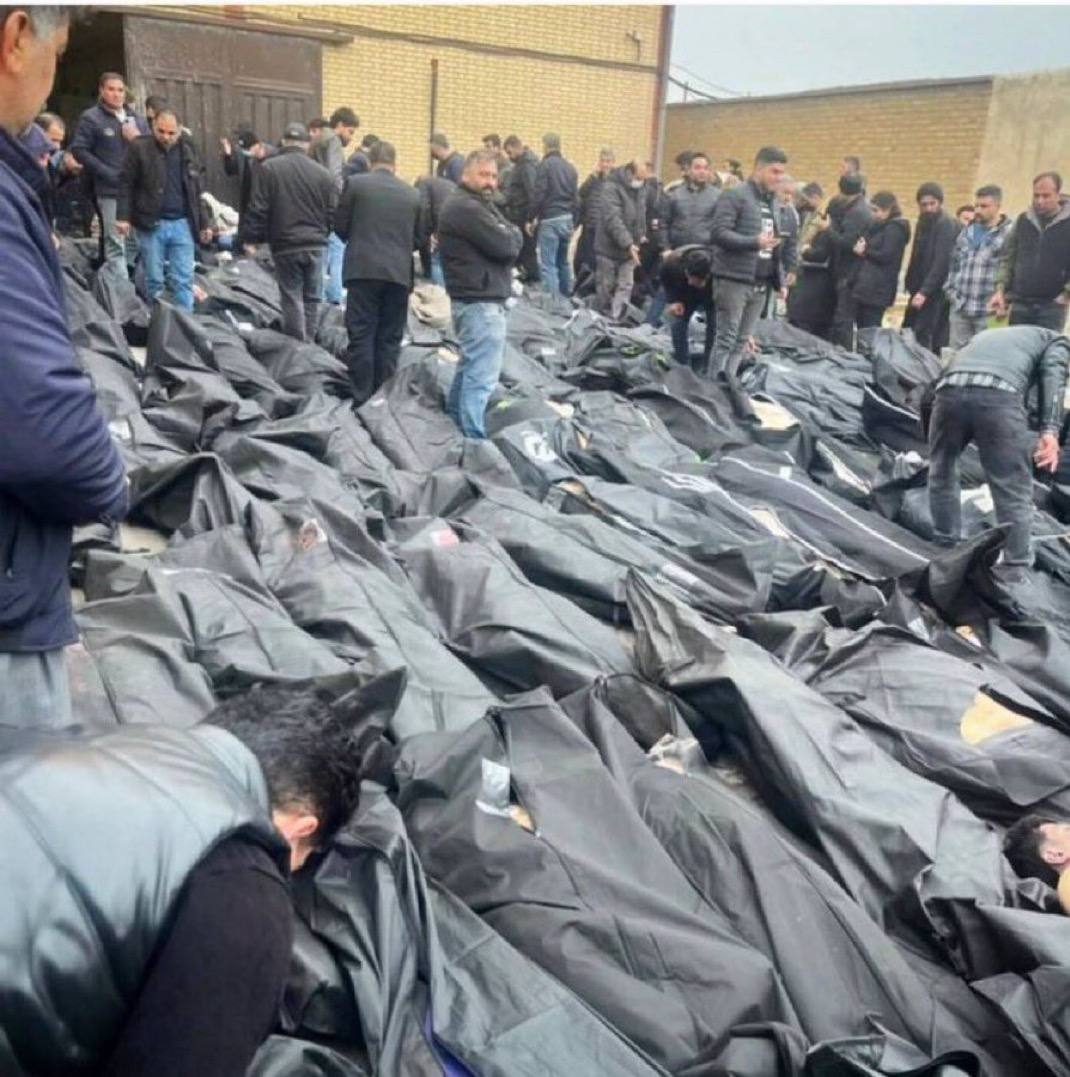
Narrative of Change in Iran
An Analytical & Research Report

From the 12-Day to the 39-Day War and the Lion & Sun Revolution

Narrative of Change in Iran

Dedicated to the families of those who survived the Lion and Sun Revolution
Scroll to read
Contents

Executive Summary

The high number of those killed in the January 2026 protests — Source: social media and citizen sources, January 2026

On May 6, 2025 — Ordibehesht 16, 1404 — roughly six weeks before the 12-day war, I published a study entitled “What Should the Opposition Do Under Wartime Conditions?” That study forecast four principal scenarios: a large-scale Israeli attack on nuclear and missile facilities; the elimination of key IRGC commanders; the death of the leadership of the Islamic Republic; and nationwide protests. A few weeks later, the 12-day war activated the external-attack scenario. Subsequent blows to the regime’s command and security structure brought the second scenario into the field: the command-security column and the regime’s authority entered a severe crisis, and Ali Khamenei was placed in a condition of elimination. The crisis of Khamenei and the regime had already appeared in January as a deep collapse in the legitimacy of his leadership; with the start of the 39-day war, however, his removal became entirely conceivable in the Middle East. Finally, the January 2026 protests realized the fourth scenario. The significance of the May study, therefore, was not merely that it anticipated war. It lay in the fact that it correctly identified the chain of crisis and the intersection of conflict: war, command, leadership, street. [1]

The central reality of this narrative is that the crisis moved from negotiation to war, from war to structural attrition, and from structural attrition to the January protests. Nuclear talks began in Oman on April 12, 2025 — Farvardin 23, 1404. After several rounds of negotiation, with positions hardening and the final sixty-day warning expiring, the 12-day war began on June 13, 2025 — Khordad 23, 1404. A ceasefire was established on June 24 — Tir 3 — but the crisis did not end. Months later, protests began in the bazaar on December 28, 2025 — Dey 7, 1404; on January 8 and 9, 2026 — Dey 18 and 19, 1404 — they reached a turning point and, at the levels of narrative and repression, became one of the Islamic Republic’s largest domestic crises in recent years. [2][3]

Analytically, the 12-day war was not merely an attack on the nuclear program; it was an attack on the regime’s deterrent assets. The killing of senior commanders, strikes on nuclear sites such as Natanz, Fordow, and related complexes in Isfahan, and then the transfer of confrontation in 2026 to energy infrastructure, rail, oil, and maritime targets show that the issue shifted from “nuclear containment” to “wearing down the capacity for survival.” Within this framework, I wrote a hybrid methodology to register the regime’s daily attrition and death. The day-39 report recorded an attrition index of 58.8 percent, based on diverse military and governance variables. The methodology itself made clear that the index was an analytical model with declared limitations, not a definitive empirical measurement; nevertheless, by assigning value to open-source military and governance-attrition data, it was able to measure the regime’s survival attrition in relative terms. [4][5][6][7]

Nor can the January protests be reduced to a reaction to rising prices. The rial lost roughly half its value in 2025, official December inflation reached 42.5 percent, and the government advanced the replacement of the preferential exchange-rate system with direct payments. Yet what made January historic was the connection of economic crisis to the political moment: Reza Pahlavi’s calls, the temporal concurrence with Donald Trump’s posts, and the regime’s deliberate choice to shut down the internet, shoot, arrest, issue judicial threats, and attack medical centers were all part of an interlocked storm of events. The available evidence indicates that this repression was not improvised. At the structural, narrative-psychological, and operational levels, the regime had been preparing for months to confront a postwar uprising. [8][9][10]

This report relies on Reuters [11], Associated Press [12], The Guardian [13], the International Atomic Energy Agency [14], bardia.ai pages, and, for official-government material, IRNA [15], Fars News Agency [16], and other texts linked to the Islamic government in Iran [17].

From Gaza to Tehran

The chain of crisis should not be dated from the Oman talks. Its real point of origin is October 7, 2023. Without Hamas’s attack on Israel, Israel would not have struck the Iranian consulate in Damascus. Without Damascus, the reciprocal attacks of April and October 2024 would not have occurred. Without those attacks, the 12-day war would not have taken shape; and without the 12-day war, there would likely have been neither the 39-day war nor, perhaps, January. Without the events tied to the regime’s wartime tensions with the United States and Israel, the January protests, the Iranian people, and therefore the opposition, might not have been drawn so deeply into a regional-war phenomenon in the calculus of civil resistance.

But there is a point many analysts avoid, and it must be stated plainly: the reaction of a significant part of the Iranian public to Israeli strikes against the regime was sympathy, not anger. This sympathy is neither a strange moral phenomenon nor a foreign conspiracy. It is the logical outcome of forty-seven years of governance and the endurance of a nation seeking fundamental change and the destruction of the Islamic regime. A regime that represses in the name of Palestine, spends the nation’s wealth on proxies in the name of Palestine and Lebanon, and declares freedom forbidden in the name of Palestine should not be surprised when its people feel relief at the moment that regime is struck. The frequently repeated slogan “Neither Gaza nor Lebanon, my life for Iran,” and later, in January 2026, direct slogans against the regime’s Palestine theater, expressed with obscene bluntness, indexed the depth of the rupture between people and regime.

The Iranian people saw the enemy of their enemy as an ally not out of ideology, but through political calculation. This datum must be registered without euphemism: the strategic overlap between the Iranian people’s demand for freedom and Israeli and American military operations against the regime is rooted in October 7 and in the chain that ran from Gaza to Tehran.

The Design of the 12-Day War and the End of Diplomacy

The facts show that the war also emerged from a diplomacy that was failing. Indirect talks between Iran and the United States began in Oman on April 12, 2025 — Farvardin 23, 1404. On May 20 — Ordibehesht 30 — Ali Khamenei called the American demand to halt enrichment “excessive and brazen.” The fifth round ended on May 23 — Khordad 2 — with “limited progress.” On June 12 — Khordad 22 — a sixth round was announced for June 15 in Muscat. Yet on June 13 — Khordad 23 — before the sixth round could take place, the attacks began. At the same time, Trump told Reuters that Iran had been given sixty days and that the attack occurred on “day 61.” [18][19]

From the standpoint of strategic analysis, this sequence was not simply a “failure of talks,” but the continuation of diplomacy under coercion. The American red line on enrichment, Tehran’s insistence on preserving it, and the continuation of the missile program and proxy network turned negotiation, in practice, into a timed window for military decision. More precisely, diplomacy in this period was not an alternative to war; it was part of the process of preparing political legitimacy for war. [20]

The war began on June 13, 2025 — Khordad 23, 1404 — with Israeli attacks on nuclear and military centers in Iran. That same day, reports spoke of strikes on Natanz and the killing of senior commanders and nuclear scientists. On June 22 — Tir 1, 1404 — direct American attacks on Fordow, Natanz, and Isfahan were recorded. The International Atomic Energy Agency first confirmed on June 13 that Natanz had been targeted and that Fordow and Isfahan had not, at that moment, been damaged; then, on June 22, it confirmed that all three sites — Fordow, Natanz, and Isfahan — had been targeted in American strikes. The ceasefire was established on June 24 — Tir 3. [21]

In terms of casualties and command, Reuters reported on the first day the killing of Hossein Salami, Mohammad Bagheri, Gholam Ali Rashid, and several nuclear scientists. Days later, an Israeli military official told Reuters that, over the course of the war, more than thirty senior security officials and eleven nuclear scientists had been killed and more than nine hundred targets hit. In the same accounting, Israel reported twenty-eight dead on its own territory, while Iranian media reported 627 killed in Iran. These figures, particularly the Iranian tolls, are based on data from parties to the conflict and remain in need of further verification in some components. The political meaning of the war was that the blow did not strike centrifuges alone. It targeted three main pillars: the nuclear fuel cycle, the chain of missile production and launch, and the command leadership. For that reason, the strategic result should be understood as “reducing deterrent capacity,” not merely “delaying the nuclear program,” the phrase most often heard in analysis. This is the point at which the war moved from the technical nuclear domain into the domain of regime survival. [22][23]

From an Unstable Ceasefire to the 39-Day War

The period after June 24, 2025 — Tir 3, 1404 — was not a period of calm. Reuters reported that only one day after the ceasefire, the regime turned to domestic repression: mass arrests, force deployment, checkpoints, and the alerting of security units, especially in sensitive areas. Later, an official report cited by the Associated Press completed the picture numerically: Iranian police said that during the same 12-day war, 21,000 “suspects” had been arrested and more than one thousand checkpoints had been established across the country. These two data points matter because, taken together, they show that from the summer of 1404 onward, the government saw the problem simultaneously as “external war” and “internal security.” [24]

In the three analytical-operational reports published in December, I formulated this condition as the hypothesis of an “unstable ceasefire.” The December 2025 — Azar 1404 — report stated explicitly that the baseline assumption was the instability of the informal ceasefire after the 12-day war and a high probability that attacks would resume. Taken together, those reports argued that all opposition groups had to see themselves, as quickly as possible, within a military coalition rather than necessarily as managers of a political situation. This mattered because some absences might then have been perceived earlier. [25]

At the level of events on day 39 of the war, reports of the regime’s military attrition spoke of the destruction of eight bridges in five cities, an official Israeli warning to keep away from rail lines, American attacks on Kharg Island, renewed targeting of the fuel-cycle links, and a diplomatic deadlock in the Security Council. These data points echoed in major media as well: Reuters recorded attacks on Kharg, warnings about rail lines, and Trump’s threat to strike bridges and power plants; Reuters also described the attack on South Pars as a turning point in striking Iran’s energy artery. From this perspective, the “39-day war” should be understood as a transition from a war of “center-targeting” to a war of “network-targeting”: the network of oil, gas, electricity, rail, and transport. [26][27]

In a broader definition, the term “39-day war” overlaps with the period from February 28, 2026 — Esfand 9, 1404 — to April 8, 2026 — Farvardin 19, 1405: a war that began with joint U.S.-Israeli attacks and ended with a disputed two-week ceasefire. The term therefore has both a real wartime range and an analytical reading of attrition that quantifies it. [28]

Yet the datum not registered on day 39 appeared in the following weeks. The regime’s attrition index, during the ceasefire phase and without a single new bomb, rose from 58.8 percent to 61.9 percent. The meaning is simple: attrition was no longer dependent on bombardment. The U.S. naval blockade generated daily losses of $435 million. The internet shutdown ordered by the regime itself destroyed a $107-billion e-commerce market. Iran’s logistics index fell below Afghanistan’s, and the regime formally declared that it lacked the money to rebuild destroyed homes. In the same interval, Trump openly acknowledged that “the Iranian government is severely fractured,” and command moved from a model of individual leadership to a “board of directors” model. Mojtaba Khamenei became the truly cardboard leader of this condition, a figure whose prominence helped explain the rise of the board. Thus the real turning point of the 39-day war was neither the ceasefire nor the final bombing. It was the moment when the ceasefire became not a source of reinforcement, but an accelerator of the regime’s death. Attrition passed from the phase of “destruction” into the phase of “structural collapse,” and it continues; it appears irreversible.

The mechanism of this attrition can also be formulated. Trump had fallen into what Robert Pape calls an “escalation trap”: the 39-day bombardment was tactically successful — thousands of targets, 80 percent of air defense, forty senior commanders — but it had still not produced a political or strategic result. The regime did not fall, the street did not rise again, and nuclear material was dispersed. Each time a limited blow failed to produce a political result, Trump was forced to escalate: first limited strikes in June 2025, then broad bombardment in February 2026, then a naval blockade in April, and finally the threat of ground operations and Operation Freedom of Hormuz in May. Retreat carries reputational costs; stopping is read as incapacity; continuing requires a larger blow. Within this framework, the concept I called the “legitimizing bridge” appears: when a maximal threat — for example the destruction of power plants — is announced but not executed, that unexecuted threat becomes a bridge that legitimizes more radical options, including regime change. Trump’s statement of April 21, 2026 stood precisely on that bridge: he did not say the words “regime change,” but he asked the regime to present a “unified proposal.” In other words, he had understood that no unified command existed. Even if the United States does not officially place the vocabulary of regime change on the table, the logic of operations drives it in that direction.

January 2026: From the Bazaar to the Street

The January 2026 protests; the Lion and Sun flag against the flames — Source: social media and citizen sources, January 2026

The protests began on December 28, 2025 — Dey 7, 1404 — in Tehran’s Grand Bazaar. Two days later, Reuters reported that students had also joined the scene. By January 6 — Dey 16 — protests had spread to twenty-seven provinces and 340 cities. On January 12 — Dey 22 — Reuters wrote that the bazaar had become the hard core of protest because of the collapse and instability of the rial’s value and anger at the distance between ordinary life and the ruling security-clerical class. This sequence shows that the bazaar supplied the spark of humiliation, but the event very quickly exceeded a guild protest. [29][30]

The economic trigger is also fairly clear. In 2025, the rial lost nearly half its value and official December inflation reached 42.5 percent. At the same time, the government had decided to abandon the preferential exchange-rate system and move instead toward direct subsidies and electronic coupons; Reuters reported that implementation of this change was scheduled for January 10, 2026 — Dey 20, 1404. The bazaar therefore was not merely reacting to “daily prices.” It was reacting to a much worse inflationary horizon that was set to become official a few days later. [31]

But January did not remain at the economic point. Reuters and the Office of the High Commissioner for Human Rights reported that the protests began inside the livelihood crisis, but quickly became opposition to the structure of clerical rule, slogans against Khamenei, and demands for political change. Here a crucial distinction must be recorded: the economy lit the initial flame; because that ignition occurred in the postwar environment and amid the attrition of authority, it rapidly acquired political language. For that reason, January can be described as a political revolutionary protest with economic triggers. [32]

The second issue behind the bazaar protest was the severe exposure of the bazaar economy, domestic production, and imports to the issue of the trustees. The trustees are a network of trusted intermediaries — individuals, companies, or particular exchange houses inside the regime — that, under conditions of international banking sanctions, receive, hold, and transfer currency generated from the sale of oil, petrochemical products, and other exports. Instead of using the formal banking system, such as SWIFT, which has been sanctioned, these networks operate informally and on the basis of trust between the political apparatus and the sales network. They keep the money in foreign accounts and return it to Iran with delay. Their main profit comes from the float and delayed transfer of currency. In other words, even without doing anything substantial, they benefit from money that belongs to the country’s oil. The trustees thus became a temporary replacement for a paralyzed banking system, but over time they turned into a corrupt and opaque structure. The initial use of this sanctions-evasion method emerged in the early 1380s — roughly 2003 to 2010 — as oil and banking sanctions against the Iranian regime intensified, particularly after access to global financial networks was cut. At first it was limited and emergency-based. But its major expansion came after 2010, especially after 1397/2018, when it became a technical requirement for survival under sanctions. After the severe U.S. oil sanctions during the Obama period and then Trump’s withdrawal from the JCPOA, informal oil sales, mainly to China, increased. Successive governments, from Rouhani onward, relied on these networks to evade sanctions. The trustees were no longer a temporary arrangement; they had become a permanent and complex system.

Through the Ministry of Petroleum and the NICO company, the Rouhani government created controlled trustees and received money directly. Under the Raisi administration — the thirteenth government — this control shifted, and the trustees were entrusted to banking networks under the supervision of the Central Bank. Critics argue that this change limited oversight and made corruption more complex and untraceable. By 1404 — 2025-2026 — as sanctions intensified, the trustees had become the main bottleneck for the return of foreign currency. The first parliamentary disclosures stated that between $6.7 billion and $11 billion had not returned to Iran. This became a major scandal. A look at the total amount of oil sold during this period suggests that the precise volume of non-returned dollars, because of fraud and rent-seeking gaps, could be far larger. The reality is that this issue, in an economy effectively split among multiple state-like power centers, placed its first severe effects on the violent instability of exchange-rate parity.

Reza Pahlavi’s Calls and Their Concurrence with Trump

In reliable open sources, three rings of Reza Pahlavi’s calls are clearer than the others. First, the call for Thursday and Friday, January 8 and 9, 2026 — Dey 18 and 19, 1404 — at 8 p.m., recorded by the Associated Press. Second, the messages of January 10 — Dey 20 — which Persian-language exile media reported as calls to continue street presence for two additional nights, to apply pressure in urban centers, and to invite strikes; this part is less thoroughly documented in first-tier international sources. It contains one notable point: the regime’s propaganda and communications apparatuses were described as legitimate targets. Third, January 16 — Dey 26 — when reports spoke of a fresh invitation to nightly slogans and nationwide strikes. What can be said with high confidence, therefore, is that the line of calls shifted from “night gatherings” to the enduring and historic presence of Dey 18 and 19, and then to “social attrition through strikes and continuity.” [33]

The effect of these calls must be assessed in the relationship between dispersion and concentration. In a later report dated January 30 — Bahman 10 — the Associated Press quoted witnesses saying that with the 8 p.m. call, the scene suddenly turned from empty streets into “a sea of thousands.” Later images and videos showed that a major part of the slogans supported Reza Pahlavi and his return to the country, while another part called for the end of clerical rule and political action for freedom. The analytical result is that Pahlavi’s calls, for the first time since the Green Movement, created a political leader and, accordingly, political hope; they also gave the protests timing, concentration, and a shared moment. [34]

Most of Reza Pahlavi’s opponents among republicans and the left reject political leadership from outside Iran. At the same time, they had mocked monarchist groups by arguing that Reza Pahlavi lacked the capacity to mobilize even a small number of protesters. Yet a review of this threefold period of calls shows that the nightly and street protests recorded a large number of participants in more than 400 cities, something that had no previous precedent on this scale.

Alongside these calls, Trump’s Truth Social posts played a temporally intensifying role. On January 2, 2026 — Dey 12, 1404 — President Trump wrote that if Iran fired on protesters, America was “loaded and locked.” On January 9 — Dey 19 — Reuters reported his renewed warning amid the internet shutdown and the spread of protests. On January 13 — Dey 23 — Reuters recorded the famous post: “Iranian Patriots, KEEP PROTESTING… HELP IS ON ITS WAY.” The fact is that concurrence existed, but in open sources there is still no evidence of “operational coordination” between Pahlavi and Trump. The more accurate formulation is therefore “political concurrence,” or the alignment of external pressure and the internal street, not proven “coordination.” [35]

This simultaneity itself became raw material for the war over narrative. The government framed it as dependence; part of the opposition also used it as a pretext to attack the protest moment itself. On January 15 — Dey 25 — Reuters wrote about the bitter split among factions of the opposition abroad: disputes among monarchists, the Mojahedin-e Khalq, and leftist and republican currents, in some cases, turned from strengthening the street’s narrative into a struggle over ownership of the street. [36]

Strategic Overlap

Between the war aims of the United States and Israel against the Islamic Republic and the Iranian people’s demand for freedom, there was not necessarily unity of project; there was, however, strategic overlap. From the angle of their national security, the United States and Israel sought to wear down the regime’s deterrent assets: the nuclear program, missile capability, the IRGC, internal-security capacity, and especially the proxy network. From the angle of political liberation, Iranian society sought to break the same structure that reproduced repression, poverty, discrimination, humiliation, execution, and political blockage. These two paths did not begin from the same point, but they reached one pressure center: the weakening of the Islamic Republic’s survival capacity.

This is why the government described the January protests as part of hybrid warfare. That was not merely a propaganda label; it was the regime’s security confession that two pressures had become simultaneous. From the ruling power’s viewpoint, when the Iranian street becomes active in a postwar moment, it is no longer merely a livelihood protest; it becomes the internal flank of the same pressure that externally targets command, deterrence, and survival capacity. The evidence shows that in the regime’s perception, external war, if linked to social fracture, legitimacy crisis, and street movement, moves beyond military destruction and becomes a crisis of command, obedience, and the future survival of the system.

The central signifier, therefore, is not that the Iranian people were instruments of a foreign war. Such a formula is morally wrong and analytically weak. The more precise point is that the regime, because of its military-ideological nature, recognizes no peaceful change and defines every demand for freedom as an extension of the enemy’s war. This is where strategic overlap acquires meaning: the Iranian people seek freedom; the United States and Israel seek the reduction of the regime’s security threat; and the Islamic Republic sees both paths in a single field because it has built its survival on the linkage of ideology, the IRGC, the nuclear program, missiles, repression, and political blockage. A strike on any one of these pillars destabilizes the others. The January protests were therefore neither an appendix to war nor merely a bread riot. They were the moment when Iranian society passed through the crack opened in the survival machine and translated freedom into the language of crisis inside power.

This formulation also clarifies the line separating “overlap” from “dependence.” The government turns the simultaneity of external pressure and internal street action into a narrative of dependence in order to justify repression; political analysis must not accept the regime’s security language. Strategic overlap means that two distinct forces, with distinct motivations, reach a common pressure point within a historical interval. People enter the field for the right to live freely, the right to political choice, and the end of ideological domination; foreign states apply pressure to reduce a security threat and alter the regional balance; the regime, seeing itself at the center of both crises, translates society into the field of hybrid war. Before January, the regime had prepared not to hear society, but to fight it.

The January Narrative: From the Bazaar’s Flames to the Chaos of Crime

Nights of protest in the streets of Iran, January 2026 — Source: social media and citizen sources, January 2026

The name that remained attached to this historic event was the “Lion and Sun Revolution.” The naming had two roots. First, supporters of Iranianism — and, in its dominant segment, supporters of Prince Reza Pahlavi — chose it. Second, and more importantly, for the first time the Lion and Sun flag, the symbol of Iran before the Islamic Republic, was raised during the demonstrations of January 8 and 9 in the streets of different Iranian cities. This symbolic choice is itself political data: a society that raises the Iranian flag against the flag of the Islamic Republic is choosing an identity, not merely registering a protest. By raising the Lion and Sun, people both distanced themselves from the regime and projected a future rooted in Iran rather than in political Islam. Whether this symbol alone has the capacity for universal mobilization, or represents only one part of society, is a question whose answer lay in the breadth of participation by different social and urban layers; but the fundamental reality is that at the peak of the crisis, the street chose a symbol that was intrinsically anti-Islamization.

The January narrative must begin at the point where the bazaar lit its small flames, but the street moved beyond the bazaar. The protests began on December 28, 2025 — Dey 7, 1404 — in Tehran’s Grand Bazaar. Students then entered the scene, and by Dey 16 the protests had spread to 27 provinces. At the same time, the collapse of the rial’s value, official December inflation of 42.5 percent, and the government’s decision to change the preferential currency system lowered the social threshold of tolerance. But January did not remain at that economic point. The slogans turned against the apex of power, the structure of the ruling clergy, and the political system in its entirety. The more precise formula is therefore this: the economy lowered the threshold of explosion; war and the attrition of authority raised the sense of possibility; and repression transformed an economic protest into a full political event.

The initial figures showed that the regime entered the field from the first days with the logic of the bullet. On Dey 18, Iran International, citing Iran Human Rights, reported that since the start of the protests at least 45 protesters, including eight children, had been killed, hundreds wounded, and more than two thousand arrested. On the same day, reports described direct fire, the use of live ammunition and pellets on the evening of Dey 18. The importance of these data is not in the final number; it is in what they reveal about the initial pattern of repression: before the protest could become a fully nationwide and organized movement, the regime decided to make the cost of the street bloody [37].

Dey 18 and 19 were the point at which the government decided not to manage the protest, but to extinguish it absolutely. The internet was cut, calls were disrupted, hospitals and medical centers were turned into security terrain, and reports spoke of direct fire, live ammunition, attacks on the wounded, arrests of the injured, and threats against families. The crime did not occur only in the street; the path of treatment, the path of information, the path of mourning, and the path of truth-recording were also targeted. For this reason, the number of the dead must be read in relation to the engineering of concealment, not only in relation to the announced figures.

On the final casualty figures, early human-rights numbers spoke of dozens killed and thousands arrested; in its fiftieth-day report from the beginning of the protests, HRANA reported 226 children among the dead; and some later media-medical reports put forward far larger numbers. These figures should not be placed on a single plane. My methodological proposal is that the various related reports that may be published later should distinguish three statistical levels: confirmed minimums, aggregate human-rights estimates, and institutional medical-media estimates under blackout conditions. In this way, the magnitude of the crime is preserved, while the text does not fall into the trap of a definitive number that cannot be defended [38].

Historically, January is not defined only by the number of deaths; it is defined by the quality of repression and the savagery of the structure. When the government uses internet shutdowns, bullets, arrests, forced confessions, attacks on treatment, the narrative of hybrid war, and judicial threats at the same time, it is defining the protester not as a dissatisfied citizen but as a combatant element. The January crime was not the product of a momentary error or the field violence of a few commanders; it was the natural outcome of a state that merges politics with security, society with the enemy, and freedom with hybrid war. In such a structure, even a peaceful demand is translated into military language, because the regime understands the possibility of peaceful change as a threat to its entire survival [39].

January 8 and 9

Bloodstains on the pavement beside the word "Iran," January 2026 — Source: social media and citizen sources, January 2026

January 8, 2026 — Dey 18, 1404 — was the transition point from sustained protest to a critical moment. The Associated Press reported that after the nighttime call, people chanted in homes and streets; hours later, the internet and telephone lines were cut. Reuters also reported a nationwide internet blackout that day. On January 9 — Dey 19 — Reuters reported that despite the communications cutoff, protests continued, while Khamenei appeared on television, called the protesters foreign mercenaries, and warned that the government would not retreat. In chronological terms, the sequence was this: the call, the appearance of the street, the communications cutoff, and then the explicit tone of repression [40].

The repression was multilayered. On one side, the internet and international calls were cut; The Guardian and Filterwatch described the shutdown as highly complex and close to total, with traffic falling by 90 percent. On the other side, human-rights reports and Reuters described the use of live ammunition and shotguns, firing on protesters and passersby, deployment of forces on streets and rooftops, waves of mass arrests, and attacks on hospitals to arrest the wounded. Amnesty International spoke of “unlawful killings on an unprecedented scale”; Human Rights Watch described the “nationwide killing of protesters and bystanders” on January 8 and 9; and a United Nations expert, speaking to Reuters, reported raids on hospitals and the arrest of the wounded [41].

The main question is not whether the government had the capacity to repress; the question is whether it had prepared in advance for this level of repression. Based on open evidence, the answer is yes — but it must be separated into three levels.

At the structural level, from the summer of 1404/2025 onward, the government elevated internal security to a priority. Reuters wrote on June 25 — Tir 4 — about force deployments, arrests, executions, and readiness in sensitive areas. Later, the Associated Press reported that Iranian police said they had established more than one thousand checkpoints and arrested 21,000 “suspects” during the 12-day war. At the organizational level, IRGC command on Dey 1, 1404, emphasized the “proper implementation of the neighborhood-based Basij plan” and described neighborhood coverage as a bridge between the state institution and the neighborhood; in Azar 1404, official reports also described a neighborhood-based management network with a “public security and social harms” committee. These are not documents of a specific plan for Dey 18 and 19, but they demonstrate changes and readiness in the institutional infrastructure of urban control [42].

At the narrative and psychological level, for months the vocabulary of “cognitive war,” “hybrid war,” “infiltration,” and “riots” had been constantly reproduced. In Bahman 1403, law-enforcement officials spoke of cognitive war. In Dey 1403, the head of Malek Ashtar University of Technology [43] said that the arena of cognitive war targets the human brain and perception. In Shahrivar 1403, Amin Police University [44] held a national conference on “hybrid war”; in Dey 1403, Malek Ashtar also held the national conference “The Arena of Cognitive War: Science and Technology,” with 95 papers. In the ecosystem linked to Imam Hossein Comprehensive University [45], articles titled “Psychological Operations and Their Impact on Urban Riots” and crisis-oriented journals centered on social security had also been published. After January, official texts from Khamenei’s office and media close to the government described the events as a “hybrid rebellion,” an “American-Zionist sedition,” and the result of cognitive war. This collection shows that before January, conceptually and propagandistically, the regime saw society through the frame of a security-cognitive conflict [46].

At the operational level, the evidence is even more concrete. On January 6 — Dey 16 — police promised to deal with the “last rioter.” On January 8 — Dey 18 — the internet and telephone lines were cut. This shutdown can be described as the most comprehensive communications blackout in Iran’s history, while The Guardian wrote of a longer-term plan for controlled separation from the global internet. On Bahman 18, 1404, the government stated through IRNA that the “National Information Network is not a replacement for the internet,” but this emphasis on network resilience and security itself shows that the infrastructure for domesticated control already existed. At the level of equipment and surveillance, the September 2025 report of the Iran Human Rights Documentation Center spoke of security forces’ access to repression and surveillance equipment through international routes, while reports by the United Nations and news agencies described the growing use of drones, facial recognition, and digital reporting infrastructure after 2022. In simple terms: the toolbox of repression for Dey 18 and 19 had already been built; it was merely activated [47].

In addition, there is an important narrative document from the government itself: in the February 18, 2026 — Bahman 29, 1404 — interview on Khamenei’s website, the head of IRGC Intelligence said he had met Khamenei “before the recent unrest” and had given him a report on the 12-day war, the enemy’s situation, and “planning for the future,” and also referred to the rapid implementation of the “Amir al-Mo’menin 2” exercise. For these reasons, it is significant that the regime itself wants to show that it had already seen the event within a security-scenario framework [48].

The conclusion of this section is clear. The repression of January 8 and 9 was not an immediate reaction to one night of protest. The combination of postwar readiness, the expansion of neighborhood-based control, the doctrine of cognitive war, digital blackout, and official data on thousands of arrests and hundreds of checkpoints shows that the regime had been preparing for months, and even for years, for a moment of this kind. What more detailed orders were issued within the security hierarchy between December 2025 and January 2026 remains unclear; but proving the existence of prior readiness does not require that level of documentation. The existing evidence is sufficient [49].

One issue must be addressed at the end of this section: the criticisms and accusations raised against Reza Pahlavi, the predominant leader of protesters in the streets of Iran. The question is framed as follows: “If we accept that such preparation already existed, why did he and his operational team continue to advance calls and protest management?” In my view, the preceding evidence confirms only that prior preparation existed. It does not confirm that Reza Pahlavi could have prevented the protests from emerging or intensifying. Indeed, protesters on January 7 — Dey 17 — had already come into the field in large numbers. Moreover, leaving the leadership space of the protests empty, as happened in the Mahsa movement, would have brought celebrities into the field to issue calls, with its own specific harms. His leadership at least created a political anchor for protesters. It seems that even if no call had been issued by him, critics would have raised other claims: that he did not intervene and therefore feared a lack of support from protesters, or that he did not have enough supporters to seize the street. In any case, it is clear that the problems of the Iranian regime’s opposition cancel out one another’s energy more than they build a powerful discourse against the regime. This is more acute on the side of the left and the republicans: they do not possess, compared with monarchist groups, significant organizational assets for confronting the regime, yet they operate very effectively in media, social networks, and antiwar European lobbying. The poisonous fracture in this claim by the left and republicans is that they cannot draw a line of distinction between being antiwar and being pro-regime.

1. Integrated Engineering of Repression

The bodies of those killed in the January 2026 protests — Source: social media and citizen sources, January 2026

The analysis of January 1404 moves from the level of moral narrative to the level of strategic anatomy only when the crimes are understood not as scattered events, but as components of a system organized around authoritarian survival. What happened on January 8 and 9 and in the days that followed was neither the momentary revolt of field commanders nor an improvised reaction to a gathering. All the data published by Amnesty International on January 20 and 22, HRANA’s 1,350-page report titled Red Winter, the separate Human Rights Watch reports in January and February, the findings of the Center for Human Rights in Iran, and the technical findings of Filterwatch and NetBlocks confirm one point at different levels: the repression of Dey 1404 was a multilayered and coordinated engineering operation whose components were activated simultaneously in the neighborhood, the street, the hospital, the detention center, the media, and the communications network [91]. In the comparative literature on authoritarianism, this pattern is known as “integrated repression” — a model in which several separate mechanisms are mobilized simultaneously for a single objective: stabilizing regime survival under conditions of acute crisis. The central question a transition analyst must ask is not how many people were killed; it is what structure was able, within a 48-hour window, to execute such a volume of killing, arrest, blackout, and concealment — and where that structure came from.

The answer has at least three foundations. First, prior institutional readiness: Reuters’ June 25, 2025 report on the regime’s turn toward internal repression after the 12-day war; official police statistics about 21,000 “suspects” arrested and more than one thousand checkpoints during that war; IRGC command’s emphasis on Dey 1, 1404, on the “proper implementation of the neighborhood-based Basij plan”; and IRNA’s report in Azar 1404 on the “public security and social harms” committee within the neighborhood-based management network all show that from the summer of 1404 onward, the regime had built the infrastructure for a broad counter-uprising operation. Second, narrative-psychological readiness: the repetition of the vocabulary of “cognitive war” and “hybrid war” in speeches by the head of Malek Ashtar University, conferences at Amin Police University, publications linked to Imam Hossein Comprehensive University, and then post-January official texts using precisely the same language show that the regime already saw itself in a security-cognitive battle, not a civil crisis. Third, technical-operational readiness: the most comprehensive communications blackout in Iran’s history on January 8; Filterwatch’s announcement, based on the regime’s official documents, of a program for “absolute digital isolation”; the prior design of a whitelist system; and academic researchers’ characterization of the event as the “largest coordinated communications shutdown in history” show that the tool of blackout was not built on January 8; it was only activated that day [92]. These three foundations — structural, institutional, narrative, and technical — lead to one conclusion: what was seen in January was the output of a multiyear project that was merely waiting for the right “shock” to be executed.

2. The Five Physical Layers of the Crime

Deployment of motorized repression units in the street — Source: social media and citizen sources, January 2026

To understand the scope and quality of the January crime, the analysis must be formulated in five separate but interconnected structural layers. None of these layers had full functionality without the others; in combination, they formed an integrated machine whose aim was not only to silence the street, but to erase the moment from national memory.

The first layer was direct fire in urban space. Amnesty International and Human Rights Watch documented in their joint January 8, 2026 report that from December 31 to January 3, at least 28 protesters and bystanders, including children, were killed by security forces in 13 cities and eight provinces. An independent pathologist who reviewed photographs of the wounded and the dead confirmed a pattern of shots to the head and chest — a pattern that, from a legal standpoint, indicates intentional shooting to kill, not controlling fire [93]. On January 8 and 9, the pattern shifted from mistaken firing to systematic firing: security forces were stationed on the rooftops of houses, mosques, and police stations, and fired rifles and shotguns loaded with metal pellets at the crowd. Video evidence and residents’ testimonies from Tehranpars, Narmak, Fardis, Kermanshah, Mashhad, Neyshabur, Sanandaj, and Malekshahi show a single pattern: a shift from nonlethal munitions to real military ammunition, deployment from elevated angles that made escape impossible, and firing at fleeing crowds [94]. This layer alone is enough for a crisis of legitimacy, but the regime knew that street gunfire without the later layers would not complete the machinery of crime. The coordination required for massacre in more than 400 cities, simultaneously and nationwide, from after 10 p.m. onward, confirms the nature of the first layer.

The second layer was the transformation of hospitals into security terrain. What the reports of HRANA, Iran International, Amnesty International, and Human Rights Watch documented was not fighting near hospitals, but systematic design to deprive the wounded of the path to treatment. The raids on Khomeini Hospital in Ilam on January 4 and 5, orders from security forces to medical staff in Isfahan to report patients with bullet and pellet wounds, arrests of doctors and nurses who had treated the wounded in non-hospital settings, and credible reports about the abduction of wounded people from hospital beds in Isfahan and Chaharmahal and Bakhtiari all show that the hospital was turned from a neutral medical space into a center for identification and arrest operations [95]. Amnesty International documented, citing a medical worker in Karaj, that on the night of January 8, 87 bodies were recorded in only one hospital and more than 400 wounded in another. The Wall Street Journal on January 31 and The New Yorker on February 11 published reports confirming the pattern of targeting medical staff and killing the wounded — the so-called final shot — inside hospitals. Abbas Araghchi’s official admission on January 11 that some wounded people were “finished off by terrorists,” when read within the context of this evidence, is not a defense of the regime but an official cover for the killing of the wounded by the regime’s own forces. In international humanitarian law, attacks on hospitals and medical staff intrinsically violate the principle of medical neutrality; in comparative authoritarianism, this pattern shows that the regime targeted not only killing, but also the path by which killing would be recorded.

The third layer was mass arrest, enforced disappearance, and sexual violence. HRANA recorded 24,669 detainees by January 18; by January 27 the number had risen to 42,324; and by February 9 it reported 51,790 arrests, including 326 children, teenagers, and students [96]. But the number is only the entry point into the issue. The methods of arrest — nighttime raids on homes, checkpoints, arrests at workplaces, and arrests from inside hospitals — show that the regime, rather than reacting to street presence, was carrying out retrospective cleansing within the protesters’ social and family networks. In at least one case documented by Amnesty International, security forces raided the home of Amir Hossein Ghaderzadeh’s family in Rasht on January 9, stripped him and his two sisters, one of them 14, in front of the family to “prove” that their bodies bore pellet marks, and then abducted Amir Hossein. For days afterward, no information about him was available [97]. This case is only one of the multiple cases of enforced disappearance whose pattern Amnesty International and HRANA have confirmed. At the detention-center level, convergent reports from Iran International, citing informed sources, Hengaw, the Kurdistan Human Rights Organization, and BBC Persian indicate that sexual violence against detainees — including gang rape, rape with objects, sexual torture as a tool of forced confession, and the return of women’s bodies to families with signs of sexual violence — was a systematic pattern, not an individual exception [98]. The independent United Nations fact-finding mission chaired by Sara Hossain announced that its evidence pointed toward the commission of crimes against humanity — a legal threshold that can be reached only by proving systematic conduct, not by scattered evidence.

The fourth layer was accelerated executions and show trials. HRANA reported that between January 5 and 14, the regime carried out at least 52 executions. On January 13, the Tehran prosecutor’s office announced that a number of protesters would be charged with moharebeh, a charge that carries the death penalty under provisions of the Islamic Penal Code. By February 16, at least 16 detained protesters had been sentenced to death; and on February 18 and 20, new sentences were issued for three brothers from Shahin Shahr and seven other protesters, including a 19-year-old teenager — sentences Hengaw described as “tainted by extensive violations of due process” [99]. HRANA and Amnesty International reports show that forced confessions, often obtained through torture, sexual violence, and threats against families, formed the basis of judgments in many of these cases. The 261 forced confessions broadcast by January 27, as recorded by HRANA, are documents of manufactured legitimacy for execution. This distinction is foundational in international criminal law: a series of executions carried out through torture and fabricated evidence is known in the literature of international tribunals as “extrajudicial execution dressed in judicial clothing.”

The fifth layer was threat and humiliation directed at victims’ families. If the four previous layers can be called the primary crime, this layer is the secondary crime: the attack on mourning, memory, and the demand for justice. Amnesty International reported that a family in Tehran province had been unable, more than two weeks after their child was killed, to receive the body because they could not pay the amount demanded by the authorities. In a case that occurred on January 9 in Neyshabur, a two-year-old girl named Bahar was killed by a direct shot to the head; state media released several videos of the father’s statements, in one of which a voice outside the frame can be heard dictating sentences to the grieving father [100]. HRANA and Iran International recorded multiple cases of regime pressure on families to accept the official narrative, arrests for rejecting that narrative, burial of bodies at geographic distance from the place of death, and refusal to hand over bodies until the family accepted the regime’s account. On February 11, the regime pressured families of detainees to participate in the Bahman 22 march, the anniversary of the regime’s revolution. The threat was that if they did not participate, their loved ones would be executed or receive heavier sentences. In human-rights literature, this layer falls explicitly under the definition of psychological torture. But in strategic analysis, its main function is something else: breaking the “community of mourning” and preventing tears from becoming memory, and memory from becoming politics.

3. Blackout as the Lever of Crime

Iran's internet connectivity collapses to about 1% from January 8, 2026 (source: NetBlocks) — Source: social media and citizen sources, January 2026

If the five physical layers formed the body of the January crime machine, the January 8 internet blackout was its heart. Filterwatch’s documented technical analysis, together with data from NetBlocks, Cloudflare Radar, IODA, and academic reports published on arXiv, shows that what happened on January 8 was neither “network disruption” nor “protection against cyberattacks,” as the regime’s official narrative claimed; it was an engineered project at a maximal level. Around 12:00 UTC, approximately 98.5 percent of Iran’s IPv6 address space was withdrawn from BGP announcement; IPv6 traffic fell from roughly 12 percent to 1.8 percent; the Telecommunication Infrastructure Company (TIC) cut its connection to several transit providers, including Russia’s Rostelecom and Gulf Bridge International; and within less than two hours, inbound and outbound traffic reached a point close to zero [101]. These figures provide a firm technical diagnosis: the blackout was neither the result of cyberwar nor an accident; it was the result of a direct political-security order designed and executed by a network of identified officials, including Ali Aram in the secretariat of the Supreme National Security Council. By May 18, the blackout had reached 80 consecutive days — more than 1,920 hours — and, according to the figures, had become the longest nationwide internet shutdown in the history of any country [102].

But the analytical significance of the blackout lies not only in its technical scale. In the engineering of the January crime, the blackout had three simultaneous functions: first, breaking the protesters’ capacity for coordination — the operational function; second, eliminating the possibility of real-time documentation — the concealment function; and third, monopolizing the narrative in the hands of state media — the narrative function. For this reason, Amnesty International, Human Rights Watch, and the United Nations Special Rapporteur Mai Sato all stated explicitly that the blackout was a tool for “concealing crime” [103]. What turns this diagnosis from a political claim into a demonstrable proposition is the numerical gap produced by the blackout: the regime’s Supreme National Security Council spoke of the regime’s recurrent figure of 3,117 killed; Mai Sato, the UN Special Rapporteur on Iran, reported by January 16 at least 5,000 killed, with the possibility of 20,000 according to medical sources; by late January, The Guardian, Time, and Iran International, citing local health officials, wrote of 30,000 to 36,500 deaths; and by February 5, HRANA had confirmed 7,015 deaths and had 11,744 cases under review [104]. This gap — approaching a ratio of 1 to 10 between official and estimated figures — is itself one of the direct consequences of the blackout and other factors: in the absence of a free flow of information, the regime can keep the official figure at a level structurally distant from the real figure and turn that distance into a political instrument. In the logic of authoritarian repression, numerical ambiguity is itself a weapon.

In addition, Filterwatch reported on January 15 that internal documents showed the regime was implementing a program of “absolute digital isolation”: turning Iran’s internet into a “barracks internet,” in which access to the outside world is possible only for individuals and organizations with security authorization, through a strict whitelist [105]. In its simplest form, this system turns the internet from a public right into an exclusive privilege. In the literature of digital authoritarianism, this model is called a “tiered internet,” and so far it has been fully implemented only in North Korea. Thus the January blackout should not be understood as a temporary security reaction; it must be understood as a strategic transition toward a new pattern of authoritarian control — a control in which the right to communicate, the right to be seen, and the right to record truth all become security assets of the regime.

4. Erasure of Evidence and the Mechanism of Truth-Destruction

Protesters confronting surveillance cameras in the street — Source: social media and citizen sources, January 2026

Precise analysis shows that in January, the destruction of evidence and truth-destruction were not secondary consequences of repression but an independent axis of the regime’s survival project. The logic of this axis can be condensed into one proposition: authoritarian systems in the crisis stage know that until national memory is stabilized, the legal space for altering evidence remains open; therefore they begin their attack on evidence at the very moment the crime is committed, not after it. In January Iran, this attack took place on five simultaneous fronts.

The first front was bodies as physical evidence. Amnesty International reported on January 22 that in a temporary morgue set up in an annex of the Legal Medicine Organization building in Kahrizak, at least 205 identifiable body bags could be seen through video analysis between January 10 and 11. The imposition of geographic distance between the place of killing and the place of burial, delays in handing over bodies, reports of mass burial, demands for large sums of money to release bodies, and refusal to release bodies until families confirmed the official narrative were all components of a single system designed to separate the victim’s body from the real context of death [106]. In comparative literature, this pattern has been seen in Videla-era Argentina, with secret burials in unnamed graves; Pinochet’s Chile, with sea disposals; and Sri Lanka in 2009, with the management of access to bodies at the end of the war. The shared function is the creation of permanent ambiguity about the fate of victims.

The second front was forced confession and reverse narrative-building. By January 27, HRANA had recorded 261 broadcast forced confessions. But the strategic function of these confessions is not only judicial conviction; it is the production of a reverse narrative. In the case of the two-year-old girl from Neyshabur, Bahar Seifi, the regime broadcast several videos featuring her grieving father in which the killing was attributed to “terrorists” — a narrative that, if accepted by society, would not only erase the regime’s responsibility but also turn the victim into an instrument for justifying repression [107]. This pattern was repeated throughout January: videos in which grieving families, under duress, repeated the official narrative; confessions whose recording conditions remained “unclear”; and manipulation of images and videos from state rallies to display maximum turnout. At the operational level, the regime sent forces to the scene on January 17 wearing distinctive clothing and equipment, including chemical masks, blending the pattern of actual appearance with ambiguity. At the narrative level, regime news agencies, by emphasizing “214 government forces killed,” according to HRANA’s record, tried to build the image of “two sides in conflict” — an image that, in the absence of free information, can become a competing narrative among non-specialist audiences unfamiliar with Iranian affairs.

The third front was the attack on the structure of civil truth-production. The arrest of doctors who treated the wounded, the arrest of journalists, the arrest of lawyers — the “One Word” lawyers’ network, which warned on January 10 about show trials, was itself quickly placed under pressure — the arrest of human-rights activists, and the inspection of citizens’ phones at checkpoints to find protest images all show that the regime targeted not only physical suppressors’ victims but also the civilian recorders of reality [108]. At the infrastructural level, attacks on Iranians’ cloud space and requests that businesses and households hand over CCTV footage, as reported by Iran International on January 17, completed the coordinated attempt to erase the local layer of event-recording. When medical staff, out of fear of arrest, refuse to record bullet wounds; when a journalist fears recording the dead; when a lawyer hesitates to take a case; and when a citizen is frightened of entering the scene with a phone, the result is not the “absence of truth” but the “absence of truth’s architect.” The difference between the two is vital to understanding the crisis: truth occurred, but the infrastructure for producing its documented narrative was destroyed.

The fourth front was the destruction of alternative media platforms. The nationwide blackout, the severe targeting of Starlink terminals — according to Filterwatch’s January 13 report, especially in Tehran — pressure on telecommunications operators to implement shutdown orders, including the dismissal of the CEO of MTN-Irancell for delay in carrying out the order, and the January 17 cyberattack on IRIB, which the regime itself attributed to foreign forces but whose response pattern makes clear that the regime intended to rebuild its media monopoly, show that the regime targeted not only alternative narratives but the basic tools of narrating [109]. Even after the gradual restoration of the internet from January 17, NetBlocks and Filterwatch warned that the return was incomplete and selective and that the regime was producing “synthetic traffic” to imply a broader restoration. This pattern is known in the literature of digital authoritarianism as a “strategic blackout with controlled return.”

The fifth front was the attack on post-event historical memory. A point insufficiently formulated in Iranian opposition literature, but central in comparative studies, is that successful repression does not end with the end of violence; it reaches completion when the official narrative is stabilized. The Hama massacre in Syria in 1982, in which Hafez al-Assad’s regime killed between 10,000 and 40,000 people in February 1982, was not acknowledged in the official narrative even as an “incident” for two decades after it occurred. Robert Fisk, the only international journalist who reported from Hama in real time, used a formulation also cited in the article: society knows that a crime has occurred, but it does not yet know how to explain it. This distance between “knowing” and “being able to explain” is precisely the space an authoritarian regime uses to construct a rival narrative. In January Iran, the long delay in the release of information flows, pressure on families to accept the official account, forced confessions, the production of distorted videos, and the official denial of the scale of the crime by the Supreme National Security Council were all components of a structural attack on the process of stabilizing historical memory. The only document that resists this structural attack is the archive of documentation: HRANA’s 1,350-page Red Winter report, extracted from 143,330 base reports; Amnesty International’s weekly reports; the documented findings of the UN fact-finding mission; and Filterwatch’s technical archives all serve as counter-weapons of memory. For this reason, in the literature of international criminal law, the primary priority after a mass crime is not immediate trial but the preservation of evidence.

The War over Narrative

After the shooting and the internet shutdown, the battle began over how to define what had happened. Khamenei called the protesters agents of America and exiles abroad; later official texts from his office spoke of an “American-Zionist sedition,” a “hybrid uprising,” and the “illusion of a virtual majority”; analysts close to the government in Fars and Tasnim likewise described the events as a foreign project against the “hard core of the system.” The reality is that, narratively, the regime translated January into a matter of national security and foreign war; and such a translation, of course, provided the legal and psychological instruments required for maximum repression [50].

On the other side, parts of the opposition and anti-regime media, instead of concentrating on the legitimacy of the street itself, became entangled in a dispute over “who owns this moment.” The Reuters report on the fracture within the opposition abroad shows that this dispute sometimes moved beyond political criticism and weakened the protest moment itself. A critical view, within an organizational cooperation, could have asked how leadership, organization, and program might become victorious; but the events after January confirmed that many in the opposition chose to diminish the event itself or portray it as contaminated. The government benefited from this fracture, because the more the narrative of the street is distorted outside the country, the easier repression becomes inside [51].

The Regime’s Narrative War and Its Penetration into the Opposition

1. The Four-Layered Apparatus of Narrative War

In the analytical literature of the Iranian opposition, narrative war is often understood as “propaganda”: an instrumental media behavior whose purpose is to distort the news. This reduction is a fundamental error, because it weakens our understanding of what the Iranian regime did in January 2026. What occurred between January 8 and the end of February 2026 was not ordinary propaganda, but the deployment of a four-layered strategic system that had been theorized for years through the concepts of “cognitive warfare,” “hybrid warfare,” and “psychological operations” at Malek Ashtar University, Amin Police University, and Imam Hossein University. Understanding these four layers is a necessary condition for grasping why the regime achieved a relative success in “preserving its existence,” even though empirically the January event was so extensive that, at the level of narrative, it could not simply be denied.

The first layer was the reduction of the political to the security domain. The regime’s first narrative move on January 3 was the artificial distinction between “protester” and “rioter” — a distinction Khamenei explicitly announced, laying the legal-psychological foundation for maximum repression [110]. This distinction appears simple, but its strategic function is deep. Once the distinction is accepted, the question in court becomes: “Was this particular protester a rioter or not?” The questions of the legitimacy of protest, the right of assembly, and the right to question power disappear into the background. In other words, this distinction moves the regime’s judiciary from the stage of “defending the directive of repression” to the stage of “proving individual convictions.” In that stage, the regime can construct person-by-person narratives through forced confession, torture, and show trials. But the main function of the narrative — the reduction of politics to security — is not the elimination of domestic opposition; it is the destruction of empathy. By turning the protester into a security suspect, the regime strips the protester of the “right to sympathy,” and this cultural, not merely judicial, function is the central objective.

The second layer was foreign conspiracy as the macro-frame. On January 9, Khamenei called the protest an “American sedition” and accused parts of the protesters of connections with foreign intelligence services. Masoud Pezeshkian called them “trained terrorists” taking orders from America and Israel, and in an unprecedented television interview spoke of protesters “beheading” people [111]. Then, on February 18, the head of IRGC Intelligence, speaking on Khamenei’s website, used the term “quasi-coup.” That expression, according to his own definition — “coercive foreign intervention aimed at overthrow through proxy forces” — likened the protests, at the legal-international level, to a military attack [112]. This layer turned the timing overlap between Reza Pahlavi’s calls and Trump’s posts into evidentiary material for the regime’s narrative. In effect, the regime upgraded political concurrence into “operational coordination,” even in the absence of any evidence for such coordination. The strategic function of this macro-frame is to generate justification for four simultaneous actions: cutting the internet in the name of “cyber defense”; immediate execution as “confronting enemy agents”; mass arrests as “cleansing proxy networks”; and street killing as “defense of national security.” In the literature of international law, this pattern is the closest thing to what Mark Galeotti calls “black war”: domestic actions dressed as security defense in order to use the legal shield of “national security.”

The third layer was the psychological distribution of guilt and moral equivalence. This layer is subtler, but more dangerous. Regime news agencies, by repeatedly emphasizing “214 government forces killed” according to HRANA’s record, tried to construct the image of “two sides in conflict” [113]. The figures circulated by the secretary of the Supreme National Security Council, which spoke of “690 terrorists and rioters,” followed the same logic of reduction, but added a new layer: not merely “rioters,” but “attackers of military sites.” The narrative constructed around “terrorist teams linked to Israel” in January, which opposition analysts such as M. Rastegar correctly noted, had one purpose: to justify the killing of several thousand people in domestic media [114]. The psychological function of this layer is to create doubt in the mind of the neutral audience. The aim is not persuasion, but ambiguity. If the audience asks, “Was Israel really involved?”, the regime’s narrative has already achieved half its purpose. For now, instead of answering for the crime, the discussion must defend responsibility and attribution. In political psychology, this pattern is known as manufactured ambiguity — the deliberate production of ambiguity in order to paralyze moral judgment.

The fourth layer was the illusion of a virtual majority and the manipulation of public presence. After January 9, the regime organized parallel pro-government gatherings across the country, turned public funerals of killed security forces into media instruments, and manipulated images of these gatherings so they would appear to represent the “real majority of the nation” [115]. The Martyrs Foundation contacted the families of all those killed and asked them to register their loved ones as “martyrs” of the foundation. On January 23, the director-general of media productions at the president’s office announced that 2,427 families had accepted. But the strategic point is this: acceptance under pressure was not intended to honor the victims, but to “rewrite the identity of the victim.” A person killed in the street for protesting is suddenly transformed into a “Basij martyr” — meaning not only that he or she has been killed, but that he or she has been killed on the side of and for the regime. At the narrative level, this rewriting operation performs the same function that, at the physical level, the erasure of medical files from hospital systems performed, as documented in the January 8 reports: the removal of the individual from the original narrative. In his January 17 speech, while confirming several thousand deaths in the “repression of protests,” Khamenei used this same “illusion of a virtual majority” framework, saying that the real majority of Iranians supported the regime and that the protesters were a “deceived minority” [116]. This layer is the endpoint of the regime’s narrative logic: the production of a parallel reality in which repression is not only justified, but the protester essentially “does not exist” except as a negligible foreign-contaminated minority.

2. The Penetration of the Regime’s Narrative into the Opposition

Because of its sensitive nature, the question of the regime’s narrative penetrating the discourse of parts of the opposition is usually handled in the analytical literature of the Iranian opposition either with a naked sword — direct accusation — or with complete silence. Neither approach is analytical. Structural critique is not mind-reading; it is the identification of patterns of reproduction. Three patterns were clearly traceable in January 2026.

The first pattern was the reproduction of the “war” frame in pacifist language. In the middle of the 12-day war and then the 39-day war, parts of the left and republican spectrum constructed a narrative in which “opposition to war,” “opposition to foreign intervention,” and “defense of territorial integrity” were the central axes. In themselves, these axes are defensible. But in timing and relative weight, they had a structural consequence: the uncertain Iranian audience heard that war against the regime was, at the moral level, as heinous as the regime’s repression. This is the same “moral equivalence” I identified in the third layer of the regime’s narrative war. The honest admission is that some on the left may not have intended to reproduce the regime’s narrative, but a large segment ended up standing in the line of that narrative. The structural result was that the audience moved away from recognizing that the principal party responsible for the catastrophe in Iran is the regime ruling Iran, not a foreign power — precisely what the regime needed for its survival. The March 5, 2026 statement of the Left Party of Iran, whose overall discourse prioritized criticism of monarchist power-seeking, was issued in the very days when Azar Mansouri and other critical reformists were in prison and daily reports of the January killings were arriving. The diagnosis of strategic priorities, at that moment, could itself have been a measured political act.

The second pattern was the transformation of concern over separatism into a political shield for the regime. The territorial integrity of Iran is a real and defensible concern; that discussion is separate from what occurred in the political discourse of January. Reza Pahlavi’s reaction to the February 22, 2026 announcement of the Kurdish parties’ coalition was that, unfortunately, in trying to criticize the Kurdish coalition, he referred them to the regime’s army for suppression [117]. If the political doctrine of a political group negates the unity of territorial sovereignty, it can be criticized and even condemned on legal, political, and moral grounds. In my view, the vocabulary of separatism should not be softened in order to normalize or socially domesticate it. The political and moral contradiction, however, is this: that one should hand an opponent of the Islamic Republic over to the regime’s criminal army and ask that army to stand against both the Islamic Republic and separatists. Certainly, the regime’s criminal army has not stood against the regime to date and has always been a partner in its crimes; but it would certainly punish a separatist. This is a moral collapse. In a land where the right to life has been abolished, the life and dignity of an opponent of a totalitarian regime must be respected under any title.

The third pattern was the prioritization of criticizing opposition rivals over criticizing the regime. This pattern, analyzed in Phase 1 of this series, covered a broad body of opposition media activity in January. A simple qualitative experience is telling: the volume of content published by leftist, republican, exiled reformist, and even some monarchist segments, whose main target was “criticism of the opposition rival,” between January 8 and the end of February 2026, was comparable to the volume of content focused on criticizing the regime. This is not a timing error; it is a sign of a tragic imbalance in content in favor of the regime. In conditions where the regime is killing and a communications blackout is in place, who benefits functionally when the narrative focus is placed on structural criticism of an opposition rival? The honest answer is unpleasant: the regime benefits. It diverts the energy of critique away from the only force that is killing people and produces exactly the “opposition fracture” Reuters noted on January 15 and which the regime used for narrative-building. This unintended reproduction is more dangerous than all the others, because it directly strengthens the regime’s hand at the macro level of narrative.

The final point of this section is analytical. The modern analytical literature on narrative penetration is largely formulated within the literature of “hybrid warfare” and “information manipulation” by theorists such as Thomas Rid and Peter Pomerantsev. The central conclusion of this literature is a specific proposition: narrative penetration into the opposition does not require direct cooperation; it is enough for the opposition, within its cognitive structure, to reproduce the frames offered by the regime. Identifying these patterns is not for the moral condemnation of forces, but for the strategic correction of patterns. An opposition that neglects this mirror held up to itself has lost the narrative war before it has even begun.

Structural Blockage of Civil Resistance

1. The Mechanism of Criminalizing Peaceful Politics

The strategic point still insufficiently formulated in the literature of the Iranian opposition is this: the blockage of civil resistance in Iran is not the result of gradual attrition; it is the outcome of a planned legal-political structure that has been built layer by layer since 2009. At the center of this structure is a simple but deadly proposition: in the logic of the Iranian regime, there is no clear boundary between “legitimate protest” and “action against national security.” This lack of distinction is not a legal weakness; it is a designed feature.

Three signs of this structural planning were visible in January 2026. First, the charge of moharebeh, which the Tehran prosecutor’s office raised against protesters on January 13 — a charge punishable by death and, according to traditional jurisprudential interpretation, one that may even include a person who “has no weapon but creates public fear” [118]. Second, the 2025 parliamentary bill to “intensify punishment for espionage,” against which 57 jurists warned of a “great catastrophe on the way” [119]. Third, the arrest of Azar Mansouri, head of the Reform Front, Mohsen Aminzadeh, Ebrahim Asgharzadeh, Javad Emam, and other reformist figures on charges of “targeting national cohesion, taking positions against the constitution, coordinating with enemy propaganda, and creating covert overthrow mechanisms,” according to a Fars News Agency report [120]. Taken together, these three signs send a single message: even the loyal critic inside the structure becomes, in conditions of crisis, the same “foreign enemy.” That is, the regime’s legal logic structurally narrows the peaceful space until it effectively reaches zero.

In the literature of comparative authoritarianism, this phenomenon is known as the “securitization of dissent” — a model Barry Buzan and other theorists of the Copenhagen School define as the movement of issues from the realm of ordinary politics into the realm of extraordinary security. The strategic function of this movement is clear: in ordinary politics, protest is a right and the government is obliged to respond; in the security realm, protest is a threat and the government has authority for unlimited repression. By securitizing all forms of discontent — from labor gatherings in Zahedan to bakers’ trade protests in May 2025 to reformist activity inside the system — the Iranian regime has effectively eliminated the “realm of ordinary politics” in Iran. When no collective action is legitimate, what remains is either surrender or a confrontation in which the regime can place any act on the other side of its moral boundary.

2. Reconfiguring the Psychology of Protest from 2009 to 2026

If the mechanism of criminalizing structure is legal-political, the psychology of protest is its consequence at the level of the subject. A comparative analysis of Iran’s protest waves over the past eighteen years shows a clear psychological pattern. In the Green Movement, protests began with the slogan “Where is my vote?” — that is, within the discourse of the existing constitution, with a demand for the enforcement of an official right. Repression in that period, despite its cruelty, was still answered at the narrative and controlled-killing level with the language of “loyal critics” in relation to political leaders. In the protests of December 2017 and November 2019, the slogan “Reformist, principalist — the story is over” showed that society had moved beyond the reformist framework and had built firm foundations for negating the Islamic regime. In 2022, the slogan “Woman, Life, Freedom” combined liberal discourse with the negation of the system, but still lacked a clear organizational framework. In January 2026, the slogan “Javid Shah” in many cities signaled a differentiation from the revolutionaries of 1979 and the search for an alternative political identity in the name of Iran [121].

These four stages — demand for law, passage beyond reform, negation of the system, search for identity — are not accidental. They are the logical psychological consequence of the same mechanism of criminalization. When a society sees that every collective action, with any degree of intensity, is answered with the same security vocabulary — in 2009 they were accused of “sedition,” and in 2026 they heard the same “American sedition” — it effectively understands that, in the regime’s logic, there is no distinction between demand and overthrow. The psychological response to this diagnosis has two patterns: either passivity, accepting the impossibility of civility; or radicalization, accepting that if every action receives the same response, why choose the most elementary action?

A precise analysis shows that in 2026 these two patterns coexisted, but the second pattern predominated among the younger generation. The young generation no longer thinks within the framework of “step-by-step protest.” From the perspective of strategic analysis, this psychological change is both an asset and a risk. It is an asset because it has lowered the threshold of fear. It is a risk because, in the absence of a guiding political architecture, it can become an energy that boils over one night and, the next night, drains into despair. This is the same “asynchrony” mentioned in the conclusion of this article, but now with its psychological layer clearer: people are ready because they have seen the structure of peaceful politics closed; but that very closure has destroyed in them the skill of guided political action.

3. The Narrowing of Strategic Options

The structural result of blockage is the narrowing of strategic options for the opposition — a phenomenon known in transition literature as “strategic narrowing.” In a relative democracy or even a mild authoritarian regime, the opposition has five options: elections, civil disobedience, broad strikes, organized street presence, and pressure diplomacy. Each, if correctly applied, can produce results. In the Iran of 2026, these five options have been narrowed in sequence. Elections, with the Guardian Council and discretionary vetting, have effectively lost their real meaning since 2013; in 2024, the president was elected with 18 million votes out of roughly 58 million eligible voters, less than 30 percent. Civil disobedience has been criminalized under the charge of “action against national security.” Labor strikes are broken by structures of labor repression — the experience of the metro workers, Haft-Tappeh, steel, and others. Street presence, as January showed, is answered with live ammunition. Pressure diplomacy does not exist in the hands of the opposition inside the country and is available only to the exiled opposition, which itself faces limits of access.

This impasse leaves the opposition with what the strategic literature calls “post-civil options”: options in which the boundary between civil resistance and military action becomes blurred. The discussion of “legitimate defense,” the discussion of “organized violence” referenced in this article, the discussion of “strategic cooperation with Israel” raised among Iran-oriented currents, and the discussion of “armed support for protesters,” which was implicit in Trump’s January 2 posts, all indicate this transition into a post-civil space. But this transition carries a fundamental danger: the very moment the opposition moves from the civil space into the post-civil space, the regime wins at the narrative level. For the regime’s four-decade narrative about “foreign armed opponents” is, in practice, confirmed. This strategic trap is the greatest challenge facing any architecture of transition: how can one pass beyond the blockage of civil resistance without surrendering to the very narrative the regime has built for four decades to justify repression?

4. Comparative Lesson: Belarus, Myanmar, and Egypt after 2013

Three comparative experiences help clarify Iran’s blockage. The first is Belarus in 2020: a broad protest with clear civil leadership in Sviatlana Tsikhanouskaya, millions in the streets, strikes in state factories, and coordinated international pressure. But Lukashenko’s regime survived with Russian support because the agents of the coercive apparatus were convinced that continued obedience was safer than defection [122]. The lesson of Belarus for Iran: even clear civil leadership and mass presence are insufficient when the coercive core of the regime remains cohesive and a third power provides support.

The second experience is Myanmar after the 2021 coup: a rapid passage from civil resistance to armed resistance, the establishment of a “National Unity Government” in exile, and a multi-year conflict. The result: neither military victory nor political transition, but a prolonged zone of instability [123]. The lesson of Myanmar for Iran: transition from a civil space to an armed space, in the absence of organized international support and a cohesive internal coalition, can fall into the trap of fragmentation.

The third experience is Egypt after 2013: Sisi’s coup showed that even after a relatively successful democratic transition, if no institutional architecture exists to protect the political space, a new authoritarian regime can close the entire civil sphere in a single blow through the language of “counterterrorism” and return the country to the pre-2011 point [124]. The lesson of Egypt for Iran: passing beyond the regime alone is not enough; from the first day, a legal-political structure protecting the civil space must also be activated.

Together, these three experiences yield one strategic judgment for Iran. The blockage of civil resistance in Iran in 2026 has become so structural that passing beyond it is impossible without combining four factors: first, crisis within the coercive core of the regime, for which the regime-attrition index data show early evidence; second, cohesive political leadership outside the country that has built transition capacity before collapse; third, coordinated international support with the logic of deterrent diplomacy, not merely symbolic statements; and fourth, institutional readiness to protect the civil space on the day after collapse, so that the Egyptian experience is not repeated. The absence of any one of these four factors either stabilizes the blockage or pushes transition into one of three traps: Belarusian, Myanmar-style, or Egyptian. The strategic project of the Iranian opposition at this moment is not simply “breaking the blockage” — which cannot be achieved by itself — but building the fourfold capacity without which even a successful collapse will not lead to a stable transition [125].

The final conclusion of this section is consistent with the article’s foundational judgment. Nonviolence in Iran today has become ineffective both because of the opposition’s strategic error in understanding the regime and because of the absence of an understanding of the structural architecture of blockage. But a move into post-civil instruments, if it occurs without an institutional-political framework, falls into the regime’s narrative trap and its bloody counteraction. The only meaningful path is the prior construction of an architecture of transition that both possesses the logic of strategic pressure on the regime and provides the capacity to protect the civil space after transition [126].

Final Conclusion: Asynchrony

1. Two Questions to Which Everything Returns

The analysis of Iran at this moment ultimately returns to two fundamental questions, and the answer to each determines the logic of political action. First: what kind of regime will the war leave behind? Is a regime made intensely vulnerable after thirty-nine days of war on the verge of collapse, or is it a structure that has passed through crisis, mutated, and reproduced a new form of monopoly over power? Second: under these multiple conditions, what kind of political institutionalization has the opposition built for the day of explosion? Before the street rises again, has it designed a real solution and a mechanism for converting anger into outcome?

These are not independent questions. Their answers appear intertwined. If the regime has become vulnerable, the window of time is short and the absence of political architecture will be disastrous. If the regime has mutated, the problem is more complex than a revolutionary street uprising and requires a redefinition of the whole strategy.

2. The Sociology of the Street

The economy is always an effective accelerator of protest in Iran, but what has been explicit and visible is that liberal values are the durable agent of change. A common analytical error in the study of Iranian protests is to equate economic pressure with the cause of uprising. Historical data do not confirm that equation. In 2009, 2017, 2019, 2022, and 2026 the intensity of economic crisis differed; none of those moments was driven by economic pressure alone, and none reached a durable result solely on that basis. The more precise question is therefore: what ignites the explosion, and what can make change endure?

The mechanism is more precise than the usual economic explanation. Economic pressure lowers the threshold of tolerance and widens the potential social scope of protest. But the detonator is humiliation and anger in a broad sense: the moment when society feels that government is not merely incompetent, but illegitimate and deeply, variously domineering. This distinction is operational, not theoretical, because it changes the path of response entirely. Yet the detonator is not enough. The history of Iranian protests over the past eighteen years shows that Iranian society does not take to the streets merely through anger and humiliation; it has also built a shared value anchorage. Liberal values - individual freedom, the rule of law, human dignity, and clear elements of secularism - have moved beyond the level of detonator and become a durable agent of change in collective memory.

Liberal values perform this role for three reasons. First, they create a common language beyond ethnicity, class, and region, something economic anger alone cannot provide. Second, they provide a framework for the day after change: a society that knows what it is fighting for more easily knows when to stand and when to continue. Third, they generate international legitimacy, which is a real lever in diplomatic and political pressure against the regime. The Iranian street moves with accumulated wounds: executions, the images of the dead, the psychological defeat of the repression apparatus, and the endurance of protest. But the sense of possibility and intolerability is the final detonator - the moment when the machine of fear cracks. The massacre of January and the thirty-nine-day war deepened that crack. The analytical result is clear: the street may activate earlier than political calculations predict. But if a street enters the field only with economic anger, a sense of possibility and intolerability, and a shared value anchorage, without a political architecture that places liberal values at its center and defines a new operational strategy on that basis, it will repeat the same eighteen-year path of bloodshed: courage, heavy cost, and no lasting achievement.

3. Asynchrony

Protesters in the street, January 2026 — Source: social media and citizen sources, January 2026

The greatest danger at this moment is neither the regime’s residual power nor society’s weakness. The main danger is a temporal gap: the street ignites before the political force is ready. Society does not wait for a detailed program - especially now, with a paradigm shift in struggle - before moving. It comes with accumulated wounds and a sense of possibility. But continuation requires a security horizon. That horizon must be built by political force, not by collective spontaneity. Iranian protest history has repeated this pattern: either the uprising is suppressed in the absence of leadership, or it is exhausted in internal disorder. 2022 is the clearest example. Courage was extraordinary; the preservation of capital and advantage for conversion into a durable result was not defined. A massive energy was produced, but there was no mechanism for turning it into outcome.

The position held by parts of the opposition - especially leftists and republicans who prefer a street without political leadership - requires careful assessment. It is presented under the language of respect for popular spontaneity. In practice, however, it is a low-cost position whose cost is paid by the people. Distance from organizational capacity is converted into theoretical justification. From this angle, the immediate duty of political force is clear: design for the day of explosion before the explosion. That means preparing operational answers in advance: what do you say in the first hour? What specific action do you make public on the first day? When the regime applies violence, what defensive mechanism do you offer? Common language, operational signals, and a minimum map of demands must be built before that moment, not during it. Beyond that, in the face of civil blockage, what capacities will confront the regime?

4. Reactive Violence

The “idea of violence” in the discourse of the Iranian opposition is often binary: either it is rejected entirely or accepted without a framework. Both positions are analytically inadequate. The precise strategic question is this: is violence against the regime intended merely to produce pain, or to become an agent of durable political change? These are not the same thing. Reactive violence, even if it harms the regime, has a structural problem: it allows the regime to translate a crisis of legitimacy into a crisis of order. The regime does not leave its own security language; it returns to it. “Riot,” “sabotage,” “foreign agent” - these words turn the scene again in favor of the repression machine. Authoritarian regimes become vulnerable in two circumstances: when internal elites defect from them, or when they face a legitimate, coordinated, durable social force whose repression costs more than retreat. Scattered violence creates neither condition.

The line of distinction is therefore clear. Violence as reaction is the discharge of anger. Violence as political design is an instrument for disrupting the balance of the monopoly of force. The latter requires organization, target selection, connection to legitimate political force, and an understanding of complexity.

5. Organized Violence

The thirty-nine-day war has produced a geopolitical reality that cannot be ignored: Israel has significantly weakened the Iranian regime’s military capacity. That weakening also changes the internal balance of force, if domestic political forces can use the opening. Is strategic cooperation with Israel to build a counterbalancing force inside Iran justifiable?

The affirmative argument is that such cooperation becomes justifiable not through ideology, but through a precise calculation of power. The objective would be to build a force capable of challenging the regime’s monopoly of violence in a durable way - not scattered terror cells that produce momentary cost while giving the repression apparatus an excuse for limitless violence. But the critical argument against such cooperation is serious: would it erode the long-term legitimacy of domestic political force? Could the regime use it for the narrative of “dependency”? These questions must be answered honestly, but they must also be calculated against the level of necessity involved in overthrowing the regime. The final operational distinction is this: any instrument that sustainably disrupts the monopoly of force and becomes an agent of political change is worth examination within strategic design. Anything that only produces momentary pain while destroying the legitimacy of the force of change is a mistake, regardless of who the partner is.

6. Conclusion: One Necessity, Three Conditions

The answer to the first question is still not definitive: what kind of regime will the war leave behind? If the regime remains vulnerable - with weakened command, eroded legitimacy, and reduced military capacity - the window of time is short. Every week lost in the absence of political architecture is a cost paid by society. If the regime has mutated - with new elites, a different survival logic, but preserved repression capacity - street uprising alone is not enough. Without an internal split among elites, protest will not become a durable outcome. In both conditions, there is one shared necessity that cannot be postponed: political architecture must be built before the explosion. The difference between the two conditions is the degree of urgency, not the nature of the task. Uprising without problem-solving capacity produces enormous energy. Energy without mechanism is either suppressed or exhausted in chaos. This is the lesson of forty-seven years of Iranian bloodshed for change. If it is repeated this time, it can no longer be attributed to surprise.

Reference Tables

Table 1 - Strategic Timeline

Gregorian Date Solar Date Event Strategic Significance Source / Status
12 Apr 2025 23 Farvardin 1404 Indirect Iran-US talks begin in Oman Start of the window later linked to the “60-day” logic and war Reuters [48]
20 May 2025 30 Ordibehesht 1404 Khamenei calls the demand to halt enrichment “excessive” Hardening of Tehran’s red lines and reduced chance of compromise Reuters [49]
23 May 2025 2 Khordad 1404 Fifth round ends with “limited progress” Diplomacy continued, but under hard deadlocks Reuters [50]
12 Jun 2025 22 Khordad 1404 Sixth round announced for June 15 in Oman War formed on the eve of the next round Reuters, AP [51]
13 Jun 2025 23 Khordad 1404 Israeli attacks begin External strike scenario activated Reuters/AP/IAEA
22 Jun 2025 1 Tir 1404 US attacks Fordow, Natanz, and Isfahan Direct US entry into the nuclear-war theater IAEA/Reuters
24 Jun 2025 3 Tir 1404 Ceasefire announced Ceasefire did not end the crisis; it opened the attrition phase Reuters/AP
25 Jun 2025 4 Tir 1404 Regime's immediate turn to internal repression Crisis shifts from the external front to internal security Reuters [55]
28 Dec 2025 7 Dey 1404 Protests begin in Tehran bazaar Economic trigger enters political moment Reuters
8-9 Jan 2026 18-19 Dey 1404 Peak protests, blackout, repression January becomes a turning point in repression and narrative war Reuters/AP/OHCHR
16 Jan 2026 26 Dey 1404 New call for nightly chants and strikes Shift from momentary gathering to attritional pressure Reuters, Iran International [59]
28 Feb 2026 9 Esfand 1404 Start of the second war / general period of the 39-Day War Move from point-target war to infrastructural war of attrition Reuters [60]
7 Apr 2026 18 Farvardin 1405 Day-39 RDI report; peak of threats against bridges, power plants, and Kharg Moment of compressed structural attrition before the ceasefire Reuters, bardia.ai [61]
8 Apr 2026 19 Farvardin 1405 Two-week US-Iran ceasefire Temporary halt of fire, without resolving the core disputes Reuters, AP [62]

Table 2 - Degree of Certainty of Predicted Scenarios

Predicted Scenario Realization in Later Events Key Evidence Political Consequence Certainty Level
Broad attack on nuclear and missile facilities 12-day war and US strike on three main sites Hit on Natanz and US attack on Fordow/Natanz/Isfahan Breaks the image of nuclear and missile immunity High
Strike on key commanders and security structure Killing of senior commanders and attrition of command Deaths of Salami, Bagheri, Rashid; later Israeli summary of senior officials and scientists killed Weakens the hard pillar of power and shocks repression command High
Crisis at the top of leadership Not necessarily physical removal; collapse of legitimacy at the apex Slogans against Khamenei, Jan. 9 speech, official “sedition” framing Moves crisis from economics to authority Medium
Nationwide protests Spread from bazaar to universities and provinces; peak on Jan. 8-9 Bazaar start, student participation, blackout, nationwide spread Society enters the “moment of action” High

Table 3 - Prior Preparation for the Repression of January 8-9

Date / Period Institution or Source Type of Preparation Evidence or Document Link to Repression Credibility
25 Jun 2025 Reuters Structural / operational Regime turn toward internal repression after 12-day war Shows postwar unrest was treated as a serious scenario High
Jun 2025 Official police figures cited by AP Operational 21,000 arrests and over 1,000 checkpoints during the 12-day war Shows rapid nationwide internal-control capacity High for claim; official self-report
22 Dec 2025 IRGC / Fars Structural Emphasis on correct implementation of neighborhood-based Basij plan Shows neighborhood-level organization before January peak Medium
14 Dec 2025 IRNA Structural Neighborhood-management network with “public security and social harms” committee Confirms neighborhood as base unit of management/control Medium
Dey 1403 - Bahman 1404 Police, Army, Malek Ashtar, Amin, Imam Hossein universities Narrative / psychological Repetition of “cognitive war,” “hybrid war,” “psychological operations,” and “urban riots” in speeches, conferences, and articles Mental preparation of personnel and public for securitizing protest Medium to high, by source [70]
8 Jan 2026 Network monitors / Reuters Technical / operational Near-total internet and phone blackout Provides concealment and coordination control High
Post-Jan 2026 Khamenei office / IRGC Intelligence Narrative / security Events framed as hybrid sedition and quasi-coup Creates security justification after and around repression Medium-high
Sep 2025 - Mar 2026 IHRDC / UN / AP / Guardian Structural / operational Reports on security forces’ access to repression and surveillance equipment and use of drones / facial recognition Explains why tracking and identifying protesters in January was rapidly possible Medium [73]

Limitations and Open Questions

Several points must be recorded explicitly. First, the casualty and detention figures for January 8 and 9 remain unusually incomplete and insufficiently documented; more access to sources is still required. Much of this deficiency is rooted in the political conflict surrounding the nature of the January events and their Iran-oriented axis within the confrontation among Iranian political and human-rights forces. Beyond political analysis, one day there may be a need for a large-scale psychoanalysis of why the vocabulary and concept of monarchy evoke such hostility among some opponents of the Islamic Republic, while hostility toward the Islamic regime itself often does not provoke the same intensity. [74][75]

In any case, the internet blackout, restrictions on media access, and the differences among official reports, HRANA, Amnesty, and United Nations sources mean that any final number still requires greater access to evidence and more precise data from inside Iran. What Iranian society knows, on the basis of repeated evidence and countless narratives, is that a crime of horrifying and historically unprecedented dimensions in modern Iranian memory occurred; what does not yet exist is enough data to master the full scale of the catastrophe. Second, some official evidence concerning prior preparation is valuable for analysis, but it does not replace independent operational documentation. Statements and narratives produced after an event may differ fundamentally, or at least substantially, from real and independent documents that existed before or during the operation [74][75].

The Narrative of Change and Understanding the Iranian Problem

The street in Iran, as in the world and in academic studies, has always been a key component of civil resistance and civil disobedience. Here, however, there is a genuinely technical discussion about how to describe the street and its objective. The central dispute must not be dragged into social-media quarrels between supporters and opponents of different camps at the expense of the technical complexity of the issue. Yes, the field of regime overthrow and revolution has always been accompanied by civil and human-rights entrepreneurship; this cannot be denied. But the central struggle should not be forgotten. It can be divided into two broad categories: first, highly impure situations involving perceived survival and negotiation with opponents for a new order - reformist revolutions; and second, fully militarized situations saturated with maximal survival calculations - Syria, Kosovo, and South Africa.

Even in “reformist revolutions,” the street is not without violence; it is almost impossible for it to proceed without violence, or more precisely, without some form of legitimate defense. This is exactly because the established power does not recognize or legalize it. Yet in general, it is difficult to find civil-resistance scholarship that categorizes street clashes themselves simply as a cycle of violence or as violent action.

Even Reza Pahlavi, especially internationally, is still conducting civil resistance and attempting to continue it in different, more effective forms. Whether he and others succeed is a matter that should be assessed alongside other civil and human-rights activism. Policy-making and political action, however, are different questions and must be pursued independently according to the criteria of political pragmatism. Where political discourse in securing foreign support moves toward seeking military action, the situation becomes a political campaign in which the authoritarian regime itself has closed ordinary civil avenues.

Four broad pillars of civil resistance and regime overthrow should be kept in view: 1) civil and political policy-making in the street; 2) tactics of civil disobedience, with strikes at the center; 3) defection inside the structure, military or political, where survival calculations become decisive; and 4) foreign support, ranging from changes in policy against the authoritarian regime to armed methods and external military action.

Armed struggle is effectively a distinct chapter and a boundary within civil resistance. It arises from the failure and suspension of politics and civility in struggle. Movements sometimes begin with armed struggle and later arrive at politics and civil action; others begin with civil resistance and then open an independent gate to the idea of non-armed violence in the street. In their full trajectory, movements seek victory and try to achieve it by every route available.

Historical Examples

This pattern usually occurs when severe regime repression, despair over nonviolent results, and the access of some actors to weapons push parts of a movement toward violence, even if the main leadership initially opposed it. The following cases are prominent and well-documented examples that correspond to this description.

1. South Africa: The ANC and Anti-Apartheid Struggle

The African National Congress (ANC), from 1912 to the early 1960s, proceeded mainly on the basis of nonviolent resistance: legal protests, the 1952 Defiance Campaign, and broad demonstrations. But after the Sharpeville massacre in 1960 and the banning of the ANC, the apartheid regime answered with extensive repression. As a result, in 1961 the ANC established its armed wing, Umkhonto we Sizwe (MK), and turned to sabotage operations, targeting state facilities without deliberately targeting civilians.

This strategic shift occurred precisely because civil resistance had failed to achieve results and because of pressure from radicalized younger activists. Armed struggle later combined with international sanctions and internal protests, ultimately leading to negotiation and the end of apartheid.

2. Kosovo, 1989-1999

Ibrahim Rugova, leader of the Democratic League of Kosovo (LDK), pursued a policy of nonviolent resistance from the late 1980s to the mid-1990s: the creation of a shadow state with parallel education and services, the boycott of Serbian institutions, and peaceful protests. The objective was to avoid war and gain international attention. But after severe Serbian repression, especially the attack on Drenica in 1998, support for Rugova declined and the Kosovo Liberation Army (KLA) grew through armed attacks on Serbian police and forces. This shift led to war in 1999 and NATO intervention. Civil-resistance scholars often treat Kosovo as a case in which a blocked civil path shifted toward military escalation under severe repression.

3. Syria and the Arab Spring, 2011

The initial movement in March 2011 was entirely nonviolent: peaceful demonstrations, strikes, and civil disobedience in Damascus, Homs, and Daraa against Bashar al-Assad. Protesters initially chanted peacefully and drew inspiration from the successful movements in Tunisia and Egypt. The regime’s bloody repression, including the killing of thousands in the first months, pushed portions of the opposition toward armed defense and then toward militarization. The Syrian case shows the darkest version of this passage: when the civil path is closed, militarization can create a space not of transition but of fragmentation, warlordism, proxy intervention, and social devastation.

Completely Impure and Perceived Survival

In the Iranian opposition, the question of political change is generally reduced either to a simple moralism or to a crude binary between nonviolence and violence. This reduction destroys a precise understanding of the problem. In the classical literature of nonviolent struggle, from Gene Sharp to Chenoweth and Stephan, the central issue is not an abstract avoidance of force but the organized withdrawal of cooperation from the regime and the erosion of its pillars of support. In this logic, political power does not come from weapons alone; it also comes from obedience, cooperation, the normal functioning of the bureaucracy, the compliance of the repressive forces, the alignment of elites, and the capacity for day-to-day administration. For this reason, nonviolence in its classical sense is not a merely moral method; it is a political technology for changing the ratio between cooperation and tyranny in a society.

With his formulation of 198 methods of nonviolent action, Gene Sharp showed that the range of nonviolent action extends far beyond symbolic protest: strikes, boycotts, disobedience, refusal, institutional boycott, disruption of administrative cooperation, and the political isolation of the regime all belong to this toolbox. Chenoweth and Stephan, using comparative data, argued that predominantly nonviolent campaigns in the twentieth and early twenty-first centuries reached maximal political goals more often than armed insurgencies on average, and often produced more stable outcomes. But this same research tradition also carries a hard condition. Success occurs when a movement can produce defection within the regime’s pillars of support. In other words, the street is not decisive in itself; what is decisive is whether the regime still commands the same degree of obedience from its key functionaries.

If we descend from the level of theory, important global patterns become visible. In Poland, Solidarity was not merely a labor protest; it was a network that managed to link civil society, the church, and trade organization, and to drag the regime to the negotiating table. In East Germany, the Monday demonstrations and church networks became effective in conditions where the government was no longer certain of full repression and the atmosphere of the Eastern Bloc was changing. In Czechoslovakia, the Velvet Revolution reached a low-cost transition when intellectuals, students, and parallel social networks were able to convert a crisis of legitimacy into a crisis of command. In Serbia, Otpor and the opposition succeeded when elections became the focal point of protest, defense of the vote, and then political paralysis. In Chile in 1988, unity around a clear demand — the “No” vote — closed the path to fragmentation.

To these patterns one must add Ukraine 2004, Georgia 2003, Tunisia 2011, Armenia 2018, Sudan 2019, the Philippines 1986, and the South African experience. None of these is a simple, linear story of “people gather and the regime retreats.” South Africa in particular shows that even in a long and complex struggle — one that contained multiple elements, from civil resistance and strikes to international pressure and the threat of violence — the real opening began where the cost of running the apartheid regime rose and the prospect of its survival darkened for parts of the power structure. The conclusion of these cases is clear: the successful pattern of nonviolence is not a symbolic ritual but a mechanism for disrupting the survival calculus inside the regime. Erica Chenoweth poses a key qualifying question in her work: “Has there ever been a purely nonviolent campaign — that is, a campaign without any unarmed violence such as street clashes or small riots?” This phrasing appears precisely in her book Civil Resistance: What Everyone Needs to Know. There she explains that real civil resistance is almost never 100 percent “purely” nonviolent, without the slightest physical clash or “unarmed violence” (such as throwing stones, building barricades, or defensive reactions in the street). She stresses that even the most successful nonviolent campaigns in practice contain some “unarmed violence,” yet still fall in the “nonviolent” category because their primary aim is not initiatory attack but legitimate defense and the continuation of resistance. In Iranian debates, however, street clashes are generally attributed to the entire movement and its leadership, and the labels of violence and “the cycle of violence” are foregrounded. Her second, more famous formulation, also found in her 2012 interviews and writings (with Maria Stephan), is: “There has never been a purely nonviolent movement. Purely violent movements have also been very rare.” For the same reason, in her well-known book Why Civil Resistance Works (2011) she uses the phrase “primarily nonviolent” rather than “purely,” because she knows that in the real world, under severe repression, maintaining a 100 percent pure state is almost impossible.

Completely Military and the Overflow of Survival Calculation

The mechanical generalization of civil-resistance patterns is a mistake; regime structures are not identical. Research on personalist regimes and coup-proofing mechanisms shows that some governments deliberately design their coercive forces to be parallel, ideological, and mutually competitive, so that both a coup becomes difficult and coordinated defection is reduced. This is only one meaning of resilience. In such structures, elites are tied to the regime not only by political privilege but by personal security, wealth, immunity, and sometimes their political and historical identity. The bureaucracy may be discontented, but as long as it cannot move from discontent to a political role, that discontent has no decisive effect. The repressive forces may grow weary, but as long as they are certain that continued obedience is safer than separation, they do not break from the system. At this point one must step back from the moral debate and define “blockage” as a structural condition.

Total blockage can be defined as follows: a condition in which social discontent is produced but is not translated into real change in the behavior of elites, the bureaucracy, and the coercive apparatus; public responses collapse to the level of ritual, symbol, and psychological release; and the regime, despite a crisis of legitimacy, still retains a sufficient capacity to govern, distribute privileges, exercise fear, and preserve the cohesion of its hard core. In such a condition, the main question is no longer “how angry are the people.” The question is “why does the regime still see the continuation of blockage as rational.” This shift of focal point is the precondition for any objective analysis.

Viewed from this angle, it becomes clear that a crisis of legitimacy alone is not enough. Many regimes survive even with low legitimacy, because legitimacy is only one of the sources of power. What becomes decisive is the ratio among legitimacy, coercion, and administration. If a regime loses its legitimacy but can still keep the repressive forces cohesive, hold elites in the orbit of loyalty through interests and fear, and keep daily administration running — however corrupt and inefficient — social discontent does not necessarily lead to an opening. In such a scene, the repetition of symbolic responses, as I explained in the book Dark Zones and the Will to Light, only helps to consolidate at the apex of power the impression that society is discontented but lacks the leverage for change.

From here, the discussion of solutions must be redefined. In a condition of total blockage, the political solution is neither “more protest” nor an abstract praise of peace. The solution is the production of a crisis of calculation inside the regime. This phrase means that, for significant parts of the ruling coalition, continuing the status quo is no longer the lowest-cost option. As long as loyalty to the regime remains the safest way to preserve power, wealth, and survival, blockage reproduces itself. A crisis of calculation begins when part of the elite, the functionaries, or the instruments of coercion conclude that continued blockage may impose higher costs on them than an opening, a compromise, power-sharing, or a controlled retreat.

At this level, the idea of violence must also be understood plainly but with conceptual precision. Violence appears in at least three forms: first, as a direct instrument of change; second, as a credible threat or horizon of escalation; and third, as a probable consequence of continued blockage. These three must not be conflated. If violence enters the equation in the guise of a direct instrument, existing research generally shows that authoritarian regimes are better prepared to confront it and can close their ranks more tightly. But if the “idea of violence” appears in the minds of elites and repressive forces as the probable horizon of instability, civil war, warlordism, fragmentation of coercion, or uncontrollable revenge, then it can become a deterrent and calculation-shaping variable. In this sense, the idea of violence is not an operational prescription for change but a warning that the continuation of blockage is becoming costly.

Put more concisely, in a fully closed world the regime does not open the field until it is confident that all responses are symbolic, scattered, and containable. If that confidence is shaken — not necessarily through violent action, but through a rising fear of a more violent and uncertain future — politics is reborn. This point is analytically important, because it allows us, without falling into the trap of glorifying violence, to accept that a preventive political solution is sometimes built precisely on the fear of more violent paths. In many transitions, actors moved toward dialogue, compromise, or retreat not because they suddenly became moral, but because they realized the alternative could be far worse.

The Causal Matrix of Total Blockage

On this basis, the five-variable model derived from the previous discussion can be transformed into a causal matrix. The first variable is the certainty of the coercive apparatus: the more confident the forces of repression are that every order can be executed fully, quickly, and at tolerable cost, the less likely an opening becomes. The second is the equivalence of elite survival with regime survival: the more elites believe that the fall or weakening of the regime equals their own destruction, the more loyalty increases. The third is governing capacity: a regime that can still circulate resources, implement decisions however badly, and prevent administrative breakdown possesses a survival advantage. The fourth is the credibility of the post-regime alternative: the more ambiguous and frightening the future without the regime appears, the more hesitant both society and elites become. The fifth is time: if time works in favor of the regime, every social crisis can lead to the exhaustion of society rather than the erosion of power.

The relationship among these variables is not linear or simple, but their weights can be specified. The mother variable is the equivalence of elite survival with regime survival. If that equivalence is strong, elites fear opening, the coercive apparatus gains cohesion, and governing capacity is preserved through that support. The second high-weight variable is the certainty of the coercive apparatus, because even when part of the elite hesitates, blockage persists as long as the instruments of repression remain confident about executing orders. The third key variable is the credibility of the alternative, because it is the bridge between top and bottom: it reduces society’s fear of vacuum and lowers the perceived cost of separation from the regime among officials.

This matrix can be summarized in two causal chains. The first is the chain of reproducing blockage: equivalence of elite survival with regime survival increases certainty in the coercive apparatus; certainty in the coercive apparatus preserves governing and repression capacity; preserved governability allows the regime to buy time; and bought time exhausts society and ritualizes responses. The second is the chain of crisis in calculation: if the credibility of the alternative increases, the mental cost of separation from the regime declines for some elites and functionaries; if, at the same time, fear of a more violent future, warlordism, or uncontrollable instability rises, continued blockage becomes more costly to them; this transformation can weaken the certainty of the coercive apparatus; weakness in coercion disrupts governing capacity; and disruption in governance turns time from an asset into a liability for the regime. At that point, politics becomes possible again.

Table 4 - Variables of the Blockage Matrix and Survival Calculation

Variable Variable Type Main Causal Effect Place in the Model
Equivalence of elite survival with regime survival Base cause Keeps loyalty safe, makes defection costly, stabilizes other variables Mother node
Certainty of the coercive apparatus Direct cause Makes command execution, repression, and deterrence low-cost and predictable Hard node
Governability / administrative capacity Mediating variable Allows time-buying, distribution of privileges, and prevention of daily collapse Survival mediator
Credibility of the alternative Intervention variable Lowers perceived cost of separating from regime for elites, bureaucracy, and society Opening lever
Costly horizon of a more violent future Warning / deterrent variable Makes continued blockage more expensive than political opening Calculation disruptor
Time Final battlefield Either exhausts society or becomes a liability for the regime Temporal battlefield

Strategic Recommendations

Before tactical discussions - drones, ground forces, the strategic diagnosis of violence, or worthless coalition-building when no minimum common ground exists - the central determining idea is the construction of an interdisciplinary team: a team that understands both political philosophy and strategy for decision-making. Put more broadly, the opposition must become an institution that intends to be an agent and decision-maker. By “opposition,” the author here primarily means the Pahlavi team, which played the central role in the January sequence. The recommendation can also apply to other parts of the opposition, provided they undertake a fundamental house-cleaning in their intellectual foundations regarding Iran, the problem of saving Iran, political pragmatism, and the identification of the enemy.

A second question concerns foreign support: which country, in maximal form, comes closest to Iranian interests in overthrowing the regime and stopping the system of repression?

1. Introduction

The analysis so far has produced three strategic findings that, together, create a composite judgment. First, the Iranian regime has moved from the phase of military destruction into the phase of structural collapse: the regime attrition and death index on day 67 was recorded at 62.3 percent, and the upper bound of the 90 percent confidence interval reached 65.4 percent - the first time the collapse threshold line was statistically crossed [127]. Second, structural blockage has turned symbolic nonviolence into ritual, and any real political solution requires the production of a crisis of calculation inside the regime. Third, the Iranian street in January 2026 proved its capacity for mass mobilization, but in the absence of prior political architecture, enormous energy did not become a durable result.

Together, these findings produce a clear strategic problem: the moment of collapse is near, but collapse itself does not guarantee democratic transition. In the absence of a transition institution, the regime can be reconstructed with new faces; the power vacuum can be filled by armed, nonpolitical actors; separatism can become war; or a disorderly transition phase can produce a pre-Syrian condition. Yet diagnosing this problem does not itself provide a prescription. Strategic recommendation can neither be reduced to sermons about “opposition unity” nor to a tactical list of what to do on “day X.” Both approaches have been repeated many times in Iran’s crisis literature and have proved ineffective.

What this chapter offers is not an operational manual, but an advisory framework. The analyst of transformation is a consulting physician, not a chief of staff. He can diagnose, place strategic options on the table, analyze the consequences of each option, and - when necessary - issue warnings. But writing a line-by-line prescription for the opposition is neither legitimate from the position of an analyst nor, honestly, useful. An opposition that moves from someone else’s prescription has neither independent decision capacity in the moment of crisis nor the capacity to answer to the people. This chapter is written with that humility.

2. Outlook

The answer to the time question is clear on the basis of the preceding chapters: the Iranian opposition is inside an eight-to-sixteen-week strategic window, roughly until late summer or early autumn 2026. This estimate is not fortune-telling; it is the result of three converging indicators, each serious on its own and, together, sufficient to establish a defensible time window.

The first indicator is the steep slope of structural attrition. The regime attrition and death index rose from 58.8 percent on day 39, the end of the thirty-nine-day war, to 62.3 percent on day 67 - a rise of roughly 3.5 points in 28 days. The upper bound of the 90 percent confidence interval crossed the estimated 65 percent threshold of state fragility for the first time. In the 12-week Monte Carlo scenario model embedded in the RDI methodology, this translates into a 15-25 percent probability of rapid collapse, a 40-50 percent probability of gradual collapse, a 25-30 percent probability of survival with structural weakness, and a 5-10 percent probability of full survival [128]. In precise terms, the combined probability of collapse, rapid or gradual, in the next twelve-week window is about 55-75 percent.

The second indicator is the pace of operational escalation by foreign powers. Operation Freedom of Hormuz, which began on May 4, 2026; the regime’s attack on American vessels; the destruction of IRGC fast boats by American attack helicopters; the regime’s attack on the UAE and Oman; and the counterattack on Qeshm all show that the ceasefire is effectively dead [129]. More important than the events themselves is their pattern: the passage from Robert Pape’s “escalation trap” into an operational phase. After thirty-nine days of tactically successful but politically inconclusive bombing, Trump has entered a path where retreat carries reputational cost, stopping appears as incapacity, and continuation requires a larger blow.

The third indicator is the visible split at the top of the regime. Trump’s admission that “the Iranian government is deeply fractured” and his demand that the regime deliver a “unified proposal” - effectively acknowledging that no unified command exists - alongside documented reports of the leader’s physical incapacity after three surgeries, the transfer of communications from digital systems to handwritten letters and motorcycle couriers, the shift from individual leadership to a “board of directors” model, and arrest-centered fissures among elites, including the arrest of reformist leaders loyal to the system, all suggest that the regime’s hard core is decaying. [130]

The combination of these three indicators yields one judgment: the window before the opposition is not measured in “the next few years” but in “the next few months.” The conservative estimate is sixteen weeks, the median estimate twelve weeks, and the bold estimate eight weeks. This is not exactly a “collapse window,” but a “transition-architecture window” - the period in which institutional structure, diplomatic network, personnel bank, and legal-political framework for the post-transition phase must be ready. If collapse comes before the end of this window and the architecture is absent, the cost will be paid in chaos.

3. Five Basic Strategic Principles

With this outlook clear, five strategic principles for transition architecture can be proposed. Each is not an order, but an analytical option that comparative transition literature shows to be effective under similar conditions.

First, asymmetric institutional construction. Instead of competing symmetrically with the regime in the field of coercive instruments - a competition that is neither possible nor desirable - investment should focus on three asymmetric assets the regime lacks: democratic legitimacy, international coordination capacity, and technical readiness for the day after collapse. Erica Chenoweth’s comparative research shows that successful movements in the twentieth and early twenty-first centuries often removed regimes from their superior position by building precisely these asymmetric assets, not by competing with them in coercive power. [131] In Iran in 1404, this means focusing on the “power to convert the street into an institutional result,” not on the “direct power of the street.” The closest comparative model: Poland in the 1980s, where Solidarity reached a bargaining position not by competing militarily with the army but by building a civic-church-trade network.

Second, transition capacity, not a government-in-exile. As explained in the National Platform document, this is the backbone of the advisory recommendation. A premature declaration of a “government-in-exile” in the absence of resources, legal recognition, an executive network, a bank of managers, and financial capacity turns the institution into a costly and low-impact title — a model that, in the case of the Polish government-in-exile (1939-1990), produced limited practical results despite decades of legal and symbolic continuity. The proposed alternative formula is this: an institution that is not a government but has state-building capacity; is not a governing authority but prepares for emergency governance; is not a substitute for the people’s vote but prevents a power vacuum, the reconstruction of the Islamic Republic, unbridled collapse, and the hijacking of the transition. This proposal is not only a possible model but appears to be the most structural model for the conditions of the eight-to-sixteen-week window. [132]

Third, minimal pluralism instead of theatrical coalition or closed concentration. The experience of the Mahsa Charter, which collapsed within six weeks in March 2023, and other opposition-unity efforts shows that maximal coalition among forces without minimum common ground leads in practice to paralysis [133]. Conversely, closed concentration of power in one person or group, even if it accelerates execution in the short term, destroys the democratic credibility of the institution in the medium term. The advisory model, as set out in the conceptual framework of Acemoglu and Robinson on the “shackled Leviathan,” is neither full organizational democracy (which paralyzes decision-making) nor closed, unrestrained command (which dries up legitimacy); it is minimal pluralism: an aligned political-strategic hard core, a pluralist specialized periphery, and an independent oversight body that keeps all three in balance. This model has been applied in different forms in the transitions of South Africa (CODESA), Chile (Concertación), and Spain (the Pactos de la Moncloa), and is itself a strategic good that can be offered to Iranian society.

Fourth, the shackled Leviathan: executive capacity with institutional restraint. The transition institution must possess real executive, financial, intelligence, diplomatic, and human capacity. Not because it seeks to reproduce concentrated power, but because without such capacity it can neither compete with the regime nor play a meaningful role in the moment of collapse. But this power should be surrounded from the beginning, not only after the emergency phase, by structural institutional restraints: financial transparency with independent auditing, a central oversight board with real authority, limited mission periods for all posts, prohibition on personal decision-making on post-transition constitutional matters, the structural separation of Reza Pahlavi’s role as guarantor of the process from day-to-day executive management, and the termination of the mission after free elections. This separation is proposed not out of distrust, but on the basis of a foundational principle of democratic governance. Power that is not structurally restrained, even in the hands of the most well-intentioned individual, ultimately reproduces authoritarianism within the command organization. [134]

Fifth, mission command with decentralized executive authority. The Mission Command model, which entered organizational literature from modern military doctrine, is well suited to crisis-management institutions. In this model, a small strategic center - a hard core of five to nine people - defines the mission, red lines, and priorities. Specialized executive units, within the mission framework, have full room for action. Outputs are measured, deviations are corrected quickly, the overall mission remains stable, and tactics change in response to changing conditions. In a setting where the regime is collapsing and the situation changes faster than centralized bureaucracy can follow, this model is more effective than either committee-based opposition or personality-based command.

Targeted Recommendations to Four Opposition Groups

The analysis so far yields a structural judgment: blockage in Iran will not be broken by social anger alone. It must be broken simultaneously through the production of a crisis of calculation inside the regime and the construction of institutional capacity outside it. But these two conditions remain on paper unless responsibility is distributed clearly among opposition forces. The forty-seven-year experience shows that the Iranian opposition is skilled at emotional unity and weak at strategic division of labor. Strategic recommendations should therefore not be reduced to general sermons about “coalition” or “democracy.” Each Iranian political group must know what role it can realistically play and what role it should stop pretending to play.

A. The Monarchist System

The past three years have shown that Prince Reza Pahlavi has been the most organizationally active actor in the opposition. The Iran Prosperity Project (IPP), unveiled in Washington in April 2025; the 180-day emergency phase plan with fourteen policy areas; the proposed transitional system consisting of a Mahestan, a government, and a transitional court; the transitional-justice drafting committee chaired by Shirin Ebadi on March 16, 2026; and the January 8-9 calls that carried protest across thirty-one provinces all indicate a serious attempt to pass from symbolic politics to governance architecture [76]. But it needs rethinking, with a focus on the transitional-capacity components and the views set out in the section on the five basic strategic principles. [77] A second issue is the reshaping of the organization’s entire entity in view of the coming crises. [78] Third, the criticism by 320 civil activists of the Ebadi appointment, and the harsh reaction of the Pahlavi office toward critics, showed that this camp still thinks within a “leader and followers” logic rather than the logic of a pluralist liberal-democratic institution. [79]. These three gaps together reveal a general weakness: the conversion of symbolic capital into institutional assets is not yet complete, and until it is, every external crisis keeps this camp’s internal coalition vulnerable.

The strategic recommendation for this system has three sides. First, the separation of Reza Pahlavi’s role as guarantor of the transition process from the role of daily executive manager must immediately move from the level of idea to the level of institution: an independent supervisory board, transparency with security boundaries, limited mission terms for groups and individuals, and a prohibition on personal decision-making on post-transition constitutional questions are necessary mechanisms for this separation [80]. Second, the transitional system must, before collapse rather than after it, be elevated toward a minimal definition of political pluralism along the lines of Acemoglu’s theory discussed in the fifth section. Third, the language of this camp must shift from “national leadership” to “the architecture of a transition guarantor”; that is, instead of repeated emphasis on the person of Reza Pahlavi, the emphasis should fall on institution-building, a vetted bank of managers, diplomatic preparation, and the design of the first 180 days. Otherwise, even this camp’s organizational successes will neither advance in the rivals’ narrative nor activate the resource capacity of the diaspora. Nearly all of what is written in the section on the five basic strategic principles consists of foundational proposals specific to the monarchists.

B. The Kurdish Political Coalition (CPFIK)

The announcement of the Coalition of Political Forces of Iranian Kurdistan (CPFIK) on February 22, 2026, with the participation of five main parties - including the Democratic Party of Iranian Kurdistan (PDKI), the Kurdistan Free Life Party (PJAK), the Kurdistan Freedom Party (PAK), the Khabat Organization, and Komala Ranjbaran - and the joining of Komala led by Mahtadi on March 4 as the sixth member, is an organizational achievement no other sector of the Iranian opposition has approached in two decades: a joint charter, unified military command, diplomatic committee, rotating leadership, and a framework for administering liberated areas in a transition period [81]. This coalition bridged a considerable ideological distance among the Kurdish forces; the combination of PJAK’s democratic confederalism with PDKI’s traditional Kurdish nationalism has historically been one of rivalry. [82] But this same coalition, in its very first days, faced several strategic risks. First, defining the goal as “the right of the Kurdish people to self-determination in Eastern Kurdistan,” although internally it was an agreement that had not been reached for years, was quickly converted in the rivals’ narrative into “separatism” from the standpoint of the non-Kurdish Iranian audience, and drew the reaction of Reza Pahlavi and a spectrum of Iran-centered forces. [83] Second, the suspended organizational link between PJAK and the PKK, which is on the U.S. terrorism list and has been the subject of Treasury sanctions since 2009. Without an official resolution of this matter, long-term cooperation with Washington hits a wall, even if the coalition’s field capacity is high. [84] Third, the Kurdistan Region of Iraq has officially announced that it will not place its soil at the disposal of operations against the Iranian regime, and Turkey, in the midst of a fragile peace process with the PKK, is sensitive to the military activation of a Kurdish axis; that is, the coalition, even if it were ready, faces severe geographic and diplomatic constraints.

The strategic recommendation for this coalition has four sides. First, the coalition must draw a clear narrative line between “legitimate defense” and a “separation project” — not because the principle of self-government is wrong, but because in Persian political language these two terms have fused in the audience’s mind, and failing to separate them conveys a direct sense of breaking the sovereignty of the Iranian nation. In Iranian historical memory, abolishing the shared, indivisible right is an impossible, incorrect, and even undemocratic proposition that runs against individual rights. Second, the coalition must begin operational behind-the-scenes negotiation with the structure around Reza Pahlavi and other Iran-centered forces, even before public statements are coordinated; the cost of open conflict is higher for both sides than the cost of quiet dialogue. Third, at the international level, a “transparency package” on PJAK’s status — including an executable guarantee of separation from the PKK structure, a commitment to international rules of war, and acceptance of inspection — could lay the basis for dialogue with the U.S. Congress and State Department on revisiting the 2009 sanctions. Fourth, and most strategically, the coalition can offer its own organizational model — the “negotiated cohesion” that experts have called a rare pattern in the Iranian opposition — as a public good to other parts of the opposition: if six Kurdish parties with a history of internal armed conflict were able to sign a joint charter, what argument remains for the inability of monarchists and republicans to reach the same level of coordination? [85] Posing this question as a strategic challenge is itself a political move.

C. The Left and Republican Currents

The position of the Iranian left and republican currents in the past two years has repeated a structural pattern that must be formulated without euphemism: the critical energy of this spectrum, instead of concentrating on the weakest and most decisive link - the Iranian regime - is often discharged against the opposition rival, the monarchist camp. The 2022 statement by six republican organizations against the monarchists’ alleged “leader-making project,” the February 2026 statement of the Left Party of Iran, and repeated reactions by republican alliances to Reza Pahlavi’s activities are examples of this pattern [86]. Add to this the undifferentiated stance of some of these currents toward the war — which, in the name of “peace” and “opposition to foreign intervention,” in practice became a political shield within the regime’s anti-overthrow narrative — and the crisis of representation of this spectrum is complete. [87] The foundational article of the Left Party after January refers to the “absence of a democratic alternative,” but if this diagnosis does not end in a structural critique of this very spectrum’s own inability to build an alternative, it turns into an ineffective general critique.

The strategic recommendation for this spectrum has three sides. First, enemy prioritization: as long as the Iranian regime is in power, the main energy of critique must remain focused on it, not on the rival within the opposition. This does not mean silence toward possible authoritarian tendencies; it means respecting the hierarchy of urgency. Second, production of an operational alternative: the republican current has spoken for two decades of a secular democratic republic, but has not built a concrete transition mechanism, personnel bank, security architecture, or foreign-support strategy capable of rivaling the Pahlavi-centered framework. Third, demarcation between antiwar politics and regime protection: this current must draw a clear line between opposing unnecessary war and functionally preserving the regime’s survival shield.

D. Reformists

The reformists inside Iran reached a point in January 2026 where their distinction from regime overthrow - the pillar of their identity for four decades - was effectively ignored by the regime itself. Three tendencies can be distinguished within the reformist front. The first is the pragmatic reformists around the Pezeshkian government, who initially entered with the language of “hearing the protesters’ voice,” but then Pezeshkian called protesters “rioters” and “terrorists” and ordered “decisive management.” This was the same role long known as loyalty to velayat in days of crisis [88]. The second tendency is the official leadership of the Reform Front around Azar Mansouri, which held an emergency session on January 11, 2026, issued a statement demanding Khamenei’s resignation and the creation of a “transitional council” / “salvation assembly,” and on February 9, together with Mohsen Amin-zadeh, Ebrahim Asgharzadeh, Javad Emam, Ali Shakouri-Rad, and Hossein Karroubi, was arrested on charges of “targeting national cohesion” and “coordination with enemy propaganda.” [89] The third tendency comprises older and more conservative figures who chose silence or minimal language. Two points emerge from this distinction. First, the reformists themselves no longer act as a single front; the rift between the Pezeshkian government and the Mansouri leadership in their stances toward the protests was not merely tactical — it was a fundamental disagreement about the relationship with the regime. Second, and most strategically, the arrest of the Reform Front’s leadership on charges of “cooperation with Israel and the United States” means that the regime no longer grants even a loyal intra-structural critic the role of a reassuring buffer. That is, the stabilizing function of reformism for the regime has come to an end.

The strategic response to this condition is neither praise for the reformists nor a total negation of their legacy. A precise analysis has four axes. First, reformism as an intra-regime adjustment mechanism is functionally finished on the threshold of collapse — not in the sense that its ideology has failed, but in the sense that the regime no longer leaves social space for it. Similar experiences (the late-1980s Soviet Union, early-1990s Algeria, late-2010s Venezuela) show that in the final phase, authoritarian regimes spend even their loyal critics. Second, the part of the reformist body that aligned with Mansouri’s language in autumn 1404, especially the “loyal intra-structural critics” who have now been arrested, moved in practice toward a new form of transitional action: not overthrow in the classical sense, but the proposal of a transitional structure from within. This stance, although it differs from the language of the opposition abroad, generates capacities that, at the moment of collapse, could become a bridge between the technical-administrative elite inside and the transition architecture outside. Third, the technical, administrative, provincial, and scientific body close to this spectrum — identified in the “National Platform of Iran” document as the “administrative/technical body of the country,” distinct from the “repression core” — is one of the most important resources for building the bank of managers for the transition period. [90] Fourth, the strategic recommendation to the opposition spectrum abroad is to treat the arrested intra-system reformist figures as “critical political prisoners,” not as “former companions of the regime.” Distinguishing between the regime’s security-repression officials and the intra-structural critics who have now become victims of that same regime is both morally correct and strategic: successful transitions in South Africa, Chile, and Poland were built on precisely this distinction, not on the wholesale elimination of all forces of the previous era.

Glossary

Persian Term English Rendering Usage Note
جمهوری اسلامی Islamic Republic Used for the ruling regime/state formation; “regime” is used when the analytical emphasis is on authoritarian survival and coercive power.
سپاه پاسداران Islamic Revolutionary Guard Corps (IRGC) First use spells out the name; subsequent uses may use IRGC.
گذار transition Used for the political-institutional passage out of the current order.
فروپاشی collapse Used for structural breakdown, not merely political weakening.
براندازی regime overthrow / regime change Context determines wording: “overthrow” for domestic political action; “regime change” for strategic or international-policy context.
مشروعیت legitimacy Political legitimacy and perceived authority, not merely legal status.
ساختار فرماندهی command structure Military/security hierarchy and decision chain.
ظرفیت بقا survival capacity The regime’s combined capacity to coerce, administer, finance, and preserve elite loyalty.
فرسایش ساختاری structural attrition Gradual erosion of material, administrative, and coercive capability.
همپوشانی استراتژیک strategic overlap Convergence of different actors’ pressure points without implying shared command or dependency.
جنگ ترکیبی hybrid war The regime’s framing of combined foreign, informational, social, and security pressures.
جنگ شناختی cognitive war The regime’s doctrine of managing perception, fear, legitimacy, and narrative.
سرکوب یکپارچه integrated repression Coordinated repression across street, hospital, detention, media, digital networks, and family pressure.
خاموشی ارتباطی communications blackout A deliberate internet/telecommunications shutdown used as an operational and narrative weapon.
حقیقت‌زدایی truth-stripping / truth-erasure The active destruction, distortion, or obstruction of evidence and collective memory.
مقاومت مدنی civil resistance Nonviolent or civilian resistance, unless the context explicitly discusses armed or organized force.
ناهمزمانی asynchrony The temporal gap between social explosion and political-organizational readiness.
لویاتان مهارشده shackled Leviathan Executive capacity combined with institutional restraint, drawing on Acemoglu and Robinson’s conceptual vocabulary.
فرماندهی مأموریت‌محور mission command A decentralized execution model organized around clear mission intent.

Copyright Notice

© All rights reserved.

This report, titled “From the 12-Day to the 39-Day War and the Lion & Sun Revolution: Narrative of Change in Iran”, authored by Bardia Mousavi, is an independent analytical and research work.

No part of this publication — including its text, analysis, graphics, tables, images, conceptual framework, or structure — may be reproduced, distributed, translated, stored, transmitted, or used commercially in any form or by any means, whether electronic, digital, print, audio, or otherwise, without prior written permission from the author.

Limited quotation and citation for academic, journalistic, or analytical purposes are permitted only with full attribution to the author and source.

This work is protected under international copyright and intellectual property laws.

References / Endnotes

The following consolidated reference list preserves the numbering of the Persian source document. URLs are active hyperlinks. Some entries retain Persian wording because the original citation, source title, or cited document exists primarily in Persian.

[1] بردیا موسوی، «اپوزیسیون در شرایط جنگی چه اقدامی باید انجام دهد؟»، می 2025. https://bardia.ai/%d8%a7%d9%be%d9%88%d8%b2%db%8c%d8%b3%db%8c%d9%88%d9%86-%d8%af%d8%b1-%d8%b4%d8%b1%d8%a7%db%8c%d8%b7-%d8%ac%d9%86%da%af%db%8c-%da%86%d9%87-%d8%a7%d9%82%d8%af%d8%a7%d9%85%db%8c-%d8%a8%d8%a7%db%8c%d8%af/

[2] گزارش رویترز درباره آغاز مذاکرات هسته‌ای ایران و آمریکا در عمان https://www.reuters.com/world/middle-east/iran-us-start-talks-oman-under-shadow-regional-conflict-2025-04-12/

[3] گزارش آسوشیتدپرس درباره اعتراضات و وضعیت داخلی ایران https://apnews.com/article/iran-protests-us-israel-war-nuclear-economy-ebddd998fbe7903e70ca62127250ebcb

[4] گزارش رویترز درباره آتش‌بس و وضعیت ایران https://www.reuters.com/world/asia-pacific/us-iran-ceasefire-what-we-know-2026-04-08/

[5] گزارش رسمی آژانس بین‌المللی انرژی اتمی درباره تحولات ایران https://www.iaea.org/newscenter/pressreleases/update-on-developments-in-iran-5

[6] گزارش رویترز درباره آغاز مذاکرات در عمان https://www.reuters.com/world/middle-east/iran-us-start-talks-oman-under-shadow-regional-conflict-2025-04-12/

[7] گزارش رویترز درباره کشته‌شدن فرماندهان و دانشمندان https://www.reuters.com/world/middle-east/iranian-commanders-nuclear-scientists-killed-israeli-strikes-2025-06-13/

[8] گزارش آسوشیتدپرس درباره حملات اسراییل و آمریکا https://apnews.com/article/iran-explosions-israel-tehran-00234a06e5128a8aceb406b140297299

[9] گزارش رویترز درباره مذاکرات و چارچوب آن https://www.reuters.com/world/middle-east/iran-us-start-talks-oman-under-shadow-regional-conflict-2025-04-12/

[10] گزارش رویترز درباره واکنش رژیم به اعتراضات بازار https://www.reuters.com/world/middle-east/irans-government-offers-dialogue-protesters-2025-12-30/

[11] گزارش رویترز درباره مرحله گفت‌وگوی پیشنهادی https://www.reuters.com/world/middle-east/irans-government-offers-dialogue-protesters-2025-12-30/

[12] گزارش رویترز و گروه‌های حقوق بشری درباره کشته‌های اعتراضات https://www.reuters.com/world/middle-east/rights-groups-say-least-25-dead-iran-protests-2026-01-06/

[13] گزارش آسوشیتدپرس درباره اعتراضات https://apnews.com/article/iran-protests-us-israel-war-nuclear-economy-ebddd998fbe7903e70ca62127250ebcb

[14] گزارش رویترز درباره آتش‌بس مورد مناقشه https://www.reuters.com/world/asia-pacific/us-iran-ceasefire-what-we-know-2026-04-08/

[15] گزارش رویترز درباره چرخش رژیم به سرکوب داخلی پس از جنگ 12 روزه https://www.reuters.com/world/middle-east/iran-turns-internal-crackdown-wake-12-day-war-2025-06-25/

[16] گزارش رویترز درباره مذاکرات عمان https://www.reuters.com/world/middle-east/iran-us-start-talks-oman-under-shadow-regional-conflict-2025-04-12/

[17] گزارش روز 39 شاخص RDI، bardia.ai https://bardia.ai/rdi/day/39/?lang=fa

[18] گزارش مرکز اسناد حقوق بشر ایران درباره تجهیزات سرکوب https://iranhrdc.org/weapons-without-borders-how-imported-weapons-fuel-state-violence-in-iran/

[19] گزارش رویترز درباره مذاکرات و توالی وقایع https://www.reuters.com/world/middle-east/iran-us-start-talks-oman-under-shadow-regional-conflict-2025-04-12/

[20] گزارش رویترز درباره دور پنجم مذاکرات https://www.reuters.com/world/middle-east/iran-reviewing-proposal-5th-round-nuclear-talks-2025-05-20/

[21] گزارش آسوشیتدپرس درباره حملات و نشست آژانس https://apnews.com/article/iran-explosions-israel-tehran-00234a06e5128a8aceb406b140297299

[22] گزارش آسوشیتدپرس درباره تلفات جنگ https://apnews.com/article/iran-explosions-israel-tehran-00234a06e5128a8aceb406b140297299

[23] گزارش رویترز درباره جمع‌بندی تلفات و فرماندهی https://www.reuters.com/business/aerospace-defense/israel-killed-30-iranian-security-chiefs-11-nuclear-scientists-israeli-official-2025-06-27/

[24] گزارش رویترز درباره چرخش به سرکوب داخلی https://www.reuters.com/world/middle-east/iran-turns-internal-crackdown-wake-12-day-war-2025-06-25/

[25] تحلیل bardia.ai درباره فرضیه آتش‌بس ناپایدار و RDI https://bardia.ai/en/report-on-the-situation-and-action-strategy/

[26] گزارش مرکز اسناد حقوق بشر ایران https://iranhrdc.org/weapons-without-borders-how-imported-weapons-fuel-state-violence-in-iran/

[27] گزارش روز 39 شاخص RDI https://bardia.ai/rdi/day/39/?lang=fa

[28] گزارش رویترز درباره آغاز جنگ 39 روزه https://www.reuters.com/world/middle-east/israel-says-it-launched-pre-emptive-attack-against-iran-2026-02-28/

[29] گزارش رویترز درباره بازار تهران https://www.reuters.com/world/middle-east/iran-turns-internal-crackdown-wake-12-day-war-2025-06-25/

[30] گزارش رویترز درباره گسترش اعتراضات https://www.reuters.com/world/middle-east/irans-government-offers-dialogue-protesters-2025-12-30/

[31] گزارش رویترز درباره وضعیت اقتصادی و بازاریان https://www.reuters.com/world/middle-east/irans-traders-frustrated-by-economic-losses-turn-against-clerics-2026-01-12/

[32] گزارش رویترز درباره گسترش مطالبات https://www.reuters.com/world/middle-east/rights-groups-say-least-25-dead-iran-protests-2026-01-06/

[33] گزارش آسوشیتدپرس درباره فراخوان‌های پهلوی https://apnews.com/article/iran-protests-us-israel-war-nuclear-economy-ebddd998fbe7903e70ca62127250ebcb

[34] گزارش آسوشیتدپرس درباره 30 ژانویه و دریای جمعیت https://apnews.com/article/iran-protests-tehran-crackdown-demonstrations-khamenei-d43414787f764ae83c608c5f19563cbb

[35] گزارش رویترز درباره پست‌های ترامپ https://www.reuters.com/world/middle-east/trump-says-us-will-intervene-if-iran-violently-suppresses-peaceful-protests-2026-01-02/

[36] گزارش رویترز درباره شکاف اپوزیسیون https://www.reuters.com/business/media-telecom/iran-protests-show-bitter-schism-among-exiled-opposition-factions-2026-01-15/

[37] گزارش آسوشیتدپرس و رویترز درباره 18 دی https://apnews.com/article/iran-protests-us-israel-war-nuclear-economy-ebddd998fbe7903e70ca62127250ebcb

[38] گزارش گاردین درباره خاموشی اینترنت https://www.theguardian.com/world/2026/jan/10/irans-internet-shutdown-is-strikingly-sophisticated-and-may-last-some-time

[39] گزارش رویترز درباره آماده‌سازی ساختاری سرکوب https://www.reuters.com/world/middle-east/iran-turns-internal-crackdown-wake-12-day-war-2025-06-25/

[40] گزارش‌های ایرنا درباره جنگ شناختی https://www.irna.ir/archive?dy=2&kw=%D8%AC%D9%86%DA%AF+%D8%B4%D9%86%D8%A7%D8%AE%D8%AA%DB%8C&mn=1&ms=0&pi=1&yr=1404

[41] سایت خامنه‌ای، گفت‌وگو با رئیس اطلاعات سپاه https://farsi.khamenei.ir/others-dialog?id=62666

[42] سایت خامنه‌ای درباره دانشگاه جامع امام حسین https://farsi.khamenei.ir/others-dialog?id=62666

[43] گزارش‌های ایرنا درباره ادبیات جنگ ترکیبی https://www.irna.ir/archive?dy=2&kw=%D8%AC%D9%86%DA%AF+%D8%B4%D9%86%D8%A7%D8%AE%D8%AA%DB%8C&mn=1&ms=0&pi=1&yr=1404

[44] گزارش رویترز درباره خاموشی و تجهیزات سرکوب https://www.reuters.com/world/middle-east/rights-groups-say-least-25-dead-iran-protests-2026-01-06/

[45] گفت‌وگوی 29 بهمن 1404 با رئیس اطلاعات سپاه https://farsi.khamenei.ir/others-dialog?id=62666

[46] گزارش رویترز درباره آمادگی پیشینی https://www.reuters.com/world/middle-east/iran-turns-internal-crackdown-wake-12-day-war-2025-06-25/

[47] گزارش رویترز درباره روایت رسمی رژیم https://www.reuters.com/world/middle-east/iran-cut-off-world-supreme-leader-warns-protesters-2026-01-09/

[48] گزارش رویترز درباره آغاز مذاکرات https://www.reuters.com/world/middle-east/iran-us-start-talks-oman-under-shadow-regional-conflict-2025-04-12/

[49] گزارش رویترز درباره موضع خامنه‌ای https://www.reuters.com/world/middle-east/iran-reviewing-proposal-5th-round-nuclear-talks-2025-05-20/

[50] گزارش رویترز درباره دور پنجم مذاکرات https://www.reuters.com/world/middle-east/us-iran-hold-nuclear-talks-amid-clashing-red-lines-2025-05-23/

[51] گزارش رویترز و آسوشیتدپرس درباره دور ششم https://www.reuters.com/world/middle-east/oman-confirms-next-round-us-iran-nuclear-talks-amid-fears-regional-risks-2025-06-12/

[52] گزارش رویترز، آسوشیتدپرس و IAEA درباره آغاز جنگ https://apnews.com/article/iran-explosions-israel-tehran-00234a06e5128a8aceb406b140297299

[53] گزارش IAEA درباره حمله به سه سایت https://www.iaea.org/newscenter/pressreleases/update-on-developments-in-iran-5

[54] گزارش آسوشیتدپرس و رویترز درباره آتش‌بس https://apnews.com/article/iran-nuclear-program-israel-united-states-uranium-e4656baed33d28e44765bbdc50377197

[55] گزارش رویترز درباره چرخش به سرکوب https://www.reuters.com/world/middle-east/iran-turns-internal-crackdown-wake-12-day-war-2025-06-25/

[56] گزارش رویترز و OHCHR درباره آغاز اعتراضات https://www.reuters.com/world/middle-east/irans-government-offers-dialogue-protesters-2025-12-30/

[57] گزارش آسوشیتدپرس و رویترز درباره 18 دی https://apnews.com/article/iran-protests-us-israel-war-nuclear-economy-ebddd998fbe7903e70ca62127250ebcb

[58] گزارش رویترز درباره 19 دی https://www.reuters.com/world/middle-east/iran-cut-off-world-supreme-leader-warns-protesters-2026-01-09/

[59] گزارش رویترز و ایران‌اینترنشنال درباره فراخوان 16 ژانویه https://www.reuters.com/business/media-telecom/son-irans-last-shah-appeals-more-pressure-help-protesters-2026-01-16/

[60] گزارش رویترز درباره آغاز جنگ 39 روزه https://www.reuters.com/world/middle-east/israel-says-it-launched-pre-emptive-attack-against-iran-2026-02-28/

[61] گزارش رویترز و bardia.ai درباره روز 39 https://bardia.ai/rdi/day/39/?lang=fa

[62] گزارش رویترز و آسوشیتدپرس درباره آتش‌بس دو هفته‌ای https://www.reuters.com/world/asia-pacific/us-iran-ceasefire-what-we-know-2026-04-08/

[63] گزارش رویترز/آسوشیتدپرس/IAEA درباره حمله گسترده https://apnews.com/article/iran-explosions-israel-tehran-00234a06e5128a8aceb406b140297299

[64] گزارش رویترز درباره کشته‌شدن فرماندهان https://www.reuters.com/world/middle-east/iranian-commanders-nuclear-scientists-killed-israeli-strikes-2025-06-13/

[65] گزارش رویترز درباره بحران در رأس رهبری https://www.reuters.com/world/middle-east/iran-cut-off-world-supreme-leader-warns-protesters-2026-01-09/

[66] گزارش رویترز/OHCHR/آسوشیتدپرس درباره گسترش اعتراضات https://www.reuters.com/world/middle-east/irans-government-offers-dialogue-protesters-2025-12-30/

[67] گزارش آسوشیتدپرس درباره آمار رسمی پلیس https://apnews.com/article/9a14b550894a32727e6f7a3c621f0534

[68] خبرگزاری فارس، اخبار سپاه درباره طرح محله‌محور https://farsnews.ir/sepahnews?lang=fa&page=1766958907021113019

[69] گزارش ایرنا درباره شبکه مدیریت محله‌محور https://www.irna.ir/news/86024941/

[70] گزارش‌های ایرنا درباره ادبیات جنگ شناختی https://www.irna.ir/archive?dy=2&kw=%D8%AC%D9%86%DA%AF+%D8%B4%D9%86%D8%A7%D8%AE%D8%AA%DB%8C&mn=1&ms=0&pi=1&yr=1404

[71] گفت‌وگوی 18 فوریه 2026 در سایت خامنه‌ای https://farsi.khamenei.ir/others-dialog?id=62666

[72] گزارش رویترز/گاردین/Filterwatch درباره خاموشی https://www.reuters.com/world/middle-east/iran-warns-suppliers-against-overpricing-or-hoarding-goods-2026-01-08/

[73] گزارش IHRDC/UN/AP/Guardian درباره تجهیزات سرکوب https://iranhrdc.org/weapons-without-borders-how-imported-weapons-fuel-state-violence-in-iran/

[74] بیانیه کارشناسان سازمان ملل درباره ایران https://www.ohchr.org/en/press-releases/2026/01/experts-urge-iran-break-cycle-violence-create-space-dialogue

[75] گزارش رویترز ـ منبع تجمیعی پایان مقاله https://www.reuters.com/world/middle-east/iran-us-start-talks-oman-under-shadow-regional-conflict-2025-04-12/

[76] اصل دوم، ظرفیت گذار، نه دولت در تبعید/همین گزارش

[77] اصل سوم، پلورالیسم حداقلی به‌جای ائتلاف نمایشی یا تمرکز بسته و اصل چهارم، لویاتان مهارشده ـ ظرفیت اجرایی همراه با مهار نهادی/ همین گزارش

[78] اصل پنجم، فرماندهی مأموریت‌محور با اختیار اجرایی غیرمتمرکز/همین گزارش

[79] National Union for Democracy in Iran (NUFDI)، Iran Prosperity Project: Emergency Phase Plan، تیر 1404 / July 2025

[80] Reza Pahlavi, Shirin Ebadi Plan Transitional Justice System for Iran، Kayhan Life، 17 March 2026

[81] CPFIK Charter، Section 3.2 درباره مدل فدرالیسم و حقوق فرهنگی-زبانی-اداری

[82] Lucan Way and Steven Levitsky، “The Rise of Competitive Authoritarianism”، Journal of Democracy 13, 2 (2002)

[83] FDD Brief on Iran’s Internal Repression، March 2026؛ ICSR King’s College Report on Iran’s Security Architecture، فوریه 2026

[84] گزارش‌های Iran International و BBC Persian درباره بازداشت رهبری جبهه اصلاحات، 9 فوریه 2026؛ بیانیه آذر منصوری از زندان اوین

[85] Mojtaba Mousavi (researcher at the Tony Blair Institute)، analytical commentary، March 2026

[86] Akbar Ganji statements، 2025-2026

[87] Majid Tafreshi، گفت‌وگو درباره تجمعات 25 بهمن، عصر ایران، 18 فوریه 2026

[88] گزارش‌های دفتر کمیساریای عالی حقوق بشر سازمان ملل و عفو بین‌الملل، ژانویه-فوریه 2026

[89] Pew Research Center polling on Iranian-Americans، 2024

[90] بردیا موسوی، «پلتفرم ملی ایران»، Policy Paper بین‌رشته‌ای، 1404

[91] Amnesty International, «Iran: Authorities unleash heavily militarized clampdown to hide protest massacres», 22 January 2026; HRANA, «The Crimson Winter», 25 February 2026; Human Rights Watch, «Iran: Human Rights Situation Spirals Deeper into Crisis», 4 February 2026

[92] گزارش رویترز، 25 ژوئن 2025، چرخش رژیم به سرکوب داخلی؛ Filterwatch، «Total Blackout: A Technical Breakdown of the January 2026 Shutdown»، 16 ژانویه 2026

[93] Amnesty International joint with Human Rights Watch، «Iran: Deaths and injuries rise»، 12 January 2026

[94] Amnesty International، «Iran: Massacre of protesters demands global diplomatic action»، 22 January 2026

[95] Center for Human Rights in Iran، 6 January 2026؛ GOV.UK Country bulletin Iran 2026؛ Wall Street Journal 31 January 2026؛ The New Yorker 11 February 2026

[96] HRANA، «The Crimson Winter»، 25 February 2026؛ Wikipedia، Children killed during the January 2026 Iranian protests

[97] Amnesty International Urgent Action UA 006/26، MDE 13/0673/2026، 30 January 2026

[98] Iran International، «UN report says Iran crushed protests»، 16 March 2026؛ KHRN reports cited via Iran International؛ Hengaw documentation

[99] HRANA execution data، 5-14 January 2026؛ Wikipedia 2026 Iran Massacres entry

[100] Amnesty International، 22 January 2026، پرونده «بهار» در نیشابور

[101] Filterwatch، «Total Blackout»، 16 January 2026؛ NCRI 9 January 2026؛ Cloudflare Radar؛ arxiv academic paper March 2026

[102] Wikipedia، 2026 Internet blackout in Iran؛ Filterwatch، «The Network Behind Iran’s Internet Shutdown»، 23 February 2026

[103] Amnesty International، Human Rights Watch، UN Special Rapporteur Mai Sato statement، 16 January 2026

[104] HRANA cumulative data، 5 February 2026؛ Iran’s Supreme National Security Council figures؛ UN figures؛ Time, Guardian, Iran International late January 2026

[105] Filterwatch، «Absolute Digital Isolation»، 15 January 2026؛ Chatham House، 26 January 2026

[106] Amnesty International، 22 January 2026، سردخانه کهریزک؛ موارد تطبیقی آرژانتین، شیلی، سری‌لانکا

[107] Amnesty International، 22 January 2026، پرونده «بهار»؛ HRANA reports on 261 forced confessions

[108] Wikipedia 2025-2026 Iranian protests entry؛ Iran International 17 January 2026؛ «One Word» lawyers’ network

[109] Filterwatch، 13 January 2026، Starlink jamming؛ Al-Monitor، 24 January 2026، MTN-Irancell؛ Bloomberg 23 January؛ NetBlocks

[110] سخنرانی علی خامنه‌ای 13 دی 1404؛ نقل در ویکی‌پدیای فارسی، واکنش‌ها به اعتراضات دی 1404

[111] ویکی‌پدیای فارسی، خیزش 1404 ایران، نقل سخنرانی خامنه‌ای 19 دی و گفت‌وگوی پزشکیان

[112] آفتاب‌نیوز، روایت رئیس سازمان اطلاعات سپاه (سردار خادمی) درباره اعتراضات دی 1404

[113] HRANA cumulative data، The Crimson Winter

[114] م. رستگار، «چهار بحران ایرانِ پساخامنه‌ای»، ملیون ایران، 29 مارس 2026، https://melliun.org/iran/521043 | https://melliun.org/iran/521043

[115] ویکی‌پدیای فارسی، کشتار دی 1404 ایران، اظهارات محمد مبین 3 بهمن 1404

[116] سخنرانی علی خامنه‌ای 27 دی 1404؛ نقل در The National، 9 February 2026

[117] واکنش ائتلاف احزاب کردستان ایران به بیانیه رضا پهلوی درباره «تجزیه‌طلبی» بی‌بی‌سی فارسی

[118] Wikipedia 2026 Iran massacres entry، on Tehran prosecutor’s 13 January 2026 «moharebeh» charges

[119] روزنه و صدای آمریکا، اعتراض 57 حقوقدان به طرح تشدید مجازات جاسوسی، 1404

[120] ویکی‌پدیای فارسی، بازداشت‌شدگان اعتراضات دی 1404، نقل اتهامات خبرگزاری فارس

[121] ویکی‌پدیای فارسی، اعتراضات دی 1404 و خیزش 1404 ایران، گاه‌شمار شعارها

[122] گزارش‌های ICG و Carnegie Endowment درباره بلاروس 2020

[123] گزارش‌های ICG درباره میانمار 2021، PDF و NUG

[124] گزارش‌های HRW و Amnesty درباره مصر پساانقلاب

[125] چارچوب چهارعاملی بر مبنای Levitsky and Way، Competitive Authoritarianism؛ Levitsky and Ziblatt، How Democracies Die

[126] گذار راهبردی به فاز 3 مقاله ـ توصیه‌های راهبردی

[127] داده‌های شاخص RDI، روز 67 (5 مه 2026)، مقدار 62.3٪؛ منبع: bardia.ai

[128] چهار سناریوی 12 هفته‌ای در روش‌شناسی RDI؛ منبع: bardia.ai، سند روش‌شناسی v3.1

[129] عملیات آزادی هرمز، 4 مه 2026؛ تحلیل bardia.ai، Day 67 RDI Report

[130] اعتراف ترامپ به شکاف در حکومت ایران؛ گزارش‌های مستند درباره وضعیت رهبری؛ Levitsky and Way، Competitive Authoritarianism

[131] Erica Chenoweth and Maria J. Stephan، Why Civil Resistance Works، Columbia University Press؛ Erica Chenoweth، Civil Resistance، Oxford University Press

[132] بردیا موسوی، «پلتفرم ملی ایران»، 1404، بخش 4

[133] منشور مهسا (مارس 2023)؛ JINSA Report، 18 March 2026

[134] Daron Acemoglu and James A. Robinson، The Narrow Corridor، Penguin Press 2019